Microsoft Corporation Class Action Lawsuit - MSFT
Company: Microsoft Corporation
Ticker: (NASDAQ) MSFT
7
Days Left
Lead Plaintiff Deadline: August 11, 2026
Join the Microsoft Corporation Class Action Lawsuit
Please Upload related files below
Add Transactions
Fill in below.
Certification of Plaintiff Pursuant to Federal Securities Laws
Upload Your Stock Tickers
Tell us the stocks you own using SnapTrade, and we will keep you informed about class action litigation related to your stocks. We monitor critical case developments that may affect the price of your shares and your possible monetary recovery. SnapTrade only shares the tickers you own and your transaction history, not your account numbers. Using SnapTrade and participating in our monitoring service is free and does not create any attorney-client relationship or obligation on your part.
Don’t miss out on possible monetary recovery - link your brokerage account with SnapTrade.
Class Period
Begins
01
May 2025
Ends
28
Jan 2026
May 01, 2025 - January 28, 2026
Allegations
Eligibility
In order to be eligible to join the MSFT class action lawsuit, you must have incurred a loss on shares of Microsoft Corporation purchased during the class period listed above.
Lead Plaintiff Deadline
If you suffered a loss in Microsoft Corporation during the relevant time frame, you have until August 11, 2026 to request that the Court appoint you as lead plaintiff. Your ability to share in any recovery doesn't require that you serve as a lead plaintiff.
Microsoft CorporationClass Action Lawsuit Details
|
MSFT Class Action Summary |
|
|
Company |
Microsoft Corporation (NASDAQ: MSFT) |
|
Lead Plaintiff Deadline |
August 11, 2026 |
|
Class Period |
May 1, 2025 – January 28, 2026 |
|
Stock Drop |
January 29, 2026 – MSFT fell $48.13 (10%) to $433.50 |
|
Lawsuit Type |
Securities Class Action |
Introduction
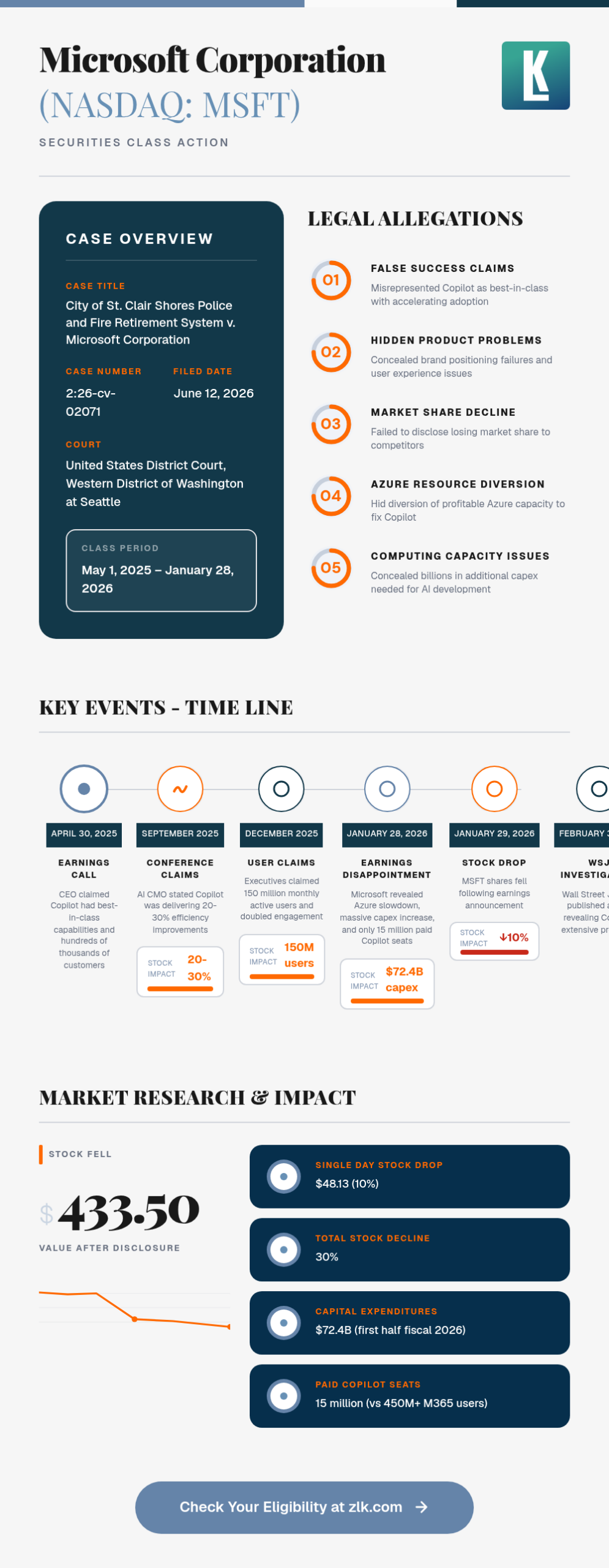
A securities class action lawsuit has been filed against Microsoft Corporation (NASDAQ: MSFT) and four of its senior executives on behalf of investors who purchased Microsoft common stock between May 1, 2025 and January 28, 2026. The complaint alleges that throughout the Class Period, defendants made materially false and misleading statements about the success, adoption, and competitive positioning of Microsoft's Copilot family of AI products, while concealing significant brand positioning failures, user experience problems, declining market share, and the need to divert billions of dollars in computing capacity away from profitable Azure cloud services to address Copilot's shortcomings. When the alleged truth began to emerge through Microsoft's disappointing fiscal second quarter 2026 earnings on January 28, 2026, and subsequent investigative reporting, MSFT shares fell over $48 per share in a single day and continued declining to a low of $380 per share by March 20, 2026, representing a 30% decline from the Class Period high.
Company Profile
Microsoft Corporation is a multinational technology conglomerate headquartered in Redmond, Washington. The Company's offerings span enterprise software, cloud computing (including its Azure platform), online services, gaming, and technological hardware. In recent years, Azure has served as Microsoft's primary growth driver, and the Company has invested heavily in artificial intelligence capabilities, including over $13 billion in OpenAI and a commitment to invest up to $5 billion in Anthropic, while launching its proprietary generative AI assistant, Copilot, across consumer and enterprise applications.
Class Period
May 1, 2025 – January 28, 2026
Investors who purchased Microsoft Corporation (MSFT) common stock during the Class Period may be eligible to seek recovery under the federal securities laws.
Allegations
The complaint alleges that Microsoft and four of its senior officers, CEO and Chairman Satya Nadella, CFO and Executive Vice President Amy E. Hood, Chief Marketing Officer for AI at Work Jared Spataro, and Executive Vice President of Experiences and Devices Rajesh Jha, made materially false and misleading statements about the performance, adoption, and competitive strength of Microsoft's Copilot family of AI products. Throughout the Class Period, these executives repeatedly told investors that Copilot enjoyed "best-in-class" capabilities, that customer adoption was accelerating at record pace, and that Microsoft was uniquely positioned to lead the AI transformation of enterprise and consumer software.
According to the complaint, beginning with Microsoft's fiscal third quarter 2025 earnings on April 30, 2025, CEO Nadella represented that Microsoft was "winning new customers with best-in-class AI capabilities" and that "hundreds of thousands of customers" were using Copilot, with adoption growing threefold year-over-year. CFO Hood highlighted "strong demand" and reported paid Microsoft 365 commercial seats growing 7% year-over-year. In subsequent quarterly earnings calls, investor conferences, and the December 2025 Annual Shareholders Meeting, defendants escalated these claims: Nadella touted surpassing 150 million monthly active Copilot users, called the product "best-in-class" on third-party benchmarks, and highlighted that over 90% of the Fortune 500 used Microsoft 365 Copilot. AI CMO Spataro told investors at the Goldman Sachs conference in September 2025 that Copilot was delivering 20% to 30% efficiency improvements and was "our fastest-growing M365 portfolio product" ever. EVP Jha, at the UBS conference in December 2025, stated that daily active engagement with Copilot had "more than doubled, quarter over quarter" for two consecutive quarters.
The complaint alleges these statements failed to disclose that Copilot had experienced significant brand positioning, user experience, usage, data siloing, computational capacity, organizational, and interoperability problems. Plaintiffs allege that Microsoft's flagship proprietary AI model ranked well below competitors on benchmark tests, that confusing product versions and forced integration were frustrating users, and that organizational silos between consumer-focused and enterprise-focused Copilot teams prevented a coherent product vision. Most critically, the complaint alleges defendants concealed that Microsoft needed to increase capital expenditures by billions of dollars and divert GPU and CPU capacity away from fulfilling demand for its profitable Azure services in order to address Copilot's competitive deficiencies and fund AI-related research and development. As a result, the complaint alleges, Microsoft had failed to convert a significant percentage of its more than 450 million commercial Microsoft 365 users to paid Copilot subscriptions, and Copilot was actively losing market share to rivals including Google's Gemini and OpenAI's ChatGPT.
The Truth Emerges
According to the complaint, the allegedly concealed problems began surfacing on January 28, 2026, when Microsoft reported its fiscal second quarter 2026 results. The earnings announcement and related call allegedly revealed three interrelated disappointments that contradicted defendants' prior representations. Azure revenue growth had slowed and missed analyst expectations, with CFO Hood attributing the shortfall to computational capacity constraints caused by the Company diverting CPU and GPU resources to Copilot applications and AI-related research and development. Capital expenditures had surged to $37.5 billion for the quarter alone, bringing the first-half fiscal 2026 total to $72.4 billion (compared to $88.2 billion for all of fiscal 2025), driven largely by Copilot development and capacity buildout. For the first time, Microsoft disclosed that total paid Microsoft 365 Copilot seats stood at only 15 million, a figure materially below analyst estimates and representing a small fraction of the Company's 450-million-plus commercial Microsoft 365 user base.
Days later, on February 3, 2026, The Wall Street Journal published an investigative article titled "Microsoft's Pivotal AI Product Is Running Into Big Problems," reporting on Copilot-related difficulties. The article reported that confusing brand positioning and interoperability problems had frustrated users, that Copilot subscribers were increasingly favoring competing products, and that some companies were using only about 10% of the Copilot subscription seats they had purchased. Previously unreported survey data showed that from July 2025 through late January 2026, the percentage of Copilot subscribers using the product as their primary option fell from 18.8% to 11.5%, while Google Gemini's share among paid users rose from 12.8% to 15.7%. The article further disclosed that Microsoft's effort to train proprietary models had been hampered by computing capacity shortages, as the Company rationed server time for OpenAI and other Azure customers. Notably, the article reported that CEO Nadella himself had sent a frustrated email to EVP Jha about Copilot's inability to fulfill basic prompts, which plaintiffs allege undercut defendants' public assurances of product excellence. Subsequent analyst commentary on February 11, 2026, by Melius Research analysts described the link between Copilot's problems and Azure capacity constraints as a "no-win situation," and on March 17, 2026, The Wall Street Journal reported that Microsoft was reorganizing its Copilot product teams in response to these challenges.
Market Reaction
Following Microsoft's January 28, 2026 earnings announcement, MSFT shares dropped over $48 per share, falling from $481.63 at market close on January 28, 2026 to $433.50 at market close on January 29, 2026, on abnormally high trading volume of nearly 129 million shares. The stock continued to decline as the market absorbed the full scope of the adverse disclosures, including The Wall Street Journal's February 3, 2026 investigative report on Copilot's problems. By February 5, 2026, MSFT had fallen below $393 per share. The sell-off deepened further through March 2026 as additional reporting and analyst commentary allegedly underscored the continuing nature of the challenges, with MSFT reaching a low of $380 per share by March 20, 2026, a 30% decline from its Class Period high above $550.
Next Steps
● Lead Plaintiff Deadline: August 11, 2026
● After the lead plaintiff deadline, the Court will consider any lead plaintiff motions.
● Defendants may file a motion to dismiss.
● If the case proceeds, the Court may later consider class certification.
Disclaimer: This shareholder alert is for informational purposes only and does not constitute legal advice. Consult a qualified attorney for personalized guidance. No specific outcomes are guaranteed.