
Expired
Lead Plaintiff Deadline
Aug 10, 2026
Choose your preferred way to stay informed of new case launches and settlement deadlines
The filed complaint alleges that Erasca, Inc. made materially false and/or misleading statements and/or failed to disclose that: (1) ERAS-0015’s preclinical data was based on improper comparisons to Revolution Medicines, Inc. (“RevMed”) and placed Erasca at risk of violating patent and trade secret protections; and (2) based on the foregoing, defendants lacked a reasonable basis for their positive statements related to ERAS-0015.
In order to be eligible to join the ERAS class action lawsuit, you must have incurred a loss on shares of Erasca, Inc. purchased during the class period listed above.
If you suffered a loss in Erasca, Inc. during the relevant time frame or pursuant to the relevant offering(s), you have until August 10, 2026 to request that the Court appoint you as lead plaintiff. Your ability to share in any recovery doesn't require that you serve as a lead plaintiff.
|
ERAS Class Action Summary |
|
|
Company |
Erasca, Inc. (NASDAQ: ERAS) |
|
Lead Plaintiff Deadline |
August 10, 2026 |
|
Class Period |
January 14, 2025 – April 26, 2026 |
|
Stock Drop |
April 27, 2026 – ERAS fell $2.34 (10.9%) to $19.15; April 28, 2026 – ERAS fell $9.25 (48.3%) to $9.90 |
|
Lawsuit Type |
Securities Class Action |
A securities fraud class action has been filed against Erasca, Inc. (NASDAQ: ERAS) and two of its senior executives on behalf of investors who purchased Erasca common stock between January 14, 2025 and April 26, 2026. The complaint alleges that throughout the Class Period, defendants made materially false and misleading statements about the preclinical profile of Erasca's lead drug candidate, ERAS-0015, by touting comparative preclinical data against Revolution Medicines' competing pan-RAS molecular glue, RMC-6236, while allegedly failing to disclose that those comparisons were improper and exposed Erasca to patent and trade secret risk. When Erasca disclosed on April 27, 2026 that it had received a letter from Revolution Medicines alleging patent infringement and trade secret misappropriation, and separately disclosed a patient death in ERAS-0015's Phase 1 trial along with an acknowledgment that its cross-study comparisons were "inherently limited" and "may not be directly comparable," the stock collapsed over two days, falling from $21.49 to $9.90 per share, a decline of approximately 54%.
Erasca, Inc. is a clinical-stage precision oncology company headquartered in San Diego, California, focused on discovering, developing, and commercializing therapies for patients with RAS/MAPK pathway-driven cancers. One of the company's primary drug candidates is ERAS-0015, a pan-RAS molecular glue designed to treat patients with RAS mutant solid tumors, a category of mutations that drives nearly one-fourth of all solid tumors worldwide.
January 14, 2025 – April 26, 2026
Investors who purchased or acquired Erasca, Inc. (ERAS) securities during the Class Period may be entitled to seek recovery under the federal securities laws.
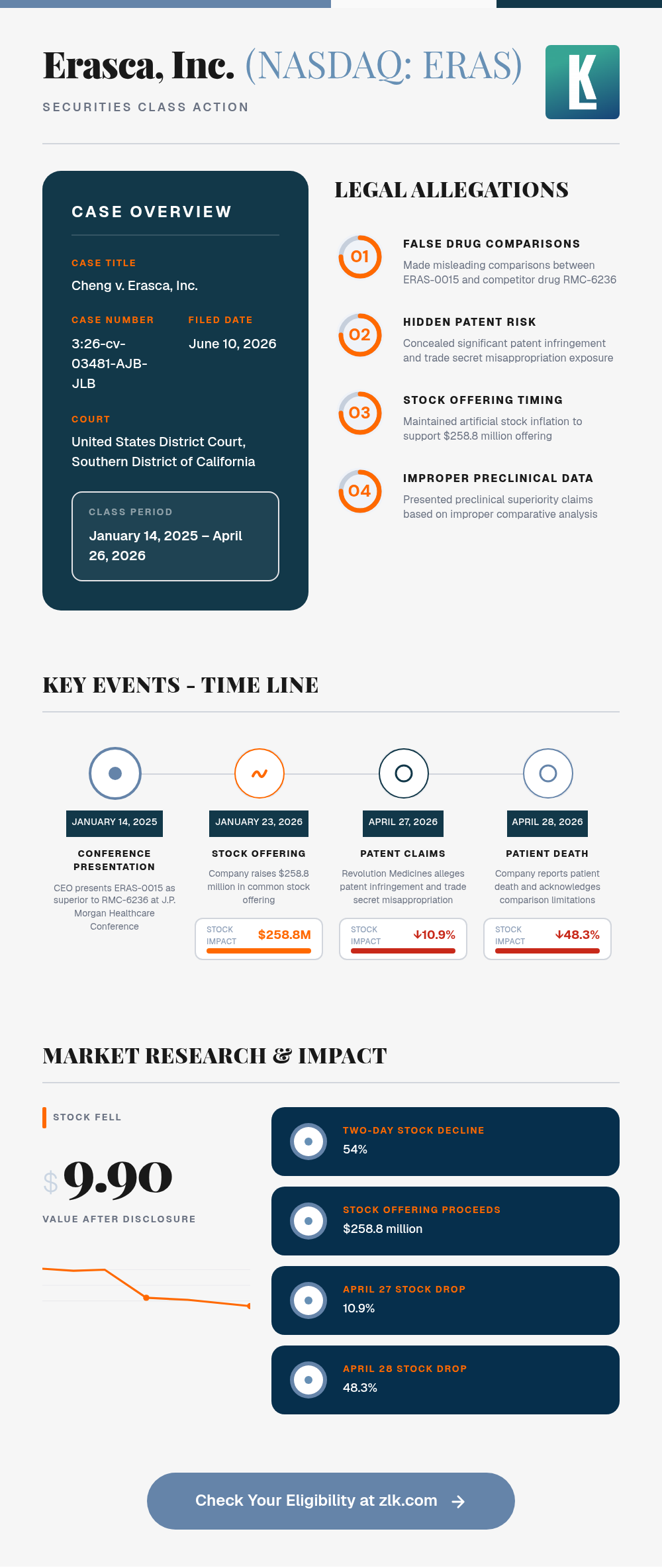
The complaint alleges that Erasca and its executives built the investment thesis for ERAS-0015 around detailed, repeated comparisons to Revolution Medicines' RMC-6236, the leading pan-RAS molecular glue in clinical development. At the January 2025 J.P. Morgan Healthcare Conference, CEO Jonathan Lim described ERAS-0015 as a "potential best-in-class" pan-RAS molecular glue with "low sub-nanomolar to low nanomolar" potency and "very high" oral bioavailability, noting tumor regression at very low doses. At the January 2026 J.P. Morgan Healthcare Conference, Lim elaborated that ERAS-0015 had 8 to 21-fold higher binding affinity to cyclophilin A versus RMC-6236, achieved comparable antitumor activity at one-tenth the dose, demonstrated preferential tumor distribution and longer residence time, and outperformed RMC-6236 on clearance, half-life, and oral bioavailability.
According to the complaint, defendants repeated and expanded these comparative claims in multiple SEC filings and investor presentations throughout the Class Period. The company's 2024 Annual Report on Form 10-K, filed March 20, 2025, included extensive side-by-side preclinical data comparing ERAS-0015 to RMC-6236 across binding affinity, tumor distribution, in vitro potency, in vivo efficacy, and pharmacokinetic profiles. A January 12, 2026 presentation filed on Form 8-K contained multiple slides with titles explicitly framing ERAS-0015 as superior to RMC-6236. Lim reiterated these comparisons at the January 2026 J.P. Morgan Healthcare Conference, and the company's 2025 Annual Report on Form 10-K, filed March 12, 2026, reproduced the same comparative preclinical data.
The complaint alleges these statements were materially false and misleading because ERAS-0015's preclinical data was based on improper comparisons to RMC-6236 that placed Erasca at risk of violating patent and trade secret protections held by Revolution Medicines. Plaintiffs allege that defendants knew or recklessly disregarded that their comparative claims were improper and that the company faced significant intellectual property exposure. The complaint further alleges that defendants were motivated to maintain the artificial inflation, pointing to a common stock offering that closed on January 23, 2026, raising approximately $258.8 million in gross proceeds, the timing of which coincided with the period of alleged misstatements about ERAS-0015's competitive profile.
On April 27, 2026, before the market opened, Erasca disclosed in a Form 8-K that it had received a letter from Revolution Medicines' legal counsel alleging that ERAS-0015 infringes a RevMed patent (U.S. Patent No. 12,409,225) and is connected to alleged trade secret misappropriation. RevMed also alleged that Erasca had "improperly compared preclinical data of ERAS-0015 and RMC-6236 in public disclosures" and demanded that Erasca cease making "deceptive and untrue comparative statements comparing ERAS-0015 and RMC-6236." According to the complaint, this disclosure revealed the serious intellectual property risk that had been concealed from investors throughout the Class Period, during which defendants had presented detailed ERAS-0015 versus RMC-6236 comparisons without disclosing the company's exposure to patent and trade secret challenges.
Later the same day, after the market closed, Erasca filed a separate Form 8-K that compounded investor concerns. The filing reported preliminary Phase 1 clinical data for ERAS-0015 and disclosed that a patient who received 24 mg of ERAS-0015 had died approximately one month after starting treatment, classified as a Grade 3 treatment-related adverse event of pneumonitis that progressed to Grade 5 after withdrawal of supportive care. In the same filing, Erasca acknowledged that its comparisons between ERAS-0015 and RMC-6236 were based on cross-study analyses "not based on any head-to-head clinical trials" and that such comparisons are "inherently limited and such data may not be directly comparable." This acknowledgment stood in stark contrast to the confident, detailed comparative presentations that had characterized defendants' statements throughout the preceding sixteen months.
Erasca's stock price declined significantly following both disclosures. Following the pre-market announcement of RevMed's patent and trade secret allegations on April 27, 2026, ERAS fell from a closing price of $21.49 on April 24, 2026 to open at $20.70 per share on April 27, and continued to fall, closing at $19.15 on April 27. The second Form 8-K, filed after the close on April 27, triggered a far steeper decline: ERAS fell more than 45% in premarket trading, opening at $10.51 on April 28, 2026, and continued to fall throughout the session, closing at $9.90 per share. Over the two-day period, the stock fell from a pre-disclosure closing price of $21.49 per share on April 24, 2026 to a closing price of $9.90 per share on April 28, 2026.
● Lead Plaintiff Deadline: August 10, 2026
● After the lead plaintiff deadline, the Court will consider any lead plaintiff motions.
● Defendants may file a motion to dismiss.
● If the case proceeds, the Court may later consider class certification.
Disclaimer: This shareholder alert is for informational purposes only and does not constitute legal advice. Consult a qualified attorney for personalized guidance. No specific outcomes are guaranteed.
TOP