
Expired
Lead Plaintiff Deadline
Apr 13, 2026
Choose your preferred way to stay informed of new case launches and settlement deadlines
The filed complaint alleges that Kyndryl Holdings, Inc. made materially false and/or misleading statements and/or failed to disclose that: (1) Kyndryl’s financial statements issued during the class period were materially misstated; (2) Kyndryl lacked adequate internal controls and at times materially understated issues with its internal controls; (3) as a result, Kyndryl would be unable to timely file its Quarterly Report on Form 10-Q for the quarter ended December 31, 2025; and (4) as a result, defendants’ statements about Kyndryl’s business, operations, and prospects, were materially false and misleading and/or lacked a reasonable basis at all times.
In order to be eligible to join the KD class action lawsuit, you must have incurred a loss on shares of Kyndryl purchased during the class period listed above.
If you suffered a loss in Kyndryl during the relevant time frame or pursuant to the relevant offering(s), you have until April 13, 2026 to request that the Court appoint you as lead plaintiff. Your ability to share in any recovery doesn't require that you serve as a lead plaintiff.
A securities fraud class action has been filed under Sections 10(b) and 20(a) of the Securities Exchange Act of 1934 and Rule 10b-5 against Kyndryl Holdings, Inc. (NYSE: KD) covering August 1, 2024 through February 9, 2026. Investors allege the company misstated its financial results and downplayed serious internal control problems while assuring the market that any control issues did not cause misstatements-and later that controls were effective. On February 9, 2026, Kyndryl announced it could not timely file its quarterly report (Form 10-Q for Q3 FY2026, ended December 31, 2025), disclosed an investigation by the SEC Division of Enforcement into cash management and related disclosures, and admitted material weaknesses in internal control over financial reporting including information and communication and tone at the top, saying prior control effectiveness conclusions should not be relied upon. The news hit hard. Kyndryl's stock fell $12.90 per share, or 55%, to close at $10.59 on February 9, 2026, wiping out about $3 billion in market capitalization.
“Most KD shareholders never file or join the class action, which means they miss out on potential recovery funds,” said Attorney Joseph Levi.
Case Name: Brander v. Kyndryl Holdings, Inc. et al.
Case No.: 1:26-cv-00782
Jurisdiction: U.S. District Court, Eastern District of New York
Filed on: February 11, 2026
Kyndryl is a technology services company that provides infrastructure services, focused on enterprise IT infrastructure services and operating in more than 60 countries. The company describes itself as engaging in the provision of infrastructure services and is incorporated in Delaware, and its common stock trades on the NYSE under ticker KD.
August 1, 2024-February 9, 2026, inclusive.
All persons or entities who purchased or otherwise acquired publicly traded Kyndryl securities on the New York Stock Exchange (NYSE: KD) during the Class Period may be eligible to join the Kyndryl Holdings, Inc. (KD) class action lawsuit.
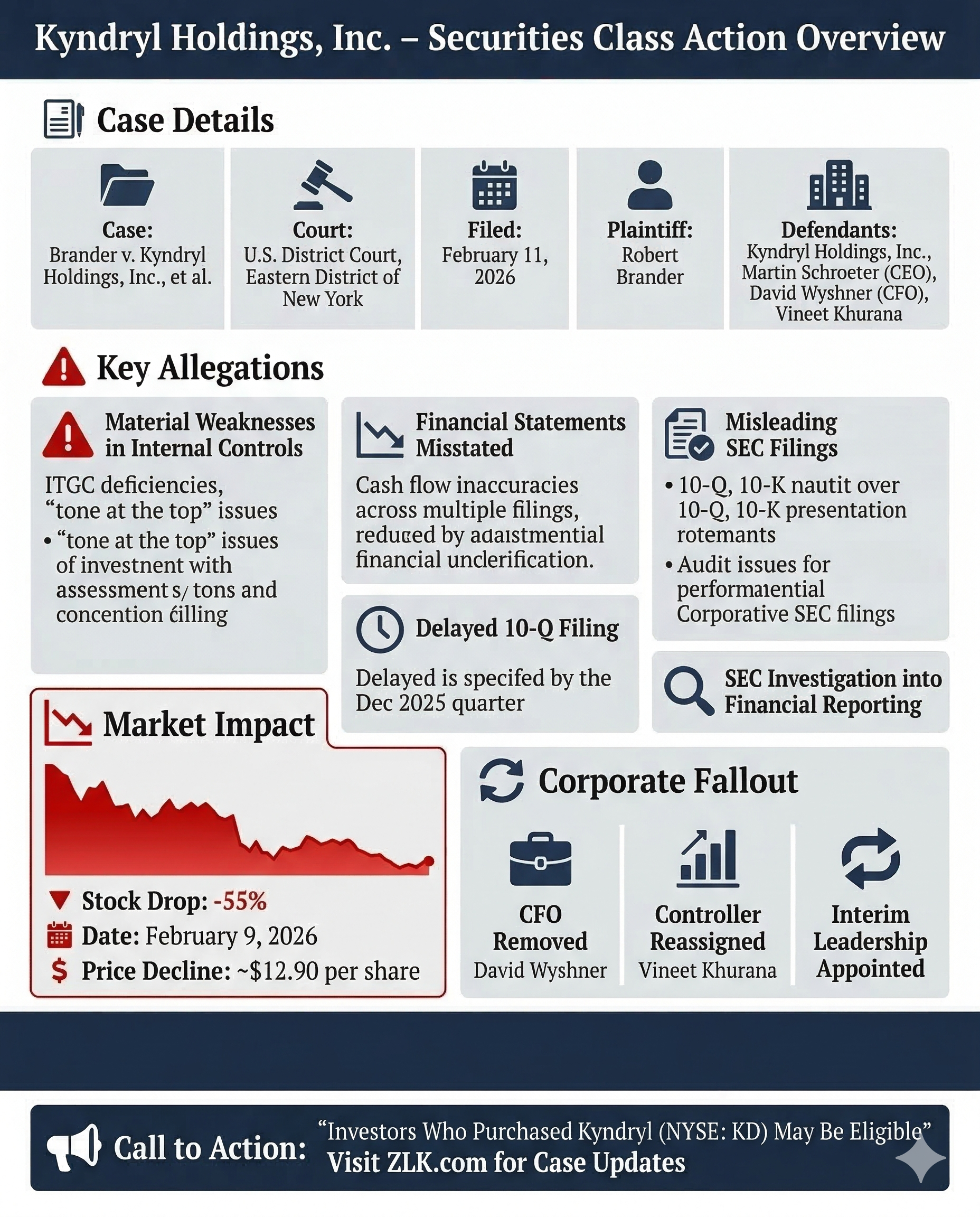
The complaint targets Kyndryl Holdings, Inc. and senior executives Martin J. Schroeter (Chief Executive Officer and Chairman), David B. Wyshner (Chief Financial Officer during the period), and Vineet Khurana (Senior Vice President, Global Controller, and Principal Accounting Officer), and alleges violations of Sections 10(b) and 20(a) of the Securities Exchange Act of 1934 and Rule 10b-5.
According to investors, the defendants told the market that control issues were contained and did not cause misstatements, and later asserted that controls were effective-assurances that allegedly concealed the true scope of internal control failures and misstated financials, and failed to disclose material weaknesses in internal control over financial reporting.
The story begins on August 7, 2024, when CEO Schroeter and CFO Wyshner signed Kyndryl's 1Q25 Form 10-Q acknowledging a material weakness in information technology general controls and stating disclosure controls were not effective. Yet they told investors that "These control deficiencies did not result in a misstatement to the annual or interim consolidated financial statements." During this period, the company emphasized free cash flow and adjusted free cash flow in its investor communications. They repeated the same message in the 2Q25 Form 10-Q on November 7, 2024, and again in the 3Q25 Form 10-Q on February 6, 2025.
The tone shifted in 2025. On May 30, 2025, in the 2025 Form 10-K, Schroeter and Wyshner concluded that as of March 31, 2025, Kyndryl's internal control over financial reporting was effective and that disclosure controls were effective, asserting compliance with disclosure controls and procedures under the Securities Exchange Act. They maintained that position into fiscal 2026, stating in the 1Q26 Form 10-Q on August 5, 2025, and the 2Q26 Form 10-Q on November 5, 2025, that disclosure controls and procedures were effective at those quarter-ends. Meanwhile, investors allege a different reality.
The complaint asserts that Kyndryl's financial statements during the Class Period were materially misstated; that the company lacked adequate internal controls and at times understated internal control issues, including deficiencies in cash management practices; and that these problems were so significant the company would be unable to timely file its Form 10-Q for the quarter ended December 31, 2025 (Q3 FY2026). As a result, the complaint alleges defendants' statements about Kyndryl's business, operations, and prospects were false and misleading or lacked a reasonable basis, constituting material misstatements and omissions actionable as securities fraud.
The truth surfaced on February 9, 2026, when Kyndryl filed a Notification of Late Filing (Form 12b-25) and a Current Report on Form 8-K, with the Securities and Exchange Commission, following the February 5, 2026 departures of its CFO, General Counsel, and Controller. The company disclosed it could not timely file its quarterly report (Form 10-Q for Q3 FY2026, ended December 31, 2025) and that the SEC's Division of Enforcement had made voluntary document requests regarding cash management practices, related disclosures-including the drivers of its adjusted free cash flow metric-and the efficacy of internal control over financial reporting.
Through its Audit Committee, Kyndryl announced a review of those areas , including an internal accounting review of cash management practices, disclosure controls, and free cash flow metrics and "certain other matters." That same day, management admitted it anticipated reporting material weaknesses in internal control over financial reporting for the quarter to be reported, for the full fiscal year ended March 31, 2025, and for the first two fiscal quarters of fiscal 2026 (Q1 and Q2 FY2026). The weaknesses were expected to include controls related to information and communication and tone at the top, and Kyndryl stated that its prior assessment of internal control effectiveness as of March 31, 2025 should no longer be relied upon. These admissions directly contradicted earlier assurances that controls were effective and that identified deficiencies had not resulted in misstatements.
Before the market opened on February 9, 2026, investors learned of the late filing and SEC investigation, and by the close Kyndryl's stock had fallen $12.90 per share, or 55%, to finish at $10.59, a single-day decline on NYSE: KD that erased approximately $3 billion in market capitalization. The sharp, same-day drop followed Kyndryl's disclosures of its late filing, SEC document requests regarding cash management and related disclosures, and its anticipation of material weaknesses in internal control over financial reporting.
The Court will issue its order for lead plaintiff and counsel in the weeks after submissions are due.
The Court will then consider motion for class certification.
The Court will later consider a Motion to Dismiss.
Disclaimer: This shareholder alert is for informational purposes only and does not constitute legal advice. Consult a qualified attorney for personalized guidance. No specific outcomes are guaranteed.
TOP