
Expired
Lead Plaintiff Deadline
May 5, 2026
Choose your preferred way to stay informed of new case launches and settlement deadlines
The filed complaint alleges that Soleno Therapeutics, Inc. made materially false and/or misleading statements and/or failed to disclose that: (a) the Soleno Phase 3 clinical trial program for product diazoxide choline extended-release tablets, DCCR, had systematically downplayed, misrepresented, and/or concealed significant evidence of safety concerns potentially related to the administration of DCCR, including issues related to excess fluid retention in clinical trial participants; (b) as a result of (a) above, the administration of DCCR to treat hyperphagia in individuals with PWS posed materially greater safety risks than disclosed by the Company or its executives; and (c) as a result of (a)-(b) above, DCCR had materially lower commercial viability and undisclosed risks related to the likelihood of significant and widespread adverse events after its commercial launch, including risks related to patient discontinuation rates, lower patient adoption, prescriber reluctance, adverse regulatory action, and potential reputational and legal fallout.
In order to be eligible to join the SLNO class action lawsuit, you must have incurred a loss on shares of Soleno Therapeutics, Inc. purchased during the class period listed above.
If you suffered a loss in Soleno Therapeutics, Inc. during the relevant time frame or pursuant to the relevant offering(s), you have until May 5, 2026 to request that the Court appoint you as lead plaintiff. Your ability to share in any recovery doesn't require that you serve as a lead plaintiff.
A securities class action lawsuit under the Securities Exchange Act of 1934 has been filed against Soleno Therapeutics, Inc. (NASDAQ: SLNO) and certain of its executives for the period between March 26, 2025 and November 4, 2025. Investors allege that the company and its officers made materially false and misleading statements regarding the safety profile and commercial viability of VYKAT XR (DCCR), the company's only commercial product used to treat hyperphagia in patients with Prader-Willi syndrome.
According to the complaint, while executives touted a favorable safety profile with no new safety signals and strong commercial adoption, the company had allegedly concealed significant safety concerns including risks of excess fluid retention, pre-diabetes, diabetes, pulmonary edema, and congestive heart failure. As these safety issues emerged publicly through an investigative report, a patient death, and management admissions of commercial disruption, Soleno Therapeutics, Inc.'s stock price moved from over $90 per share to lows of less than $45 per share, reflecting a pattern of material stock price declines.
“Most SLNO shareholders never file or join the class action, which means they miss out on potential recovery funds,” said Attorney Joseph Levi.
Case Name: City of Pontiac Police and Fire Retirement System v. Soleno Therapeutics, Inc., et al.
Case No.: 3:26-cv-01979
Jurisdiction: U.S. District Court, Northern District of California, San Francisco Division
Filed on: March 6, 2026
Soleno Therapeutics (NASDAQ: SLNO), a rare disease focused biopharmaceutical company, is a pharmaceutical company focused on developing therapies for rare diseases and is headquartered in Redwood City, California. At the time of the complaint filing, the company's only commercial product, reflecting its single-product company dependency, was diazoxide choline extended-release tablets (DCCR), marketed as VYKAT XR, for the treatment of hyperphagia in individuals with Prader-Willi syndrome, including hyperphagia in PWS.
March 26, 2025 – November 4, 2025, inclusive.
All persons who purchased Soleno Therapeutics, Inc. common stock during the Class Period may be eligible to join the Soleno Therapeutics, Inc. (SLNO) class action lawsuit, including investors who purchased common stock on the NASDAQ (NASDAQ: SLNO).
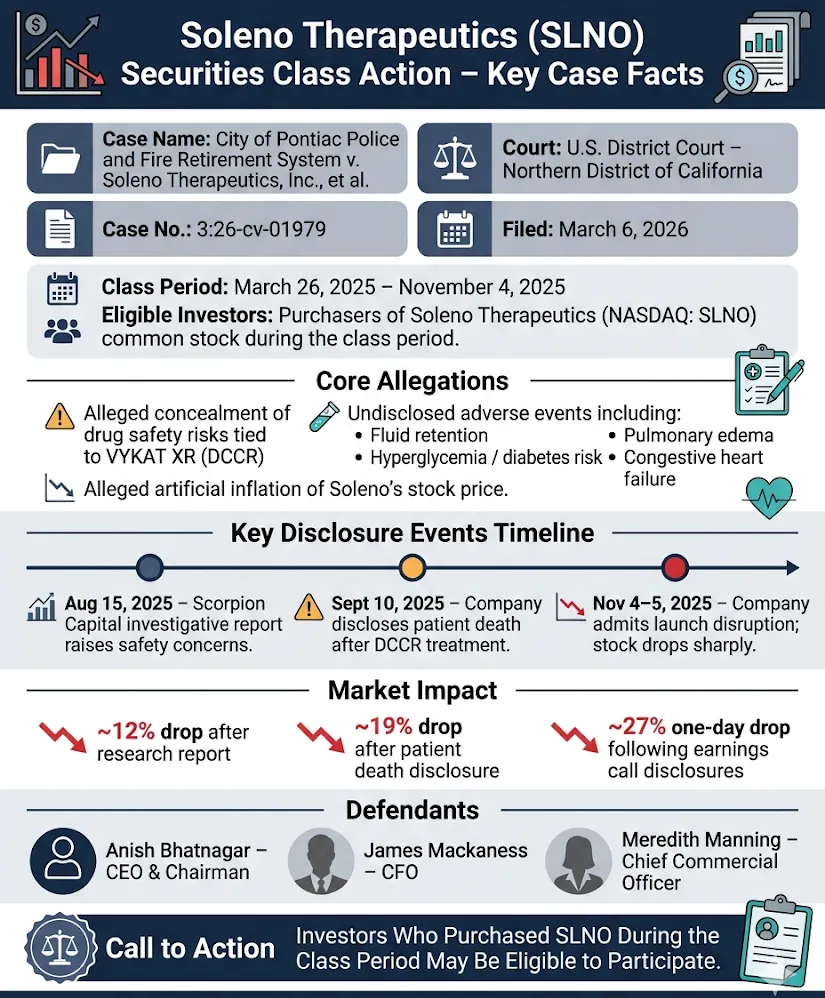
The complaint targets Soleno Therapeutics, Inc. and three of its executives: Anish Bhatnagar, Chief Executive Officer and Chairman of the Board; James Mackaness, Chief Financial Officer; and Meredith Manning, Chief Commercial Officer, alleging violations of the Securities Exchange Act of 1934. Investors allege that these defendants made materially false and misleading statements about the safety profile and commercial prospects of VYKAT XR throughout the class period and downplayed or concealed material safety concerns and related commercial risks.
On March 26, 2025, as the product received approval, by the Food and Drug Administration, CEO Bhatnagar emphasized on a conference call that the label "reflects VYKAT's favorable safety and tolerability profile, contains no [box] warnings, no contraindications for diabetes, no exclusions for severity of hyperphagia, and no requirement for a risk evaluation and mitigation strategy or REMS program."
Just weeks later on May 7, 2025, Bhatnagar highlighted in a press release that "the high level of interest that we are experiencing, as reflected in both patient start forms and unique prescribers, reflects the significant unmet need that VYKAT XR can address as a first-to-market treatment for this debilitating condition." During the second quarter, Soleno Therapeutics, Inc. reported $32.7 million in revenue from DCCR sales, and by August 6, 2025, Bhatnagar told investors on a conference call that "discontinuation rates are substantially lower than what we saw even in clinical trials" and assured them that "we have not seen anything in the postmarketing setting that is different from the clinical trial setting. So there are no new safety signals," while investors allege the company downplayed adverse events.
According to the complaint, these statements were materially false and misleading because the company's Phase 3 clinical trial program had allegedly systematically downplayed, misrepresented, or concealed significant evidence of safety concerns potentially related to DCCR administration, including issues related to excess fluid retention in clinical trial participants, and other adverse events. The complaint alleges that DCCR posed materially greater safety risks than disclosed and had materially lower commercial viability due to undisclosed risks of significant and widespread adverse events, including risks related to patient discontinuation rates, lower patient adoption, prescriber reluctance, adverse regulatory action, and potential reputational and legal fallout.
The truth began to surface on August 15, 2025, when Scorpion Capital LLC published an extensively researched exposé, a 415-page report titled "Russian Roulette With Prader-Willi Children: How The Latest Rare Disease Price-Gouging Scheme Fleeced the FDA, Parents, And Its Own Study Investigators With A Worthless, Toxic Drug." The report detailed problems with Soleno Therapeutics, Inc.'s clinical trial conduct, safety and efficacy concerns with DCCR, and patient reports of serious adverse reactions, with key trial investigators broadly rebuking VYKAT XR as a failure and looming safety disaster, including high risks of pre-diabetes, diabetes, pulmonary edema, and congestive heart failure, which plaintiffs allege helped reveal previously undisclosed safety concerns.
On September 10, 2025, Soleno Therapeutics, Inc. filed a Form 8-K with the U.S. Securities and Exchange Commission disclosing that a patient had died after taking DCCR, though the company stated that the treating physician and Soleno Therapeutics, Inc.'s own assessment concluded the death was not related to treatment with VYKAT XR.
Finally, on November 4, 2025, during an earnings call, CEO Bhatnagar admitted that the Scorpion Capital Report had caused a "disruption" in DCCR's launch trajectory, signaling commercial launch disruption and concerns within the Prader-Willi syndrome community, with a lower number of patient start forms and increased discontinuations beginning after the report's publication. These revelations directly contradicted the company's prior assurances about VYKAT XR's favorable safety profile, absence of new safety signals, strong commercial adoption, and low discontinuation rates. What executives had portrayed as a successful first-to-market treatment with robust demand was now revealed to face significant safety concerns and commercial headwinds.
Following the August 15, 2025 Scorpion Capital Report, which alleged safety and clinical-trial concerns related to DCCR, Soleno Therapeutics, Inc.'s stock price (NASDAQ: SLNO) declined from more than $77 per share on August 14, 2025 to close at approximately $68 per share on August 18, 2025, nearly a 12% drop over two trading days on above-average trading volume.
After the September 10, 2025 disclosure of the patient death, the stock fell from more than $70 per share on September 9, 2025 to close at approximately $57 per share on September 11, 2025, approximately a 19% drop over two trading days on above-average trading volume, continuing a pattern of stock price declines following the disclosures described in the complaint. On November 5, 2025, following the company's third quarter results and CEO Bhatnagar's admission of commercial disruption along with a social media post about congestive heart failure, amplifying safety concerns, the stock plummeted from nearly $64 per share on November 4, 2025 to close at approximately $47 per share, a one-day drop of approximately 27% on above-average trading volume.
● The Court will issue its order for lead plaintiff and counsel in the weeks after submissions are due.
● The Court will then consider motion for class certification.
● The Court will later consider a Motion to Dismiss.
Disclaimer: This shareholder alert is for informational purposes only and does not constitute legal advice. Consult a qualified attorney for personalized guidance. No specific outcomes are guaranteed.
TOP