![Inspire Medical Systems Inc. (INSP) Lawsuit Update [November 26, 2025]](https://dropinblog.net/cdn-cgi/image/fit=scale-down,format=auto,width=700/34260815/files/featured/insp-alert-plus-banner-image.webp)

The $1.2 Billion Implosion of the Inspire V Launch and the INSP Securities Fraud Allegations
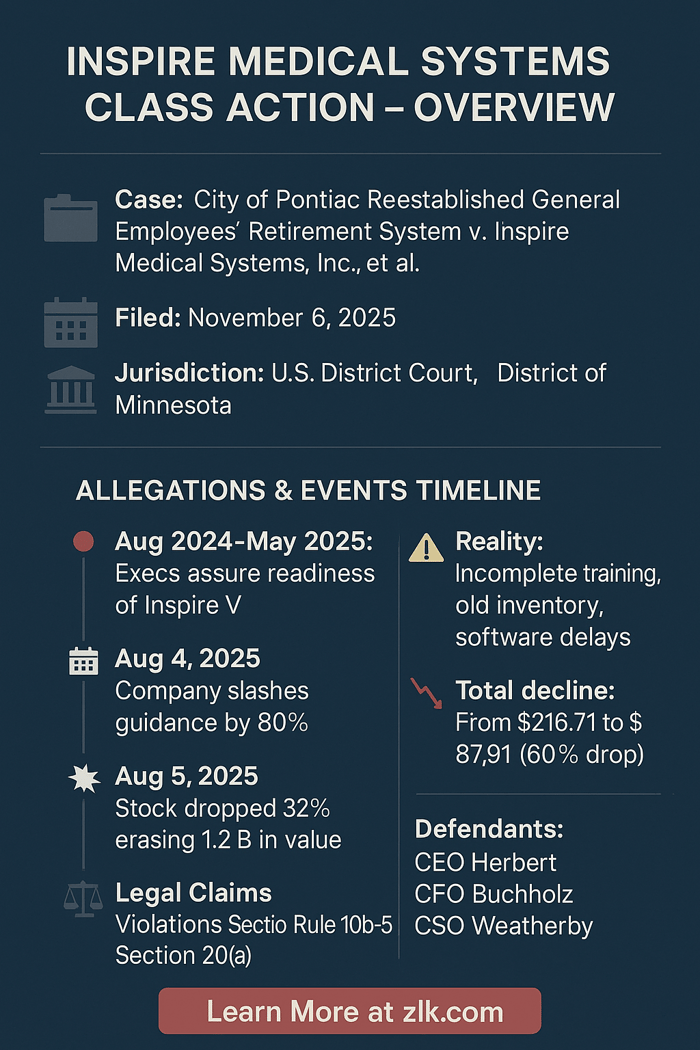
Case Name: City of Pontiac Reestablished General Employees' Retirement System v. Inspire Medical Systems, Inc., et al.
Case No.: 0:25-cv-04247
Jurisdiction: U.S. District Court, District of Minnesota
Filed on: November 6, 2025
Class Period: August 6, 2024–August 4, 2025

Introduction
Inspire Medical Systems Inc. promised investors a new generation of growth, tethered firmly to the success of its flagship product, the Inspire V sleep apnea device. It wasn't ready. The promise of a smooth, successful launch—a story told and retold by the medical technology company’s senior leadership over nearly a year—has since collapsed into a federal securities class action lawsuit.
This action, filed in the United States District Court for the District of Minnesota, alleges that Inspire and its top executives knowingly concealed critical failures in the Inspire V rollout throughout the Class Period, from August 6, 2024, through August 4, 2025. The core accusation is stark: the launch was a "disaster," hampered by unexpected poor demand and a fundamental failure to complete necessary operational groundwork, including provider training and key software updates for Medicare reimbursement. When the truth could no longer be contained, the company was forced to slash its 2025 earnings guidance by more than 80%, wiping out roughly $1.5 billion in shareholder value in a single day of reckoning.
Backdrop and Business Context
Inspire Medical Systems operates at the intersection of medical technology and treatment for obstructive sleep apnea, offering an implantable neurostimulator—eponymously named "Inspire"—as an alternative to the traditional Continuous Positive Airway Pressure, or CPAP, machine. The company’s market proposition hinges on continuous innovation and expanding access to this implanted device.
The launch of the latest iteration, the Inspire V, was heralded as a moment of significant potential revenue growth, setting it up as a critical event for investors laser-focused on the company’s trajectory. The operational narrative presented to the market suggested a methodical approach: secure regulatory approval, build inventory, conduct a measured "soft launch," and then engage a full commercial rollout. This setup, however, provided the foundation for the alleged misconduct, as the market's anticipation of a flawless technical and commercial transition allegedly became a liability when internal realities failed to meet the public projection.
Promises Made vs. Reality
From the onset of the Class Period, the Company’s narrative was one of preparedness and imminent success. On the August 6, 2024 earnings call, CEO Timothy Herbert assured the market, stating the company was prioritizing "operational readiness and building sufficient inventory to support a soft launch [of Inspire V] in late 2024 and a full launch in 2025." He further minimized the complexity of the rollout, declaring the launch was "going to be very simple."
In September 2024, CFO Richard Buchholz reinforced this optimism, suggesting that the market's "2025 revenue consensus [of 20% growth] is reasonable" largely due to the expected help from the Inspire V launch. Even after the soft launch began, the sentiment remained effusive. In January 2025, CEO Herbert boasted that the early "feedback has been tremendous." In May 2025, announcing the full commercial launch, Herbert affirmed the company was "ready to throw the switch and be able to move into full launch," forecasting a "strong second half of 2025."
The reality, as alleged by the plaintiff, was a stark and total contrast. While management painted a picture of coordinated readiness, the Inspire V launch was allegedly compromised from within due to minimal demand, with medical providers already "flush with inventory" of the older device. Furthermore, the company allegedly failed to secure necessary precursors to a successful launch, including not completing training for "many centers" and failing to ensure that the proper claims processing software for Medicare reimbursement would take effect until July 1, 2025—well into the full launch period. These omissions fundamentally undermined the public assurance that the reimbursement, technology, and support were all "ready."
Timeline of Alleged Misconduct and Disclosures
The chronological march of public statements and subsequent corrections provides the backbone of the securities fraud claim.
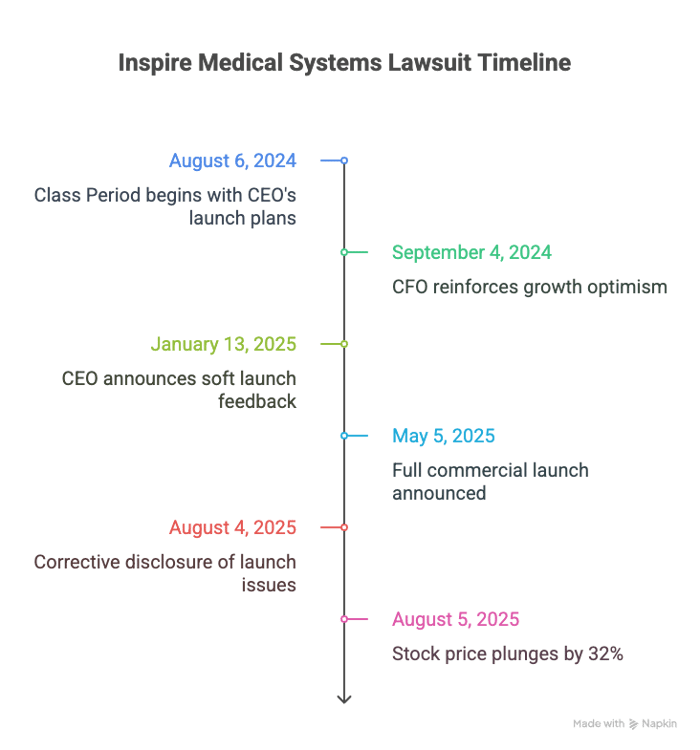
- August 6, 2024: The Class Period begins. CEO Timothy Herbert announces plans for a "soft launch in late 2024 and a full launch in 2025," citing the focus on building sufficient inventory for "expected demand."
- September 4, 2024: CFO Richard Buchholz calls the 2025 consensus revenue growth target of 20% "reasonable," partly due to the anticipated success of Inspire V. The stock price later hits a Class Period high of $216.71 on September 23, 2024.
- January 13, 2025: CEO Herbert announces the soft launch has begun, claiming the "feedback has been tremendous," and boasts the company is "at the cusp of being able to launch the Inspire V."
- May 5, 2025: Inspire announces the start of the full commercial launch, claiming "experience to date [...] has been very positive" and noting CPT code coverage for approximately 80% of covered lives. CEO projects a "strong second half of 2025."
- August 4, 2025: Corrective Disclosure. Inspire announces that the Inspire V launch is facing an "elongated timeframe" due to poor demand from excess inventory, incomplete training/onboarding at many centers, and the delayed July 1, 2025, implementation of Medicare claims software updates. The stock closes at $129.95.
- August 5, 2025: The market reacts sharply to the disclosure, with the stock dropping $42.04 per share, a plunge of over 32%, to close at $87.91, wiping out $1.2 billion in market capitalization.
 Investor Harm and Market Reaction
The disclosure on August 4, 2025, was not merely bad news; it was a market-shattering event that allegedly served as the corrective revelation of the fraud. Investors suffered quantifiable, material losses tied directly to the news that the successful launch narrative had been hollow.
Inspire’s stock closed at $129.95 per share on August 4, 2025. The very next day, following the revelation of the "elongated timeframe" and operational shortfalls, the price fell by $42.04 per share, translating to a brutal plunge of over 32%. The sheer magnitude of this drop effectively erased $1.2 billion from the Company’s market capitalization in a single trading session. Seen in broader context, the August 4th news marked the final capitulation from the Class Period high of $216.71 reached on September 23, 2024, resulting in a total price depreciation of nearly 60% and confirming the sustained nature of the alleged inflation.
Analyst commentary immediately shifted from cautious optimism to outright condemnation. The cut to the 2025 earnings guidance—reduced by more than 80%, from a range of $2.20 to $2.30 per share down to just $0.40 to $0.50 per share—served as the definitive quantification of the operational debacle, cementing the loss causation for class members.
Litigation and Procedural Posture
The plaintiff, the City of Pontiac Reestablished General Employees' Retirement System, initiated this class action on behalf of all investors who acquired Inspire common stock during the Class Period. The lawsuit asserts claims for violation of Section 10(b) of the Exchange Act, the core anti-fraud provision, and Rule 10b-5 promulgated thereunder, against all defendants. Additionally, claims are lodged against the Individual Defendants—CEO Timothy Herbert, CFO Richard Buchholz, and Chief Strategy and Growth Officer Carlton Weatherby—for violations of Section 20(a) of the Exchange Act, which addresses control person liability.
The critical element of scienter, or fraudulent intent, is central to the Section 10(b) claim. The complaint alleges that the Individual Defendants acted with knowledge or reckless disregard, knowing that adverse facts concerning the flawed Inspire V launch were being withheld from the public while positive, misleading statements were disseminated. As senior executives, they allegedly had "extensive knowledge" about the core financial and business operations and actively controlled the content of public disclosures. This pervasive control and access to non-public information—the internal truth about the inadequate training, excess inventory of older devices, and the Medicare claims software delay—is marshaled to support the allegation that the fraud could not have been perpetrated without their complicity. No specific confidential witness statements or insider trading activity is described in the initial complaint document.
Shareholder Sentiment
The sentiment from investors—the raw, often emotional response found outside formal analyst reports—mirrored the shock waves felt by the broader market, even if the primary source of documented reaction is the analysts who follow the company. When a stock sheds over 32% of its value in a single day, the underlying investor sentiment turns violently negative. The suddenness of the news—the dramatic shift from projected 20% revenue growth to an 80% reduction in earnings guidance—suggests a profound and immediate breach of trust with the retail and institutional investor base. The initial shock captured by phrases like "firmly in the Penalty Box" suggests a sense of executive negligence, or worse, a willful failure to manage investor expectations or disclose critical business risks. The essence of shareholder sentiment in the wake of the disclosure was defined by a feeling of having been willfully misled about the company’s "operational readiness" for its most vital product launch.
Analyst Commentary
The reaction of the professional analytical community provides a clinical measure of the perceived severity of the corporate disclosure, and in this case, the response was one of profound disappointment, a stark reversal of earlier, more favorable projections.
Before the corrective disclosure, consensus was that the company’s expected growth rate was "reasonable," hinged specifically on the timely and successful launch of Inspire V. The optimistic narrative was priced in.
Following the August 4th disclosure, the abrupt guidance reduction and the unspooled details of the launch failures forced an immediate and aggressive reappraisal of the stock's value and management’s credibility. The consensus commentary shifted from investment thesis support to a kind of controlled panic. Analysts at JPMorgan articulated the new reality with the striking assessment that the lowered guidance "Puts Inspire Firmly in the Penalty Box," indicating a serious loss of confidence requiring an extended period of atonement and re-proof before the stock could regain favor. Mizuho analysts employed even more visceral phrasing, noting a "Big Time #s Cut with Everything But Kitchen Sink Hitting Biz," a comment that highlights the comprehensive nature of the operational and commercial failures revealed at once—encompassing training, inventory, reimbursement, and overall demand.
This collective professional commentary not only downgraded the Company’s immediate prospects but pointed directly to a fundamental disconnect between management's public statements and the internal operational reality.
SEC Filings & Risk Factors
While the complaint does not cite specific risk factors from filed SEC documents like 10-K or 10-Q, the core allegations fundamentally concern the omission of critical, known, and materialized business risks in public statements and press releases. The defendants allegedly touted that Inspire was "ready to throw the switch and be able to move into full launch," assuring investors that everything from technology to reimbursement policies was set.
The lawsuit argues that this positive messaging was materially misleading because it failed to disclose concrete, existing operational roadblocks. These alleged "omitted operational risks" included multiple failure points that should have been disclosed to ensure the forward-looking sentiment wasn’t rendered fraudulent. Specifically, the key undisclosed risks that immediately materialized were: the company’s failure to complete necessary provider training and onboarding criteria prior to the launch; the existence of "excess inventory" of the prior device, which naturally dampened demand for the new Inspire V; and the failure to synchronize Medicare claims processing software updates until July 1, 2025, a critical delay that discouraged treatment centers from billing for the new device. In essence, the alleged fraud lies in transforming what should have been cautionary risk disclosures into declarative statements of successful execution.
Conclusion: Implications for Investors
The Inspire Medical Systems securities class action serves as a resonant warning for investors across the medical technology and growth sectors, especially those betting on major product launches. The central lesson is one of extreme caution regarding corporate narratives of flawless execution in complex commercial rollouts. Now, investors are fighting back.
Disclaimer: This shareholder alert is for informational purposes only and does not constitute legal advice. Consult a qualified attorney for personalized guidance. No specific outcomes are guaranteed.
![Firefly Aerospace, Inc. (FLY) Securities Class Action Lawsuit Update [November 21, 2025]](https://dropinblog.net/cdn-cgi/image/fit=scale-down,format=auto,width=700/34260815/files/featured/fly-alert-plus-banner-image-j88uj.webp)
![Telix Pharmaceuticals Ltd. (TLX) Securities Class Action Update [November 21, 2025]](https://dropinblog.net/cdn-cgi/image/fit=scale-down,format=auto,width=700/34260815/files/featured/tlx-alert-plus-banner-image.png)
![Primo Brands Corporation (PRMB) Securities Class Action Update [November 25, 2025]](https://dropinblog.net/cdn-cgi/image/fit=scale-down,format=auto,width=700/34260815/files/featured/prmb-alert-plus-banner-image.webp)