![StubHub Holdings, Inc. (STUB) Securities Class Action Lawsuit Filed [December 1, 2025]](https://dropinblog.net/cdn-cgi/image/fit=scale-down,format=auto,width=700/34260815/files/featured/stub-new-case-alert-banner-image.webp)

Introduction to StubHub Holdings, Inc. (STUB) Securities Class Action Lawsuit
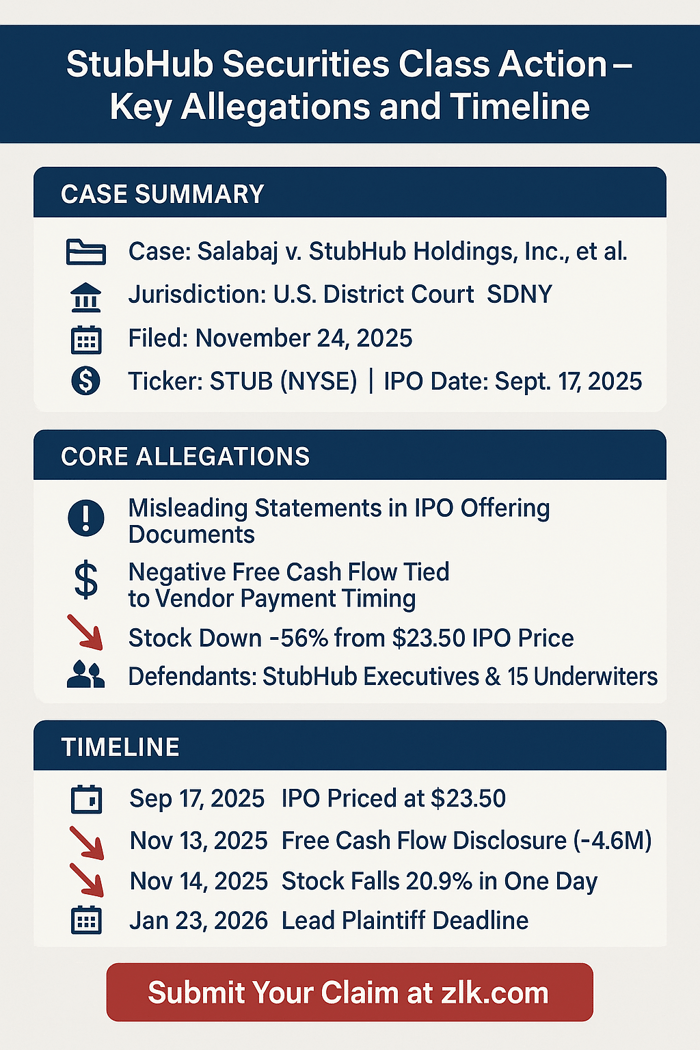
A securities class action has been filed against StubHub Holdings, Inc. (NYSE: STUB) in connection with its September 2025 initial public offering. The case challenges statements in the Registration Statement and Prospectus for the IPO, which priced at $23.50 per share. According to the complaint, the Offering Documents highlighted free cash flow as a key liquidity metric but allegedly failed to disclose that changes in the timing of payments to vendors were having a significant adverse impact, including on trailing 12 months free cash flow. On November 13, 2025, StubHub disclosed negative free cash flow for the quarter and tied the decline to vendor payment timing, revealing the impact the IPO materials allegedly downplayed. Investors saw immediate losses: the stock fell sharply the next day and, by the filing of the lawsuit, had traded as low as $10.31 per share—nearly 56% below the offering price.
 StubHub Holdings, Inc. (STUB) Securities Lawsuit Case Details
Case Name: Salabaj v. StubHub Holdings, Inc., et al.
Case No.: 1:25-cv-09776
Jurisdiction: U.S. District Court, Southern District of New York
Filed on: November 24, 2025

StubHub Holdings, Inc. (STUB) Company Profile
StubHub Holdings, Inc. is an operating company with an established ticketing marketplace. It runs a global platform for live-event tickets through the StubHub and viagogo websites and mobile applications. Key services include its online marketplaces enabling buyers and sellers to transact for live events across geographies.
StubHub Holdings, Inc. (STUB) Securities Lawsuit Class Period
This class action lawsuit concerns StubHub Holdings, Inc.'s IPO. Investors who purchased StubHub Holdings, Inc. securities in connection with StubHub Holdings, Inc.'s IPO on or around September 2025 may be eligible to join the StubHub Holdings, Inc. (STUB) class action lawsuit.
Allegations in the StubHub Holdings, Inc. (STUB) Securities Class Action Lawsuit
The complaint names StubHub, certain senior officers and directors, and the IPO underwriters as defendants. The individual defendants include CEO Eric H. Baker, CFO Connie James, Executive Vice Chairman/General Counsel and director Mark Streams, director Sameer Bhargava, and director Jeremy Levine. The underwriter defendants are J.P. Morgan Securities LLC, Goldman Sachs & Co. LLC, BofA Securities, Inc., Evercore Group L.L.C., BMO Capital Markets Corp., Mizuho Securities USA LLC, TD Securities (USA) LLC, Truist Securities, Inc., Nomura Securities International, Inc., WR Securities, LLC, Citizens JMP Securities, LLC, Oppenheimer & Co. Inc., Wedbush Securities Inc., and PNC Capital Markets LLC.
In the Offering Documents dated September 17, 2025 (with the Registration Statement effective September 16, 2025), StubHub told investors that "free cash flow is a meaningful indicator of liquidity for management and investors" and reported its free cash flow metrics. It stated that free cash flow in the first half of 2025 was $160.8 million versus $395.1 million in the first half of 2024, attributing the decrease primarily to changes in the timing of cash receipts and payments associated with ticket sales as well as the timing of payments to vendors.
According to the complaint, the Registration Statement and subsequent final amendment was materially false and misleading because it omitted that the Company was experiencing changes in the timing of payments to vendors and that those changes had a significant adverse impact on free cash flow, including trailing 12 months free cash flow. As alleged, the Company's free cash flow reports were materially misleading, and positive statements about the Company's business, operations, and prospects lacked a reasonable basis at the time of the IPO. As a result, investors who purchased shares issued in the IPO did so based on Offering Documents that allegedly misrepresented the true condition of StubHub's liquidity and free cash flow trends. When the later disclosure outlined the actual impact of vendor payment timing on free cash flow, IPO purchasers faced substantial losses.
The Truth Emerges
After the market closed on November 13, 2025, StubHub issued a press release and filed its Form 10-Q revealing free cash flow of negative $4.6 million for the quarter, a 143% decline from positive $10.6 million in the same quarter the prior year. The Company stated that the decrease primarily reflects changes in the timing of payments to vendors, disclosing the significant adverse impact that, according to the complaint, had not been properly conveyed at the time of the IPO.
Market Reaction
On November 14, 2025, the first trading day after the disclosure, StubHub's stock fell $3.95, or 20.9%, to close at $14.87—$8.63 below the $23.50 offering price—on unusually heavy trading volume. The stock continues to trade below its IPO price. By the commencement of this action, StubHub's shares had traded as low as $10.31 per share, a nearly 56% decline from the $23.50 per share IPO price.
Next Steps
Submissions for lead plaintiff are due: January 23, 2026.
The Court will issue its order for lead plaintiff and counsel in the weeks after submissions are due.
The Court will then consider motion for class certification.
- The Court will later consider a Motion to Dismiss.
To learn if you are eligible for recovery under the STUB securities class action lawsuit, visit the case submission page here. 
![Alexandria Real Estate Equities, Inc. (ARE) Securities Class Action Lawsuit Filed [December 1, 2025]](https://dropinblog.net/cdn-cgi/image/fit=scale-down,format=auto,width=700/34260815/files/featured/are-new-case-alert-banner-image.webp)
![Jayud Global Logistics Limited (JYD) Securities Class Action Lawsuit Filed [December 1, 2025]](https://dropinblog.net/cdn-cgi/image/fit=scale-down,format=auto,width=700/34260815/files/featured/jyd-new-case-banner-image.webp)
![Perrigo Company plc (PRGO) Securities Class Action Lawsuit Filed [November 24, 2025]](https://dropinblog.net/cdn-cgi/image/fit=scale-down,format=auto,width=700/34260815/files/featured/prgo-new-case-banner.webp)