
Defining Fiduciary Duties: An In-Depth Overview
A fiduciary duty represents one of the highest standards of care and responsibility imposed by law. It requires an individual or entity to act in the best interests of another party—often to the exclusion of their own interests
The fiduciary is ethically and legally bound to put the interests of the beneficiary, principal, ward, or client above their own.
Fiduciary duties are central to trust and integrity in numerous aspects of society. Understanding these responsibilities—and respecting their boundaries—not only protects parties from harm but also creates a stronger, more ethical foundation for business, law, and personal affairs.
The Essence of Fiduciary Duty
At its core, a fiduciary duty arises when one party places special trust and confidence in another, who then assumes a legal obligation to act for the benefit of that party.
Trust, loyalty, and integrity are foundational to every fiduciary relationship.
Examples abound, from a financial advisor managing a client’s portfolio to a corporate director making decisions impacting shareholders.
The principle remains: the fiduciary must avoid conflicts of interest and must never use their position for personal gain.
Legal Framework Governing Fiduciary Duties
Fiduciary duties are governed by common law principles shaped by judicial precedent. While most fiduciary duties are governed by common law, specific industries (e.g., investment advisory, healthcare, law) are also subject to regulatory codes and statutes that may impose stricter or supplemental standards.
Corporate boards , for example, are governed by statutory obligations laid out in company laws, while trustees and agents may also be subject to duties specified in contracts or trust documents.
Enforcement mechanisms include civil lawsuits, regulatory penalties, and professional sanctions.
When a breach of fiduciary duty occurs, remedies might include monetary damages, removal from office, or even criminal charges. While fiduciary breaches are typically civil matters, criminal charges may arise if the breach involves independently criminal acts, such as fraud, embezzlement, or insider trading.
Identifying Types of Fiduciary Relationships

Many professional and personal relationships are fiduciary in nature. Understanding them helps clarify who owes such duties and why.
Trustee and Beneficiary Dynamics
In trusts and estates, the trustee holds legal title to assets on behalf of the beneficiary and must manage those assets solely in the beneficiary's interest.
Typical obligations include prudent investment, impartial treatment among beneficiaries, and prompt disclosure of relevant information.
Guardianship and the Ward Relationship
When an adult is appointed as guardian for a minor or an incapacitated adult (the ward), the guardian becomes the fiduciary, required to make decisions related to healthcare, education, and finances solely in the ward’s best interests.
Courts are deeply involved in appointing and monitoring guardians to ensure adherence to this high duty.
The Role of Agents and Principals
An agent is empowered to act on behalf of a principal in a business or legal matter. This could involve negotiating contracts, executing financial transactions, or managing properties.
The agent must follow the principal’s instructions and avoid self-dealing or undisclosed conflicts of interest.
Attorneys and Clients: A Special Connection
The relationship between an attorney and client is the quintessential fiduciary relationship.
There are several duties attorneys owe their clients under the law and professional codes, such as the ABA’s Model Rules of Professional Conduct. These include the duty to provide competent representation, to maintain confidentiality, to act in the best interests of their client and avoid conflicts of interest.
Corporate Governance: Fiduciary Duties of Directors

Directors and officers of corporations owe fiduciary duties to the company and its shareholders. Directors must act in the best interests of the company, comply with applicable corporate laws and governing documents, and treat all shareholders equitably. Corporate directors are primarily bound by the duties of care, loyalty, and good faith. In nonprofit contexts, a duty of obedience—requiring adherence to organizational mission and governing documents—may also apply.
Key duties include:
- Duty of care : Engage with diligence and informed judgment
- Duty of loyalty : Prioritize company interests, avoid conflicts
- Duty of obedience : Uphold laws, bylaws, and policies
- Duty of good faith : Act honestly in all actions
Other Notable Fiduciary Relationships
Other meaningful fiduciary relationships include:
- Doctor and patient: Duty to recommend treatments in the best medical interests of the patient and maintain confidentiality.
- Financial advisors and clients: Advisors must offer guidance aligned with the client’s goals and risk tolerance, disclosing any potential conflicts of interest. Some financial advisors, such as registered investment advisers (RIAs), owe fiduciary duties under the Investment Advisers Act of 1940.
- Partners in a business partnership owe fiduciary duties to each other, including loyalty and fair dealing.
Exploring Variants of Fiduciary Duties
Fiduciary obligations come in several forms, each designed to safeguard specific interests. The principal duties include:
1. Duty of Care: What It Entails
The duty of care demands that fiduciaries act with the same level of care an ordinary prudent person would exercise in similar circumstances.
This involves gathering all reasonable information, considering risks and alternatives, and making well-informed decisions.
2. Duty of Loyalty: Prioritizing Interests
The duty of loyalty is paramount. Fiduciaries must act solely in the best interest of beneficiaries, avoiding actions that create conflicts of interest.
This includes refraining from profiting personally from their position and transparently disclosing any relationships or interests that could compromise their judgment.
3. Duty of Disclosure: Transparency in Relationships
The duty of disclosure obligates fiduciaries to fully and promptly share all information relevant to the decision-making process or the beneficiary’s interests.
Concealing material facts or providing misleading information constitutes a serious breach.
4. Duty of Prudence: Making Informed Decisions
The duty of prudence, often emphasized in trust law and ERISA, requires fiduciaries to manage affairs or assets with skill, caution, and diligence. For example, trustees and directors are expected to assess risks carefully and act reasonably, rather than speculatively or recklessly, with the assets under their control.
5. Duty of Good Faith: Upholding Trust
Fiduciaries must act with honesty, integrity, and an intent to further the beneficiary’s interest. Good faith means maintaining pure motivations and actions within the bounds of legality and ethics.
6. Duty of Confidentiality: Protecting Sensitive Information
All fiduciaries, whether doctors, attorneys, trustees, or board members, must keep information related to the beneficiary confidential and not use it for personal advantage.
Consequences of Breaching Fiduciary Duties
Understanding Breaches: Definitions and Examples
A breach of fiduciary duty happens when a fiduciary fails to fulfill obligations of loyalty, care, or other core duties, resulting in harm to the beneficiary.
Breaches can involve self-dealing, negligence, misappropriation of assets, failing to disclose conflicts, or otherwise acting in bad faith.
Examples:
- A director who approves contracts that benefit their own side business without disclosure.
- An attorney revealing confidential client details to a third party.
- A trustee investing trust assets recklessly and ignoring sound investment principles.
Legal Repercussions of Fiduciary Breach
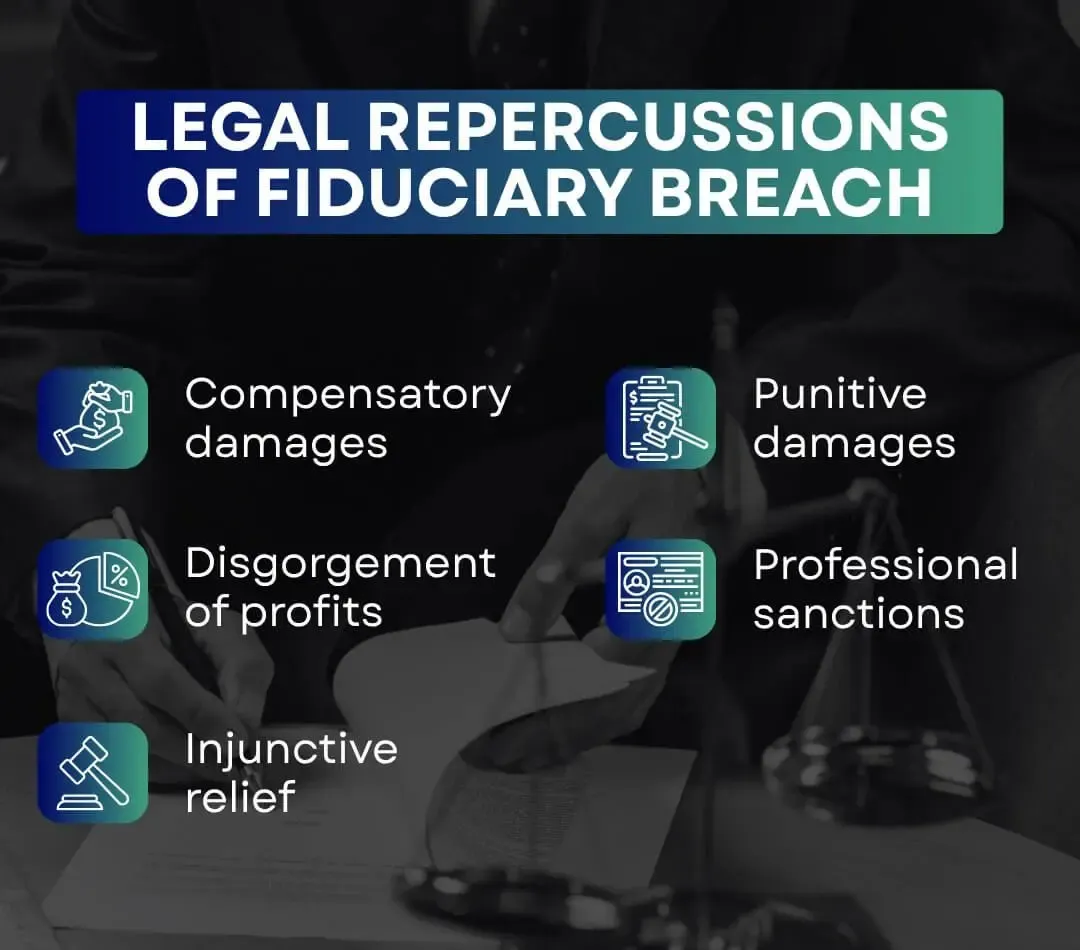
Legal consequences include civil lawsuits (and sometimes criminal charges). Courts may order:
- Compensatory damages: Direct reimbursement for losses caused by the breach.
- Disgorgement of profits: Surrender of any profit gained from the breach.
- Injunctive relief: Orders to prevent further harm or force compliance.
- Punitive damages: May be awarded in egregious cases involving intentional misconduct, fraud, or malice—though they are rare in fiduciary duty cases and depend on state law.
- Professional sanctions: Disbarment, removal from office, or loss of license.
Establishing a Fiduciary Breach Claim: Key Elements
To succeed in a legal claim for breach of fiduciary duty, the claimant must generally prove:
1. Proving Existence of the Duty
There must be a clear fiduciary relationship, established by law, contract, or the conduct of the parties (such as formal appointments of trustees, guardians, or board members).
2. Demonstrating the Breach Occurred
Evidence must show that the fiduciary failed to act according to obligations (e.g., acted in self-interest, neglected duties, or made unauthorized disclosures).
3. Establishing Damage: Proof of Harm
Actual harm must have resulted, either in the form of financial loss, reputational damage, or loss of opportunity.
4. Connecting Breach to Damage: Establishing Causation
There must be a direct connection between the breach and the harm suffered by the beneficiary or principal.
Real-World Examples of Fiduciary Breach Cases
Notable Legal Precedents and Their Implications
- Bernie Madoff Ponzi Scheme : Madoff, a trusted investment advisor, abused investor trust over decades, ultimately resulting in estimated losses of $64.8 billion.
This case highlights the devastating impact that fiduciary breaches can have, underscoring the need for robust oversight and regulatory controls.
- Allen Stanford Case : Stanford concealed the true nature of investments in a $7 billion Ponzi scheme, devastating thousands of investors.
The criminal trial highlighted the devastating consequences of negligent and deceitful actions by fiduciaries, serving as a stark warning to investors and professionals alike.
- Medical Malpractice in New Mexico : In December 2024, a men's health clinic in New Mexico was found liable for a $412 million verdict after a misdiagnosis and unnecessary treatments were found to breach the standard of care and fiduciary obligations to the patient, illustrating the real-world, life-altering consequences that such breaches can have in healthcare settings.
This case illustrates the importance of trust and competence in fiduciary roles and the potentially significant damages resulting from violations.
Lessons Learned from Famous Cases
Famous fiduciary breach cases teach that vigilance, transparency, and enforcing checks and balances are essential for maintaining trust.
The repeated theme is that breaches may go undetected for years, and even the most sophisticated investors or organizations are not immune.
The Importance of Upholding Fiduciary Duties
Fiduciary duties are the backbone of trust in commercial, legal, medical, and personal relationships. Upholding these duties builds confidence among investors, clients, and the general public while reducing risk and promoting ethical conduct.
Building Trust Through Responsible Practices
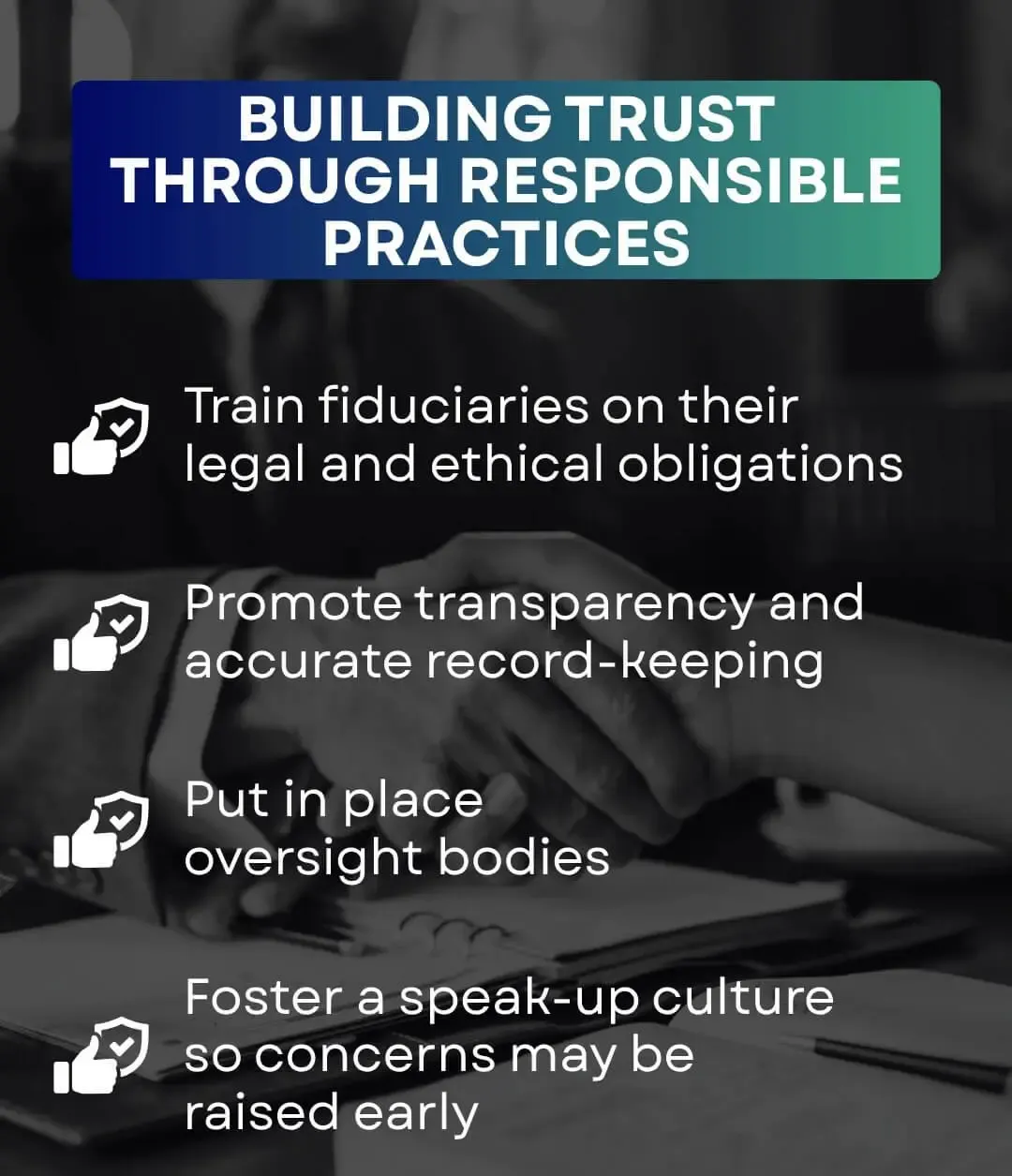
Organizations and professionals should:
- Train fiduciaries on their legal and ethical obligations.
- Promote transparency and accurate record-keeping.
- Put in place oversight bodies (such as audit committees).
- Foster a speak-up culture so concerns may be raised early.
Future Trends in Fiduciary Responsibilities
Evolving societal expectations and the growing importance of ESG (Environmental, Social, and Governance) criteria mean that fiduciary duties are expanding to cover broader interests.
Courts and regulators are increasingly holding fiduciaries accountable for failing to consider environmental and social impacts, digital privacy, and other stakeholder concerns.
Trustee/beneficiary
- Guardian/ward
- Agent/principal
- Attorney/client
- Doctor/patient
- Corporate officers/shareholders
What legal remedies exist for a breach of fiduciary duty?
Available remedies may vary depending on the jurisdiction and the type of fiduciary relationship involved. Remedies may include:
- Compensatory damages for direct losses
- Disgorgement of any profit realized from the breach
- Injunctive relief to prevent ongoing or future harm
- Punitive damages in severe cases
- Professional sanctions such as loss of license or position