![Bitdeer Technologies Group (BTDR) Securities Class Action Lawsuit Update [December 8, 2025]](https://dropinblog.net/cdn-cgi/image/fit=scale-down,format=auto,width=700/34260815/files/featured/btdr-alert-plus-banner.webp)

Allegations of Misled Investors Over a Revolutionary 5 J/TH Bitcoin Mining Chip
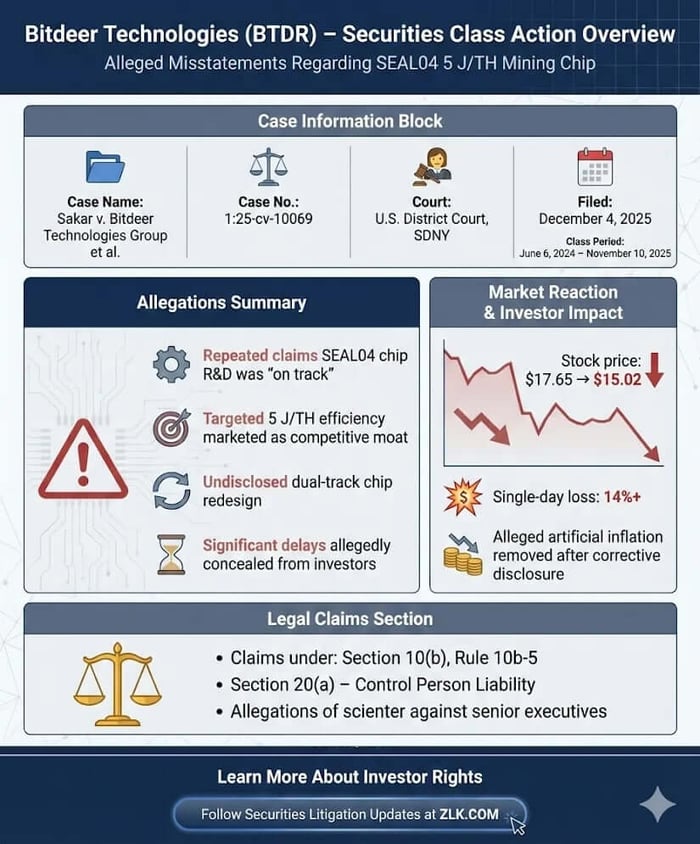
Case Name: Sakar v. Bitdeer Technologies Group et al.
Case No.: 1:25-cv-10069
Jurisdiction: U.S. District Court, Southern District of New York
Filed on: December 4, 2025
Class Period: June 6, 2024-November 10, 2025
Introduction
A seismic event in the Bitcoin mining sector has given rise to a new securities class action: Ismail N. Sakar v. Bitdeer Technologies Group, et al., filed in the Southern District of New York. The lawsuit targets Bitdeer Technologies Group (BTDR) and three key executives—CEO Jihan Wu, CBO Matt Linghui Kong, and CSO Haris Basit—for allegedly concealing critical development issues surrounding the company’s next-generation SEALMINER A4 mining rig.
The core allegation is that between June 6, 2024, and November 10, 2025 (the "Class Period"), executives repeatedly assured investors that the research and development (R&D) for the highly anticipated SEAL04 ASIC chip, targeting an industry-leading 5 J/TH efficiency, was "on track." This projected technological breakthrough was positioned as the Company's competitive moat, poised to unlock substantial value for shareholders.
The alleged deception unraveled on November 10, 2025, when Bitdeer announced its net loss had widened to $266.7 million, attributing the increase to R&D costs. More notably, management was forced to disclose that the development of the next-generation SEAL04 chip was "significantly delayed." The market reacted immediately. This sharp, corrective disclosure triggered the lawsuit, which now seeks to recover damages for investors who purchased BTDR stock at prices allegedly inflated by the executives’ misleading statements.

Backdrop and Business Context
Bitdeer is an international corporation operating in the Bitcoin mining and high-performance computing (HPC) data-center infrastructure space, with facilities spanning Singapore, the United States, Bhutan, and Norway. The Company provides self-mining and hosting services, but the narrative pivot in its business model centered on its proprietary mining solutions under the SEALMINER brand.
The pursuit of vertical integration through its own Application-Specific Integrated Circuit (ASIC) technology was an integral part of Bitdeer’s strategy. Management consistently framed the development of proprietary chips as providing distinct advantages—rapid hashrate deployment, a lower cost structure, and a dramatically improved supply chain, particularly relevant in the multi-billion dollar ASICs market. The Company believed that achieving the most efficient ASIC was the key factor to winning market share.
The entire case revolves around the fourth-generation SEALMINER A4 machine and its core component, the SEAL04 chip. This project was a testament to the Company’s stated "commitment to maintaining technological leadership and pushing past perceived limitations of ASIC design."
Promises Made vs. Reality
From the outset of the Class Period, Bitdeer—through press releases and executive commentary—established a clear technological benchmark. On June 6, 2024, the Company published its SEALMINER Technology Roadmap, which included a commitment to transparency in an industry plagued by price uncertainty.
The promise was stark: the SEAL04 chip was "Expected in Q2 2025" with a chip energy efficiency "as low as 5J/TH." The ensuing SEALMINER A4 mining machine was "planned for mass-produced with expected delivery starting in Q4 2025." Executives amplified this message, with CSO Haris Basit emphasizing that they were targeting an "unprecedented 5 J/TH efficiency."
The alleged reality, as presented in the complaint, was a critical dissonance. Investors allege that the statements created the false impression that management possessed "reliable information" that the SEAL04 R&D was proceeding as planned. In truth, according to the lawsuit, there were material issues with the SEAL04 chip design progress that R&D eventually needed to address by implementing a "dual-track approach"—creating two completely independent designs—to ensure eventual mass production. The investors assert that this critical, adverse fact about the design issues and resultant delays was concealed, allowing them to purchase the stock at artificially inflated prices.
Timeline of Alleged Misconduct and Disclosures
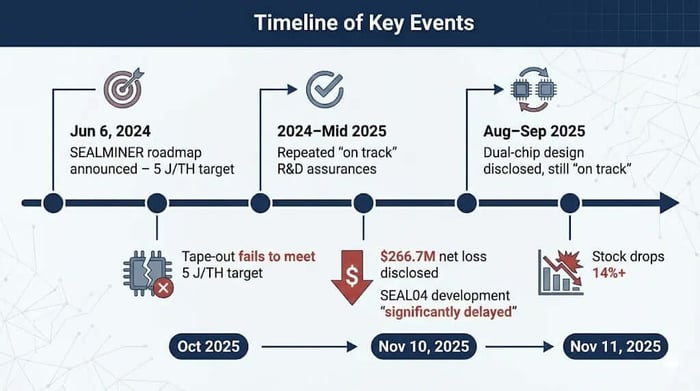
The alleged misconduct unfolded across a series of corporate communications, where optimistic projections remained static against a steadily shifting, yet consistently undisclosed, reality. This is the chronological breakdown of promises made and the ultimate, disruptive revelation:
June 6, 2024: Bitdeer inaugurates the Class Period by announcing its SEALMINER Technology Roadmap. The key promise: the revolutionary SEAL04 chip, targeting an "unprecedented 5 J/TH efficiency," was Expected in Q2 2025.
November 18, 2024: During the Q3 earnings call, CSO Haris Basit slightly walks back the timeframe, stating the fourth-generation chip would now be taped-out in the second half of 2025. Critically, the aggressive 5 J/TH efficiency goal is reiterated.
January 8, 2025 (Production Update): The Company officially adjusts the milestone, stating SEAL04 R&D remains "on track" but the anticipated initial tape-out is now scheduled for Q3 2025.
February 12, 2025 & March 12, 2025 (Monthly Updates): Bitdeer repeats the claim that SEAL04 R&D remains on track for an initial tape-out in Q3 2025.
April 9, 2025 (Production Update): The clock keeps ticking forward: the Company again claims R&D "remains on track," but the expected initial tape-out is pushed back to the Q4 2025.
May 15, 2025 (Q1 Earnings): Executives stress that R&D efforts are "focused" on the A4 project and that the tape-out is "on track" for the new Q4 2025 deadline.
June 11, 2025 & July 9, 2025 (Monthly Updates): Bitdeer continues to assure the market that the SEAL04 chip's initial tape-out is expected in Q4 2025 and the project remains "on track."
August 13, 2025 (Production Update): A subtle, yet significant, structural issue is first hinted at: the Company states it is "Planning two different chip designs of SEAL04 to ensure success," yet maintains the project is still "On track."
September 12, 2025 (Production Update): The Company reiterates its "dual-track approach" of two different chip designs, affirming the A4 project "remains on track" for the 5 J/TH goal.
October 14, 2025 (Production Update): Bitdeer discloses that the first SEAL04 chip tape out was completed in September. However, initial testing shows a power efficiency "still above the 5 J/TH target," demonstrating sub-10 J/TH results. Despite the failure to meet the efficiency target, management expresses confidence in mass production for this first design.
November 10, 2025 (Corrective Disclosure): The façade collapses. Bitdeer reports its Q3 net loss widened to $266.7 million. Executives admit that the mass production for the first SEAL04 design is now targeted for Q1 2026 and, most crucially, the development of the "second-generation SEAL04 chip is significantly delayed." The stock closes at $17.65 per share.
November 11, 2025 (Market Reaction): In response to the widening loss and the material technological delay, the stock price plummets by more than 14%, closing at $15.02 per share.

Investor Harm and Market Reaction
The disclosure of the SEAL04 chip's significant delay—a crucial failure in the Company's most touted technological initiative—sent a clear signal to the market.
Investors and analysts reacted immediately to Bitdeer’s revelation. The price of BTDR stock had closed at $17.65 per share on the day of the disclosure, November 10, 2025. By the close of the next trading day, November 11, 2025, the stock had plummeted to $15.02 per share. This single-session drop represented a loss of more than 14%.
The complaint asserts that this sharp decline was the direct result of the market processing the truth: that the Company had been disseminating misrepresentations about its technological readiness. Investors who purchased shares during the Class Period, believing in the feasibility and timeline of the 5 J/TH chip, suffered economic loss when the prior artificial inflation was purged from the price.
Litigation and Procedural Posture
The lawsuit, filed by lead plaintiff Ismail N. Sakar, asserts claims on behalf of the class under Sections 10(b) and 20(a) of the Securities Exchange Act of 1934, as well as the accompanying Rule 10b-5.
The claims rest on the assertion that Bitdeer and the Individual Defendants engaged in a scheme to deceive the public and artificially inflate the stock price by failing to disclose adverse, material facts.
Scienter Allegations
A central component of the Section 10(b) claim is the assertion of scienter, or intent to deceive. The complaint alleges that the Individual Defendants—Wu, Kong, and Basit—were the authors of the allegedly false statements and, due to their senior positions, had access to material non-public information about the SEAL04 chip's true status. Investors allege that the executives acted with the knowledge that the optimistic representations were materially false, or at a minimum, with reckless disregard for the truth by failing to ascertain and disclose the adverse facts. This is not a description of simple mismanagement; it is an accusation of systemic, knowing misrepresentation to the market.
Insider Sales and Confidential Witnesses
The complaint states that its allegations are based upon facts obtained through an investigation, with further evidentiary support expected after discovery. It further notes that "most of the facts supporting the allegations contained herein are known only to the defendants or are exclusively within their control." While the provided complaint outlines the core allegations and the basis for scienter, it does not include details on any specific insider sales or direct quotes from confidential witnesses, often referred to as CWs.
Shareholder Sentiment
Following Bitdeer's November 10, 2025, earnings reveal of the SEAL04 chip delay and a $266.7 million Q3 net loss. Social media erupted with frustration from retail investors, amplifying a 20%+ stock plunge as users vented over CEO Jihan Wu's no-show on the call, Tether's share dumping, and an Ohio facility fire.
On X, early reactions were bearish, with one user calling out the "no concrete update on AI lease potential" and stock tanking 20%, while others questioned the "dual-track" design pivot as a red flag.
However, sentiment flipped bullish by November 13 on Stocktwits, jumping from neutral amid "extremely high" message volume tied to a $400M notes offering, as traders eyed the 6-7 J/TH efficiency as a "game changer" for margins and U.S. production to dodge tariffs.
Later in December, the class action lawsuit filing sparked fresh negativity, with one user noting a 41% YTD drop and SHA256 News highlighting the 14% dive, while optimists defended BTDR as "IREN 2.0" for its EH/s quadrupling to 41.2 and NVIDIA ties, signaling resilient pockets of hype amid broader disappointment.
Analyst Commentary
Bitdeer’s November 10, 2025 earnings and SEAL04 delay announcement caused an immediate 15-20% stock plunge with heavy volume, as investors reacted to the widened $266.7 million loss and the reversal of months of “on track” claims.
CoinDesk reported the initial 20% drop, while The Block noted a two-day decline exceeding 30%. On November 11, Rosenblatt raised to $30, H.C. Wainwright trimmed to $30, and B. Riley to $29—all maintaining Buy ratings. The only cautious note came from Seeking Alpha contributor Mike Fay, who upgraded to Hold while questioning AI ambitions amid the chip delay.
SEC Filings & Risk Factors
While the complaint confirms that the investigation included a review of relevant filings made by Bitdeer with the SEC, the text primarily cites the Company's press releases and earnings call transcripts—the very documents containing the alleged misstatements.
The most salient discussion related to risk is found in the executive commentary. CBO Matt Kong framed the disclosure of the R&D roadmap as a commitment to "enhancing transparency" because "the financial models of Bitcoin miners are significantly impacted by price uncertainty." The subsequent failure to execute that roadmap—leading to the significant loss attributed to R&D expenses—demonstrates that the risk of technological failure and execution missteps was highly material, even if management had claimed to be mitigating it through increased transparency. The allegations essentially claim that the most pertinent risk, the failure of the core technology pipeline, was being actively masked by misleading disclosures.
Conclusion: Implications for Investors
The Bitdeer case provides a potent lesson on the distinction between technological ambition and corporate disclosure. For investors, the immediate red flag lies in the cadence of executive pronouncements: the months-long chain of statements that R&D was "on track" right up until the point of a catastrophic public announcement that a core project was "significantly delayed."
In the capital-intensive and rapidly evolving sector of Bitcoin mining ASICs, execution risk is paramount. Companies that hinge their competitive advantage and shareholder value on a technological breakthrough must be candid about the inherent challenges. The lawsuit is a reckoning on that failure of candor—a systemic breakdown that allegedly allowed executives to maintain a deceptive narrative until it could no longer be sustained.
This case has broader relevance for the entire cryptocurrency infrastructure market, particularly for growth companies betting on proprietary hardware. It underscores that while projections are standard, when management repeatedly links the health of the business to the certainty of an R&D milestone, any delay or design failure must be treated as a material fact, not a minor scheduling adjustment.
Disclaimer: This shareholder alert is for informational purposes only and does not constitute legal advice. Consult a qualified attorney for personalized guidance. No specific outcomes are guaranteed.
![DeFi Technologies Inc. (DEFT) Securities Class Action Lawsuit Update [December 8, 2025]](https://dropinblog.net/cdn-cgi/image/fit=scale-down,format=auto,width=700/34260815/files/featured/deft-alert-plus-banner.webp)
![Blue Owl Capital Inc. (OWL) Securities Class Action Lawsuit Update [December 9, 2025]](https://dropinblog.net/cdn-cgi/image/fit=scale-down,format=auto,width=700/34260815/files/featured/owl-alert-plus-banner.webp)
![StubHub Holdings, Inc. (STUB) Securities Class Action Lawsuit Update [December 3, 2025]](https://dropinblog.net/cdn-cgi/image/fit=scale-down,format=auto,width=700/34260815/files/featured/stub-alert-plus-banner.webp)