
Investment fraud is a centuries-old and widespread threat. It deceives investors into funding illegitimate ventures with promises of high returns. This causes significant financial losses, erodes trust in markets, undermines confidence, and potentially destabilizes economies.
Investment scams persist despite regulations because fraudsters exploit regulatory gaps, technology, and investor psychology (desire for quick wealth and fear of missing out).
Many investors lack awareness of warning signs, and sophisticated scams can deceive even professionals. Social media and online platforms facilitate scammers' global reach by facilitating credible-looking websites and tactics.
Investment frauds have changed drastically. Traditionalscamsinvolvedin-person pressure tactics, like Ponzi schemes. Digital fraud, especially cryptocurrencyscamspromoted online, now causes significant losses. In Canada, over 50% of the$309 million investment fraud losses in 2023 were crypto-related, often spread via social media and messaging apps.
The consequences of investment fraud extend far beyond individual victims. Widespread fraud and financial scandals can reduce overall market confidence, decrease trading volume and liquidity, and even deter foreign investment, ultimately hindering economic growth and increasing inequality.
From historical Ponzi schemes to modern crypto fraud, common investment scams persist by exploiting new technologies and regulations. This article examines the most significant investment frauds in history, their methods, their impact, why they continue, and how investors can protect themselves.
Types of Investment Scams
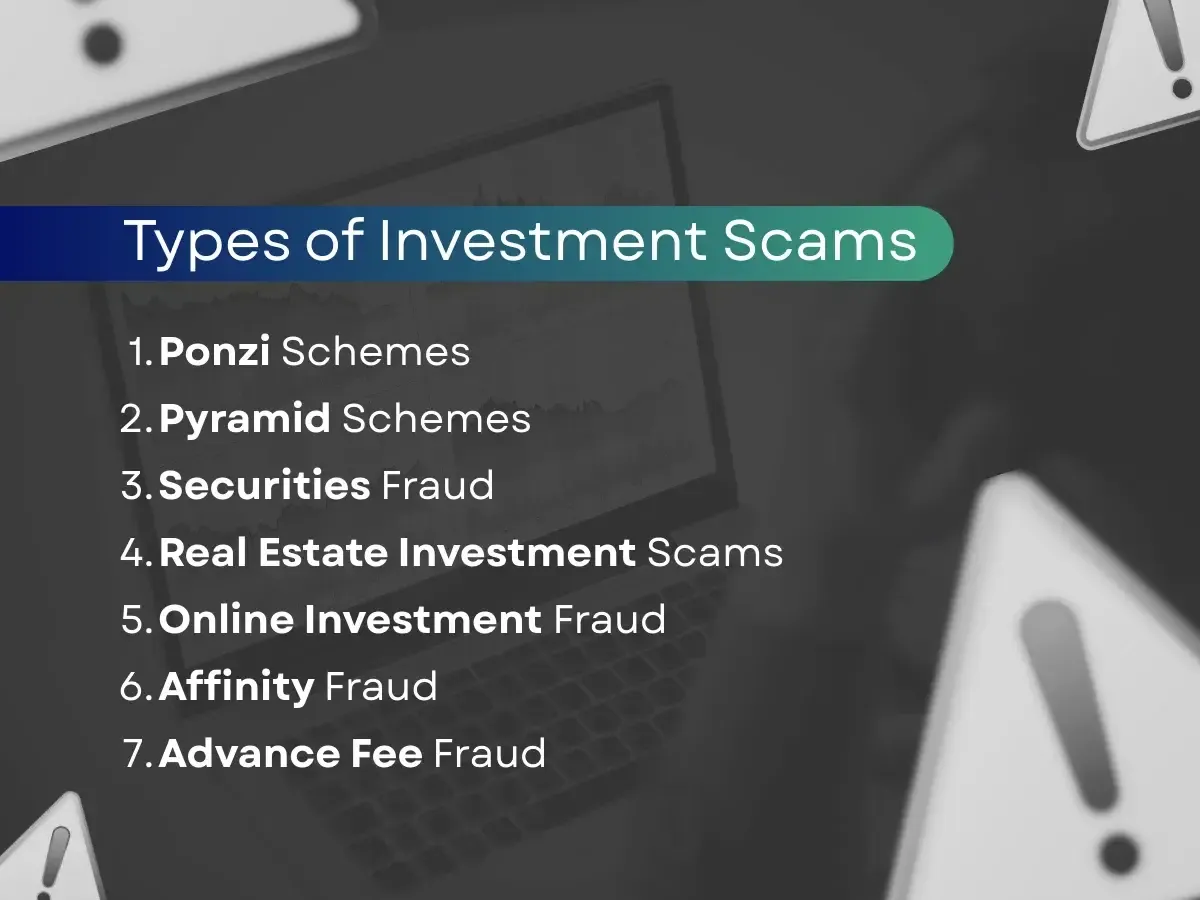
Ponzi Schemes: A fraudulent investment operation that pays early investors with funds from later investors instead of actual profits. This requires a constant stream of new money and collapses when new recruitment decreases or withdrawals increase. Named after Charles Ponzi's 1920s scheme promising high returns through postal coupons, it defrauded investors of approximately $20 million.
The most infamous modern example is Bernie Madoff, whose multi-decade Ponzi scheme defrauded approximately $64 billion from over 16,000 investors. Madoff fabricated account statements and used new investments to pay returns, creating the illusion of steady profits until the scheme unraveled in 2008.
Pyramid Schemes: Pyramid schemes promise high returns with little or no risk, but rely on recruiting new participants rather than genuine investment activity. Each participant must recruit others to profit, and the structure collapses once recruitment slows.
The 1970s"Dare to Be Great" scam exemplified this model, luring thousands with promises of wealth through self-improvement seminars only to reveal that profits depended solely on attracting new members.
Securities Fraud encompasses deceptive practices in buying and selling securities, such as insider trading, market manipulation, and falsifying financial statements. Corporate scandals like Enron and WorldCom involved executives inflating company profits and hiding debt, leading to massive investor losses and corporate bankruptcies. Enron’s collapse alone wiped out $74 billion in shareholder value, while WorldCom’s $11 billion accounting fraud led to $100 billion in lost investments.
Real Estate Investment Scams:Thesescamsoffer high returns through misleading or fictitious real estate investments. During the2008 financial crisis, fraudulent mortgage-backed securities and misrepresented property values contributed to the collapse of the real estate market, devastating investors and homeowners alike.
Online Investment Fraud: The internet has enabled a new wave of scams, including fake investment platforms, fraudulent forex trading, and cryptocurrency schemes. To lure victims, scammers use high-pressure sales tactics, fake testimonials, and identity theft. The collapse of FTX, a cryptocurrency exchange, is a recent example of billions in investor funds being mismanaged or misappropriated.
Affinity Fraud: Affinity fraud targets specific communities, such as religious, ethnic, or professional groups, by exploiting shared trust and relationships. Scammers infiltrate these groups, often posing as members, to promote fraudulent investments. Notable cases include scams targeting the Church of Latter-day Saints community.
Advance Fee Fraud: In advance fee fraud, scammers promise substantial investment returns but require upfront fees. The notorious "Nigerian Prince" email scams are classic examples, where victims are asked to pay processing fees to unlock supposed windfalls that never materialize.
Evolution of Investment Frauds
- Investment fraud is not a modern phenomenon. Schemes like the South Sea Bubble andCharles Ponzi’s coupon scam relied on word-of-mouth and print media.
- As financial markets globalized and technology advanced, fraudsters adapted, leveraging mass communication, complex financial instruments, and the anonymity of online platforms.
- The media and globalization have amplified scams' reach and impact. The internet enables fraudsters to target victims worldwide, while social media accelerates the spread of misinformation.
- Compared to the relatively localized frauds of the past, today’s scams can ensnare millions across continents within days.
Notable Investment Fraud Cases
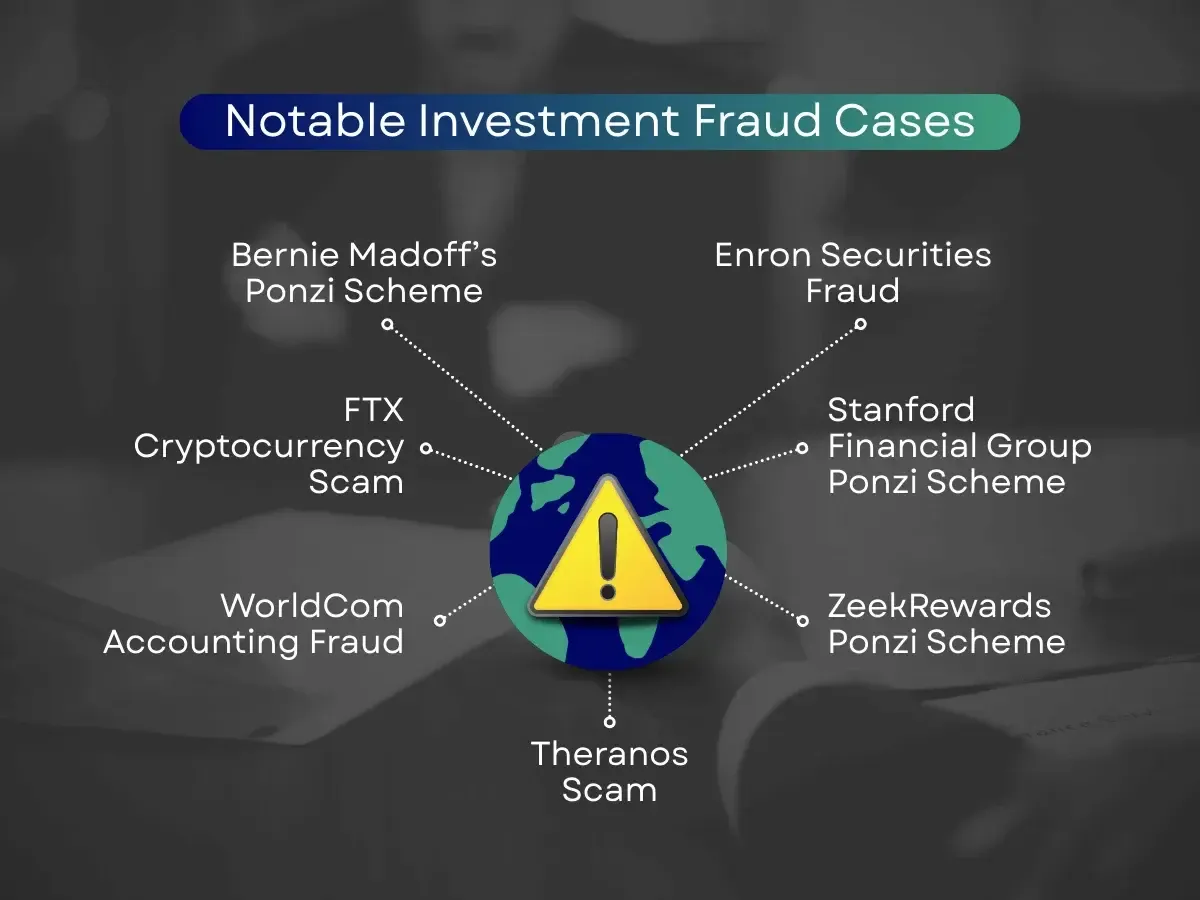
Investment fraud has taken many forms over the decades, but certain cases stand out for their scale, audacity, and impact on financial markets and public trust.
Below is a detailed look at some of history’s most infamous investment frauds, each illustrating the diverse tactics and devastating consequences of such schemes.
1. Bernie Madoff’s Ponzi Scheme
Bernie Madoff orchestrated the largest Ponzi scheme in history, luring investors with promises of steady, above-market returns. Madoff fabricated account statements for decades and used new investments to pay existing clients. The scheme collapsed during the 2008 financial crisis when withdrawal requests overwhelmed the operation, exposing $64 billion in losses.
2. Enron Securities Fraud
Enron, once a Wall Street darling, collapsed in 2001 after revelations of massive accounting fraud. Executives used complex off-balance-sheet entities to hide debt and inflate profits, misleading investors and regulators. The fallout destroyed $74 billion in shareholder value and led to sweeping regulatory reforms.
3. Stanford Financial Group Ponzi Scheme
Allen Stanford's Stanford Financial Group ran a $7 billion Ponzi scheme, promising high returns on certificates of deposit (commonly referred to as CDs). Investor money funded earlier clients and Stanford's extravagant lifestyle.
Aggressive marketing and incentivized advisors sustained the fraud. After the scam came to light, a 110-year sentence was awarded, underscoring the importance of due diligence and regulatory oversight.
4. ZeekRewards Ponzi Scheme
ZeekRewards, a penny auction site, defrauded over a million investors of $900 million by promising up to 50% daily profits through a Ponzi scheme. The SEC intervened in 2012, highlighting the risks of unregistered online investment scams.
5. Theranos Scam
Theranos, founded by Elizabeth Holmes, falsely claimed revolutionary blood-testing technology, raising hundreds of millions and reaching a $10 billion valuation. Investigations exposed the technology as unreliable, and executives were convicted of misleading investors and patients, causing billions in losses.
6. WorldCom Accounting Fraud
WorldCom, the second-largest US long-distance phone company, collapsed in 2002 due to an $11 billion accounting fraud. Executives falsified entries to inflate profits and hide losses, leading to a major bankruptcy. The scandal contributed to the passage of the Sarbanes-Oxley Act, which strengthened corporate accountability and financial reporting requirements.
7. FTX Cryptocurrency Scam
Cryptocurrency exchange FTX declared bankruptcy in November 2022 due to fraudulent mismanagement of customer funds. Billions were unaccounted for, and unauthorized transactions occurred during its collapse. Investigations showed an inflated balance sheet with illiquid tokens, leading to the founder, Sam Bankman-Fried's, conviction for directing fraudulent activities. This case highlights the risks in unregulated crypto markets and is significant for digital asset regulation.
Additional Securities Fraud Cases
8. Volkswagen Emissions Scandal
Volkswagen and its former CEO were charged with defrauding investors by making false and misleading statements about the environmental compliance and quality of its "clean diesel" vehicles. The company raised billions through bond sales while concealing its cars' true emissions performance, resulting in significant financial and reputational damage.
9. Wirecard Accounting Fraud
Wirecard, a German payment processor, collapsed in 2020 after it was revealed that €1.9 billion ($2.1 billion) was missing from its balance sheet. Investigative reports exposed years of fabricated revenues and nonexistent cash, leading to bankruptcy and criminal investigations.
10. Luckin Coffee Stock Fraud
LuckinCoffee, once a high-flying Chinese coffee chain, admitted in 2020 to fabricating over $300 million in sales transactions. The fraud was uncovered following whistleblower allegations and an internal investigation, causing the company’s stock to plummet and resulting in lawsuits and regulatory penalties.
Investment fraud has devastating consequences, causing individual financial ruin and systemic market and legal framework shocks.
Understanding Securities Fraud
Forms of Securities Fraud
- Insider trading:Trading based on non-public information.
- Market manipulation: Artificially inflating or deflating stock prices.
- False financial reporting: Misrepresenting company performance.
- Pump-and-dump schemes: Driving up stock prices before selling off shares.
Who Commits Securities Fraud?
Frauds, for financial gain, involve insider trading, market manipulation by traders, and account misrepresentation by businesses. These activities deceive investors and harm market integrity.
Consequences
Penalties include hefty fines, criminal charges, civil lawsuits, and imprisonment. For example, Madoff received a 150-year sentence, and WorldCom’s Ebbers was sentenced to 25 years.
Regulation and Enforcement
TheU.S. Securities and Exchange Commission (SEC) plays a central role in detecting, investigating, and prosecuting securities fraud. The SEC works alongside other agencies and offers resources to help investors verify the legitimacy of investment opportunities.
Investor Protection Strategies
Investors should verify legitimacy via regulatory filings and thorough research, including financial statement analysis and independent audits, and only work with registered professionals.
Online Investment Risks
The rise of internet-based scams presents new challenges. Fraudsters may attempt to deceive you through various methods, including:
- Employing fake websites
- Social media platforms
- Sending unsolicited emails
- Using high-pressure sales tactics
- Promising guaranteed returns
- Demanding payment through unusual channels
- Insisting on secrecy.
The SEC warns investors to be skeptical of unsolicited offers.
Protecting Your Assets from Investment Fraud
As scams become increasingly sophisticated, leveraging technology, social media, and global networks, even experienced investors can find themselves at risk. While regulatory agencies and law enforcement work tirelessly to detect and prosecute fraud, an informed and vigilant investor is the first and most effective line of defense.
Follow these practical steps to protect your hard-earned wealth
Due Diligence: Thoroughly research any investment opportunity. Review financial statements, verify professional licenses, and consult independent third-party custodians.
Work with Reputable Professionals: Ensure that advisors are licensed and regulated by checking with the SEC or FINRA.
Avoid Unrealistic Promises: Be wary of any investment promising guaranteed or unusually high returns.
Diversification: Spread investments across different assets and sectors to minimize risk.
Red Flags of Investment Scams
The following are common warning signs of investment fraud. You should be alert, but not assume that the presence of one red flag means an investment is fraudulent. Consult a legal or financial advisor before making economic decisions.
- Too-good-to-be-true returns:Promises of high, consistent profits regardless of market conditions.
- High-pressure sales tactics:Urgency to investimmediately, often with aggressive or unsolicited offers.
- Unregistered investment products:Lack of documentation or registration with regulatory authorities.
- Lack of transparency:Unwillingness todisclosedetails or provide clear information about the investment.
- Complex or vague strategies:Investments pitched with overly technical explanations or those that are hard to grasp.
Reporting Investment Fraud
If you suspect investment fraud, act quickly to protect yourself and help authorities. Report it so regulators can investigate, track patterns, and recover assets. Multiple federal and state agencies can receive and act on complaints and offer support.
Where to Report
- U.S. Securities and Exchange Commission (SEC):The SEC is the primary federal agency investigating securities fraud, including Ponzi schemes, insider trading, and market manipulation. You can file a tip or complaint online through the SEC’s official portal, by phone at 1-800-732-0330, or by email at [email protected]
- Financial Industry Regulatory Authority (FINRA):FINRA oversees brokerage firms and their representatives. Investors can report suspected fraud or file a tip with FINRA online or by calling 844-574-3577.
- State Securities Regulators:Each state has its own securities regulator, often within the state’s Department of Commerce or Attorney General’s office.
- Other Agencies:Depending on the nature of the fraud, you may also report to the North American Securities Administrators Association (NASAA), theCommodity Futures Trading Commission (CFTC), or the Federal Trade Commission (FTC).
Importance of Reporting
Reporting investment fraud is critical for several reasons:
- It enables authorities to investigate and stop ongoing scams, potentially preventing others from becoming victims.
- Your report contributes to a broader database that law enforcement uses to track and analyze fraudulent activity.
- Even if you cannot recover your losses immediately, your information may assist in future enforcement actions or recovery programs.
Whistleblower Programs
The SEC Whistleblower Program offers financial incentives to individuals who provide original information about securities law violations.
Whistleblowers may be eligible for awards ranging from 10% to 30% of monetary sanctions collected in successful enforcement actions.
Tips can be submitted anonymously through an attorney, and the program has awarded billions to whistleblowers since its inception. For more information or to submit a tip, visit the SEC’s whistleblower page.
Preventing Investment Scams
Protect yourself from investment fraud by staying informed and vigilant.
- Understand commonscamtactics like guaranteed high returns and high-pressure sales.
- Verify the credentials and regulatory history of financial advisors.
- Utilize resources from the SEC and FINRA to research firms and professionals.
- Ensure you work with licensed and reputable individuals.
- Conduct thorough due diligence to safeguard your financial future.
Investment Fraud Laws and Regulations
Investment fraud laws in the United States are anchored by two landmark statutes: the Securities Act of 1933 (“Securities Act”) and the Securities Exchange Act of 1934 (“Exchange Act”). These laws were enacted in response to the widespread financial abuses and the catastrophic market crash of 1929. Their purpose was to restore investor confidence, enhance transparency, and deter fraudulent practices in the securities markets.
Securities Act of 1933: The Securities Act, the first major federal securities law, mandates issuers to register securities with the SEC and provide full disclosure via a prospectus. This aims to provide investors with crucial information and prevent fraud and misrepresentation in securities sales. Ensuring transparency during issuance helps avoid the unchecked speculation and misinformation that led to the 1929 market crash.
Securities Exchange Act of 1934: The Exchange Act regulates secondary securities trading. The Exchange Act established the SEC, granting it broad oversight of the securities industry, including exchanges and brokerage firms. Among other things, the Act requires continuous periodic financial reports and prompt material disclosures.
Role of SEC
Established by the Exchange Act, the SEC is the chief regulatory authority enforcing these laws. It investigates violations, brings enforcement actions, and provides public access to company disclosures to maintain market integrity and investor confidence.
State Securities Regulators
State securities regulators are vital for local investor protection and enforcing anti-fraud laws. Each state has "blue sky" laws ensuring fair and transparent securities offerings within its borders. These regulators act as a primary contact for investor complaints and an early detection system for scams.
State regulators possessextensive enforcement authority, enabling them to investigate, subpoena, conduct proceedings, and pursue legal action against violators.
Unlike the SEC, they can often act swiftly against local investor harm, such as Ponzi schemes, and collaborate with federal and other state agencies via NASAA for interstate fraud.
State enforcement against investment fraud varies, with attorneys general or specialized regulators taking action. This decentralized approach enables localized responses and fills federal enforcement gaps. State regulators are effective at obtaining restitution for victims and levying substantial penalties.
Notable Legal Precedents/SEC Crackdowns
Landmark cases such as the Enron and WorldCom scandals serve as critical junctures in the history of financial markets, profoundly influencing the development of contemporary securities regulation and enforcement mechanisms worldwide.
The sheer magnitude of these frauds, characterized by intricate accounting manipulations and the deliberate deception of investors, exposed significant vulnerabilities within existing corporate governance structures and regulatory oversight.
The collapse of these once-leading corporations resulted in billions of dollars in losses for shareholders and employees. It triggered a widespread crisis of confidence in the integrity of financial reporting.
In response, legislative bodies and regulatory agencies enacted significant reforms, most notably the Sarbanes-Oxley Act in the United States, which aimed to enhance corporate accountability, strengthen internal controls, and increase the penalties for financial misconduct.
These regulatory changes have impacted how companies operate, audit their financials, and interact with investors, underscoring the enduring lessons learned from these infamous episodes of corporate malfeasance.
The repercussions of Enron and WorldCom continue to shape discussions around ethical leadership, corporate responsibility, and the ongoing need for vigilant regulatory oversight to protect stakeholders' interests and maintain the stability of the financial system.
Investment Fraud Enforcement
The Securities and Exchange Commission (SEC) leads the enforcement of investment fraud laws in the U.S., which investigates, fines, and prosecutes individuals and entities involved in securities fraud.
The SEC’s Division of Enforcement handles these actions, using tools such as civil lawsuits, administrative proceedings, injunctions, disgorgement of ill-gotten gains, and substantial financial penalties to hold violators accountable and recover money for harmed investors.
Federal and state agencies frequently collaborate on large-scale or complex fraud cases. The SEC works closely with the Department of Justice (DOJ), state securities regulators, and other law enforcement bodies to share resources, coordinate investigations, and pursue civil and criminal actions.
This cooperation enhances the effectiveness of enforcement, especially for frauds that cross state or national boundaries.
Notable SEC crackdowns include high-profile actions against Bernie Madoff, Enron, and WorldCom, resulting in convictions, industry bans, billions in fines, and restitution for victims.
In 2024 alone, the SEC filed 583 enforcement actions and secured $8.2 billion in financial remedies, demonstrating its ongoing commitment to protecting investors and maintaining market integrity.
Recovery Options for Investment Fraud Victims
Investment fraud and money laundering victims have several avenues to pursue potential recovery, though the process can be complex, and outcomes vary.
While not all losses can be recouped, taking prompt and informed action increases the likelihood of recovering assets or obtaining compensation.
SEC Recovery Programs
The U.S. Securities and Exchange Commission (SEC) may establish Fair Funds or disgorgement funds following successful enforcement actions against fraudsters. When possible, these funds are distributed to harmed investors.
Details about ongoing or upcoming distributions are available on the SEC’s website, and investors can contact the SEC’s Office of Distributions for information about specific cases. However, it’s important to note that recovered amounts may be significantly less than the original losses, and not all victims will be eligible for compensation.
Civil Lawsuits & Arbitration
Victims can pursue civil remedies, such as lawsuits or arbitration, to recover losses from fraudsters and associated parties.
Arbitration, offered by bodies like FINRA, is often a faster and less costly alternative to court, especially for disputes involving brokerage firms or registered professionals.
In some cases, class action lawsuits may be filed for all affected investors, providing a collective path to seek restitution.
Civil litigation can also include seeking court orders to freeze assets or force disclosure of information about the fraud. However, these processes can take time, and success depends on the ability to locate and recover assets.
Hiring an Investment Fraud Attorney
Navigating recovery options is often challenging, making legal representation valuable. Specialized investment fraud attorneys can help victims assess their case, file claims, and pursue litigation or arbitration.
While full financial recovery is not always possible, these steps can help victims reclaim some losses, protect their future finances, and contribute to broader enforcement efforts against fraud.
At Levi &Korsinsky, LLP, we specialize in investor class action lawsuits, representing shareholders who have suffered financial losses due to securities fraud, corporate misconduct, and deceptive investment practices.
With over 80 collective years of experience, our experienced attorneys are on hand to provide you with the support and legal expertise you need to maximize your recovery.
The Checklist to Steer Clear of Investor Fraud
Investment fraud remains a persistent threat, evolving with technology and market trends. History’s biggest scams—from Ponzi and Madoff to Enron and FTX—demonstrate their devastating impact on investors and the broader economy.
Key takeaways for investors:
- Conduct thorough research before investing.
- Stay vigilant for red flags.
- Report suspected fraud to the authorities.
- Diversify investments and consult professionals before committing capital.
Disclaimer:The information provided in this blog is for general informational purposes only and does not constitute legal advice. Readers should not act or refrain from acting on any of the information contained in this blog without consulting a qualified legal professional. Levi & Korsinsky LLP is not responsible for any actions taken or not taken based on the information provided in this blog.