
Class action lawsuits allow one or more individuals with similar grievances to seek remedies against a common defendant collectively. While these serve as a legal tool for plaintiffs to get justice, they also have unique risks and considerations.
This article will explore the risks of joining a class action lawsuit, your role as a class member or a plaintiff, and how to approach this legal procedure.
Risks and Considerations
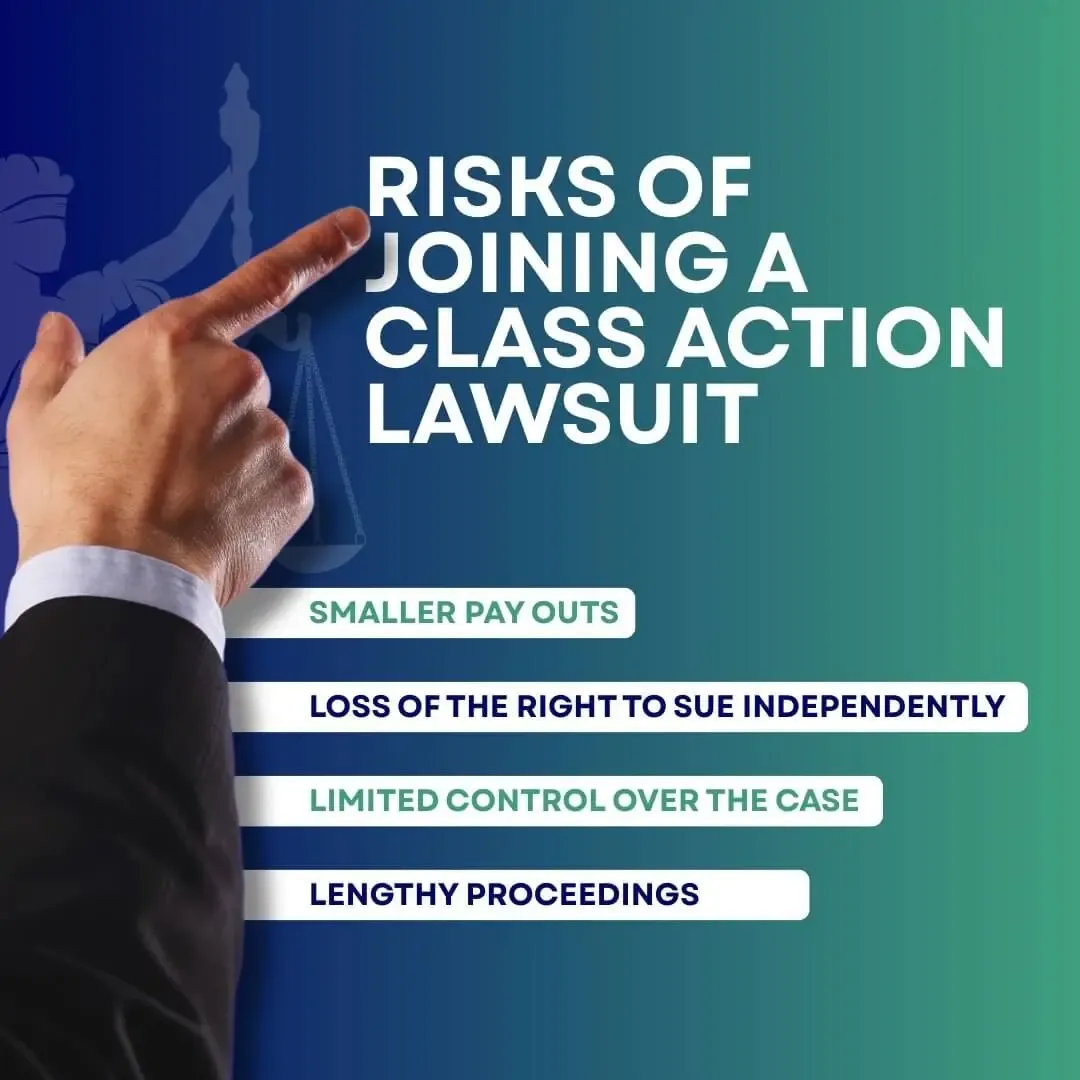
- Smaller Individual Payouts: Joining a class action lawsuit often results in smaller individual payouts due to the large number of claimants sharing the settlement.
For instance, despite multi-billion-dollar settlements, the Volkswagen emissions scandal and Fen-Phen litigation yielded relatively minor individual rewards for the numerous class members. - Loss of Right to Bring an Independent Lawsuit: Joining a class action suit typically means giving up the right to file an individual lawsuit on the same matter.
The same has been codified in Rule 23 of the Federal Rules of Civil Procedure (FRCP), which makes class action judgments binding on all members who don't opt out, even if they disagree with the result.
The Supreme Court in Hansberry v. Lee (311 U.S. 32, 1940) also confirms the binding nature of class action judgments on all members, except in limited situations. - Lengthy and Complex Proceedings:Class action lawsuits are often complex and protracted.
For instance, the BP Gulf of Mexico oil spill litigation took six years to resolve due to intricate negotiations and processes like class certification, discovery, and settlement approval, potentially causing long waits for class members. - Loss of Control Over the Case: Joining a class action lawsuit means individual plaintiffs have little to no control over the case's strategy and key decisions. The lead plaintiffs and their lawyers make these choices, such as whether to settle or go to trial.
As outlined in Rule 23, class members generally do not have direct input into these decisions, with court-appointed class counsel representing the entire group's interests.
Understanding Your Role in a Class Action Lawsuit
When a class action lawsuit is certified by a court, a group of individuals with comparable legal grievances has been formally recognized.
This certification process, often governed by criteria ensuring a sufficiently large class size and the presence of shared legal or factual questions, allows the collective pursuit of justice for widespread harm.
A crucial aspect of class action procedure is the requirement for class members to be informed about the lawsuit by “best notice that is practicable under the circumstances.”
In some cases, individuals may be automatically included once the class is certified. The courts provide an opportunity for individuals to request exclusion (opt-out).
Conversely, depending on the governing jurisdiction and the specifics of the legal action, potential class members might be required to actively opt in to join the class.
For most class members, the primary role involves observing the progress and eventual resolution of the lawsuit.
However, the legal counsel representing the class may, in certain circumstances, find it necessary to contact specific class members. This might involve requesting information relevant to the case or testimony regarding their particular experiences.
Becoming a Class Representative
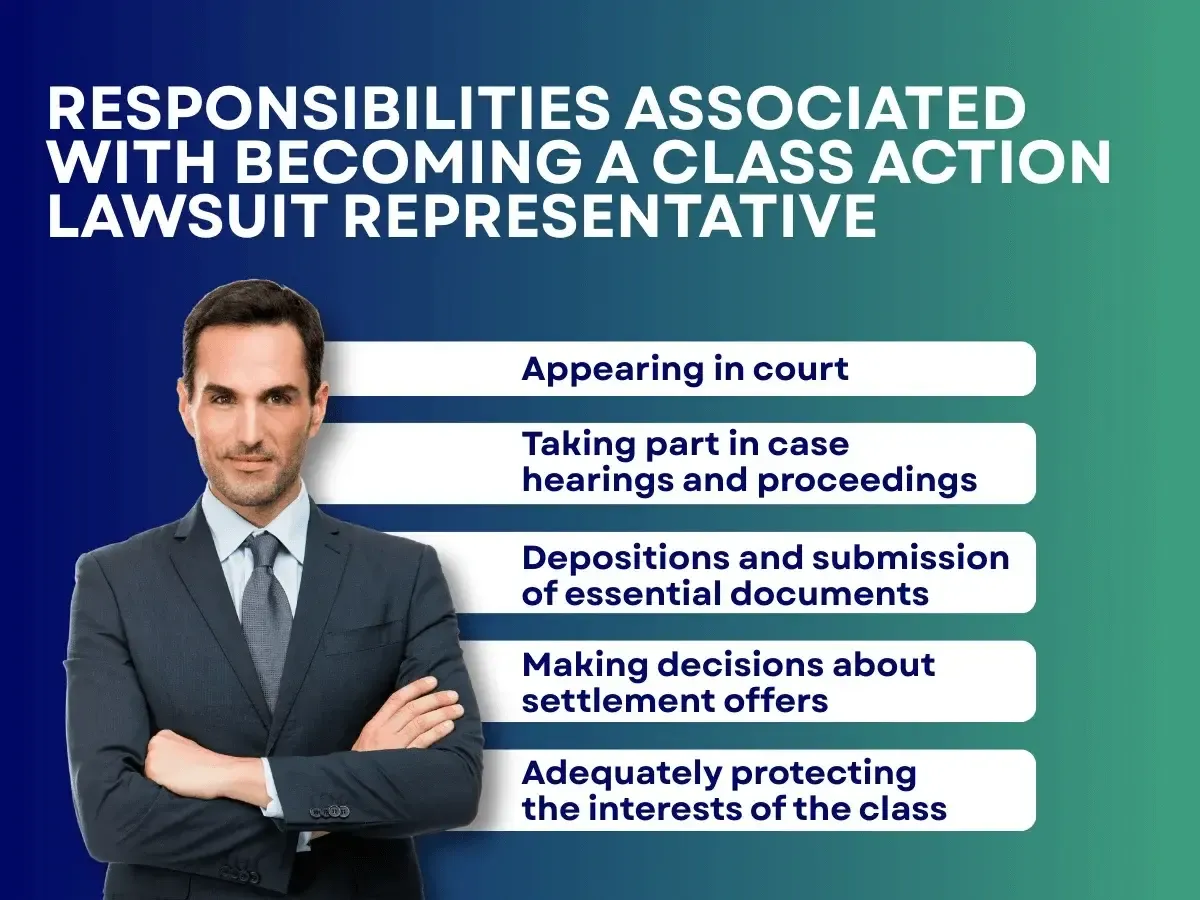
Role and Responsibilities: A class representative, or lead plaintiff, is responsible for adequately representing all class members.
A class representative must act in a manner that serves the interests of all class members.
This role comes with responsibilities such as:
- Appearing in court and taking part in case hearings and proceedings.
- Active participation in depositions and submission of essential documents.
- Making decisions about settlement offers.
- Adequately protect the interests of the class, as required by Rule 23(a).
There is no certainty of larger payouts. Lead plaintiffs in class action lawsuits may receive modest incentive awards approved by courts for their extra work.
For instance, in the WorldCom case, lead plaintiffs helped secure a $6.1 billion settlement, but their compensation remained proportionate to the class.
Opting Out of a Class Action Lawsuit
Right to Exclude Yourself: Rule 23(c)(2) gives class members the right to opt out of most class actions seeking monetary relief.
Opting out preserves an individual’s right to file an independent lawsuit, which may be advantageous if the damages are significant or they seek more control over their case.
Potential for Higher Recovery: Individuals pursuing a separate lawsuit can sometimes expect a higher recovery, especially in cases with substantial personal damages.
For example, in the aftermath of the tobacco litigation, some individuals chose to pursue separate claims rather than participate in the $246 billion Master Settlement Agreement, hoping for larger awards.
Small Claims Courts: For minor issues, pursuing a small claims court case could be quicker and cheaper than joining a class action lawsuit, though fees differ depending on the jurisdiction.
Limited Involvement
In a class action lawsuit, class members have limited involvement in the lawsuit’s direction.
The lead plaintiff and class counsel make strategic decisions; most class members are passive participants.
Once the settlement process is approved by the court and the award (claim amount) is distributed, a class member’s involvement typically ends. They have no ongoing obligations or rights related to the case.
Class members often lack visibility into the lawsuit’s funding, legal fees, or settlement negotiations. These matters are typically handled by class counsel and approved by the court.
Non-Monetary Compensation
Class action lawsuit settlements sometimes offer non-monetary compensation, like coupons or rebates.
For instance, the AOL Time Warner settlement provided some class members with non-cash benefits, leading to dissatisfaction because of their limited usefulness.
Courts have scrutinized such settlements for fairness, but they remain common in consumer cases.
Non-monetary awards are often criticized for failing to provide meaningful compensation. In some instances, many recipients felt that coupons or rebates did not adequately address the harm suffered.
Seeking Professional Advice for Class Action Lawsuits
Given the complexity of class actions, it is advisable to consult a reputable legal firm like Levi & Korsinsky. Class action lawsuit attorneys at Levi & Korsinsky can explain your eligibility, the risks and benefits of joining, and whether opting out might better serve your interests.
Particularly in complex cases involving securities fraud or defective products, L&K has served as lead or co-lead counsel in over 50 securities class actions, recovering $200+ million for investors in cases involving IPO misstatements, accounting fraud, and regulatory violations.
Takeaways for Potential Class Members
Joining a class action lawsuit can be a strategic decision, but it carries risks: smaller payouts, loss of individual rights, lengthy proceedings, and limited control.
Statutory provisions like Rule 23 of the FRCP in the U.S. govern these actions and define your rights and obligations. If you are uncertain about joining, you can seek legal advice from attorneys at L&K to ensure your rights and interests are protected.
Disclaimer:The information provided in this blog is for general informational purposes only and does not constitute legal advice. Readers should not act or refrain from acting on any of the information contained in this blog without consulting a qualified legal professional. Levi & Korsinsky LLP is not responsible for any actions taken or not taken based on the information provided in this blog.