
Class action lawsuits represent a vital mechanism within the American legal framework, empowering groups of individuals with similar grievances to seek legal redress from large entities jointly.
This collective approach allows numerous plaintiffs to pool resources and present a unified front, enhancing their ability to challenge powerful defendants who might otherwise be impervious to individual claims.
This article explores the history, evolution, and impact of class actions, highlights the most significant cases across different sectors, and distills key lessons for future litigants and policymakers.
History of Class Actions
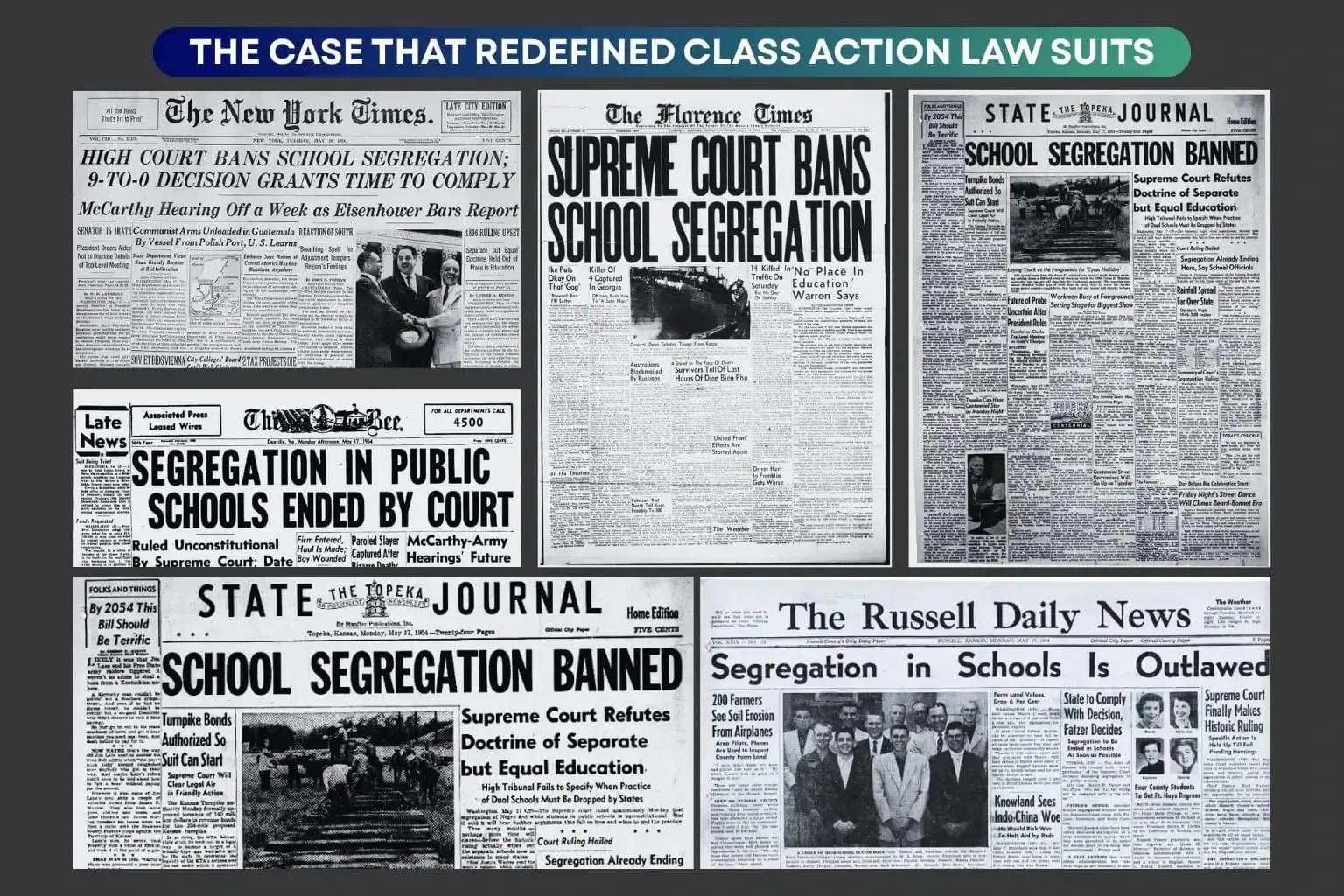
The modern class action lawsuit traces its roots to the mid-20th century, but its conceptual foundation in U.S. law dates back even further.
The landmark decision in Brown v. Board of Education(1954) set the stage for the civil rights movement by declaring racial segregation in schools unconstitutional. This decision paved the way for using class actions as a tool for enforcing collective legal action. Brown allowed groups of plaintiffs to challenge systemic injustices that would have been impossible to address through individual lawsuits.
Class action suits soon became instrumental in addressing various issues beyond civil rights, including product liability, securities fraud, and consumer protection.
The significance of class action lawsuits lies in their ability to aggregate similar claims, making them a powerful mechanism for holding large entities accountable and securing remedies for widespread harm.
Evolution of Class Action Lawsuits
While collective legal actions were recognized in the American justice system as early as 1820, the class action as we know it today emerged with the adoption of Rule 23 of the Federal Rules of Civil Procedure (FRCP) in 1966. This rule provided the procedural framework for certifying classes, ensuring adequate representation, and managing complex litigation involving numerous plaintiffs.
The 1966 amendments to Rule 23 greatly expanded the scope of class actions, making it easier for groups of individuals to seek collective redress in cases involving securities litigation, consumer fraud, employment discrimination, and environmental harm.
One of the most significant milestones in securities litigation was the Enron settlement, which, at $7.2 billion, remains the largest securities class action settlement in U.S. history.
Impact on the Legal System
The impact of class action lawsuits is visible not just in individual case outcomes but in creating new legal standards, forming oversight bodies, and evolving judicial procedures.
Transformative Effects on the Legal System
Class actions have:
- Advanced Civil Rights and Social Justice:Landmark class action lawsuits, like Brown v. Board of Education, ended discriminatory practices in public institutions, established legal precedents and enforced constitutional rights through collective litigation.
The case and increased public agitation led to the Civil Rights Act, which further established the Equal Employment Opportunity Commission (EEOC). Driven Legislative and Regulatory Reform:Major class actions have prompted Congress to enact new laws and regulatory bodies. Some include:
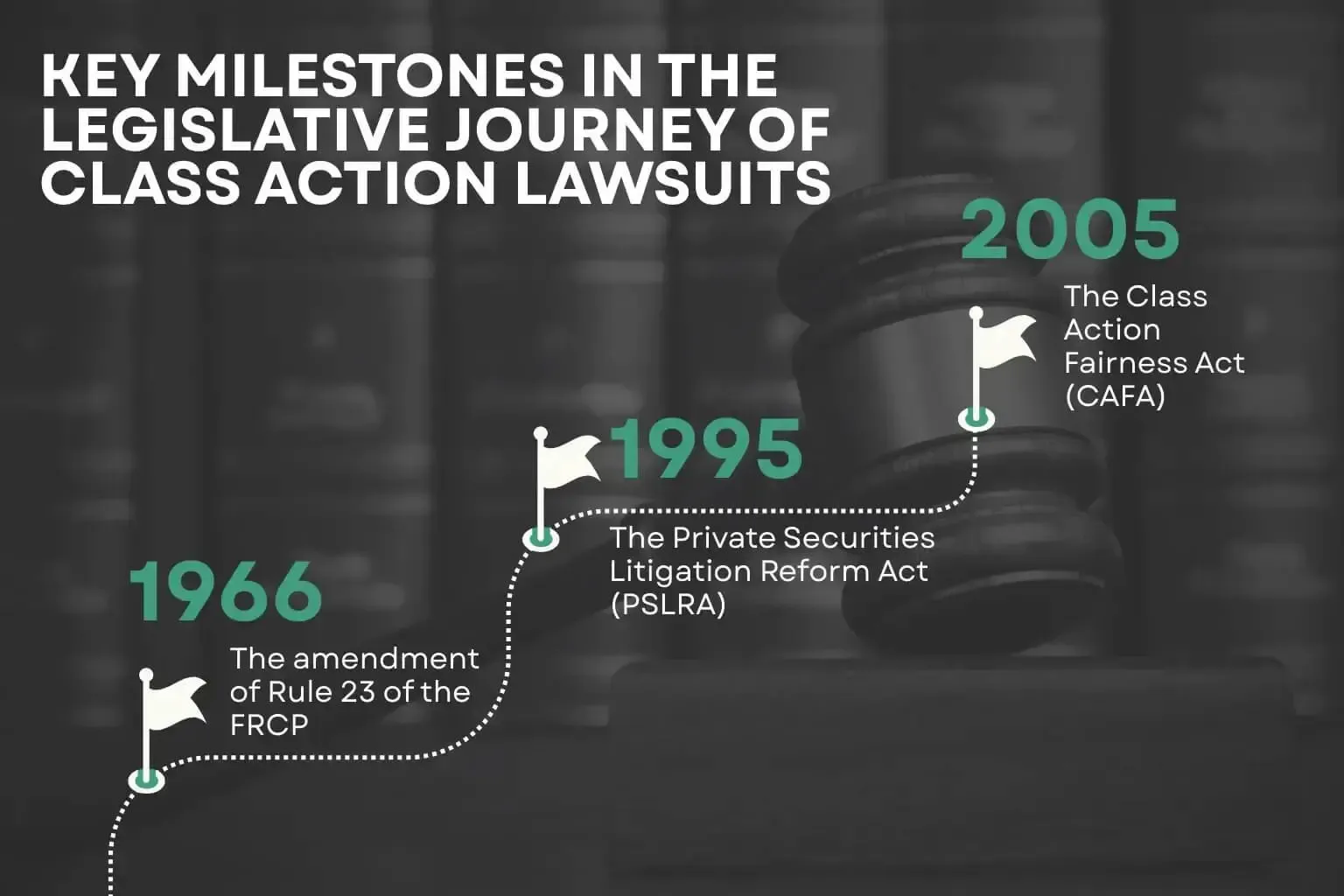
- The amendment ofRule 23 of the FRCPstandardized and broadened the use of class actions, making them accessible for a broader range of legal claims.
- The Private Securities Litigation Reform Act (PSLRA) of 1995 was passed in response to waves of frivolous securities fraud class actions. The PSLRA tightened requirements for plaintiffs and shaped the way securities litigation is conducted.
- The Class Action Fairness Act of 2005 expanded federal jurisdiction over significant class actions, curbing forum shopping and standardizing procedures nationwide.
- Environmental class actions like those following the Exxon Valdez and BP Deepwater Horizon oil spills led to stricter environmental regulations and strengthened agencies like the Environmental Protection Agency (EPA).
- Promoted Judicial Efficiency: Class actions reduce duplicative litigation and streamline the judicial process by consolidating thousands of similar claims into a single proceeding.
For example, The Asbestos litigation (Jenkins v. Raymark Indus. Inc.) allowed courts to manage thousands of claims together, thereby preventing court backlogs and inconsistent judgments. - Set Public Precedent and Transparency:Unlike confidential individual settlements, class action resolutions are typically court-approved and publicly accessible, creating legal precedents and guiding future conduct.
Additional Systemic Impacts
- Enhanced Access to Justice:Class actionsallowindividuals with limited resources to pool claims and share legal costs, ensuring that even those harmed by powerful corporations can seek redress.
Example: TheVolkswagen emissions scandalclass action enabled millions of car owners to receivecompensationand forced industry-wide changes in emissions standards.
- Catalyzed the Formation of Oversight Bodies:Some class actions have directly led to the creation or empowerment ofoversight agencies.
- Driven Corporate Accountability and Deterrence:The threat and outcome of class actions incentivize companies to adopt better compliance programs and ethical practices, knowing that widespread harm can result in massive collective liability and regulatory scrutiny.
Largest and Most Notable Class Action Lawsuits
Class action lawsuits have spanned various sectors, from environmental disasters to product liability and securities fraud. Below are 15 of the most notable cases, each illustrating the breadth and impact of class actions in the U.S. and beyond:
1. Tobacco Master Settlement Agreement (1998)
The largest lawsuit in history, the Tobacco Master Settlement Agreement, resulted in a record-breaking $206 billion settlement with major tobacco companies.
The case addressed the health impacts of smoking and required tobacco companies to make annual payments to states in perpetuity and change their marketing practices.
This landmark case fundamentally altered both public health policy and the tobacco industry.
2. BP Deepwater Horizon Oil Spill (2016)
Following the catastrophic 2010 Gulf of Mexico oil spill, BP agreed to a $20 billion settlement to resolve civil claims over environmental damage.
The settlement covered federal penalties, payments to state and local governments, and compensation for businesses and individuals affected by the disaster. This case set a massive precedent for environmental accountability.
3. Volkswagen Emissions Scandal (2016)
Volkswagen faced a $14.7 billion settlement after it admitted to installing software in diesel vehicles to cheat emissions tests. The settlement provided funds for vehicle buybacks and financial compensation to affected car owners, highlighting the power of class actions in addressing corporate deception and environmental harm.
4. Enron Securities Fraud (2008)
The collapse of Enron, once a leading energy company, led to a $7.2 billion settlement for shareholders who suffered losses due to fraudulent accounting practices. The case remains the largest class action settlement in U.S. history and underscores the importance of transparency in corporate governance.
5. WorldCom Accounting Scandal (2005)
WorldCom’s$6.1 billion settlement resolved claims that the telecommunications giant had engaged in massive accounting fraud, misleading investors, and ultimately filing for bankruptcy. The case resulted in the conviction of top executives and significant reforms in corporate accounting practices.
6. Fen-Phen Diet Drugs (2000)
A $3.75 billion settlement was approved for users of the diet drug fen-phen, which was linked to potentially fatal heart valve damage. The settlement compensated millions of affected individuals and set a benchmark for pharmaceutical liability cases.
7. American Indian Trust Settlement (2011)
This $3.4 billion settlement resolved claims that the U.S. government had mismanaged funds in land trust accounts for Native Americans. The case, which addressed decades of financial mismanagement, resulted in direct payments to hundreds of thousands of beneficiaries and reforms in federal trust management.
8. Silicone Breast Implants (1990s)
Manufacturers of silicone gel breast implants agreed to a $3.4 billion settlement to resolve claims that the implants cause autoimmune disorders. The case highlighted the importance of product safety and corporate responsibility in the healthcare industry.
9. Tyco International Accounting Fraud (2007)
Tyco International reached a $3.2 billion settlement after executives were found to have enriched themselves at shareholders’ expense through fraudulent accounting. The case led to significant changes in corporate governance and executive accountability.
10. AOL Time Warner Accounting Fraud (2006)
AOL Time Warner was the subject of a $2.5 billion settlement after falsely inflating advertising revenue. The case underscored the risks of aggressive accounting practices and the importance of accurate financial reporting.
11. Nortel Networks Accounting Fraud (2006)
Nortel Networks agreed to a $2.45 billion settlement for allegedly recording phony sales to boost its stock price. The settlement enabled investors to recover compensation and led to reforms in financial oversight.
12. Actos Diabetes Drug Litigation (2015)
Takeda Pharmaceutical agreed to pay $2.4 billion to settle claims that it concealed the cancer risks of its diabetes drug Actos. Thousands of claimants received compensation, and the case reinforced the need for transparency in pharmaceutical safety.
13. Bank of America/Merrill Lynch Merger (2013)
Bank of America paid $2.4 billion to settle claims that it misled investors about Merrill Lynch's financial health prior to its acquisition. The settlement provided restitution to shareholders and highlighted the importance of full disclosure in mergers and acquisitions.
14. Exxon Valdez Oil Spill (2008)
The Exxon Valdez oil spill resulted in an initial $5 billion punitive damages award, which the Supreme Court later reduced to $2.5 billion. The case remains a landmark in environmental litigation and corporate liability for ecological disasters.
15. Tesla Securities Litigation (Ongoing)
Tesla and its CEO, Elon Musk, have faced multiple class action lawsuits over Musk’s tweets about taking the company private.
Investors allege that the statements artificially inflated Tesla’s stock price and caused financial harm. While Musk paid a $20 million SEC fine, the class actions are ongoing, reflecting the evolving landscape of securities litigation in the digital age.
Financial Outcomes and Implications
The financial outcomes of these settlements have had profound implications for both plaintiffs and defendants.
For example, in the Tobacco Master Settlement Agreement, states received ongoing payments that have funded public health initiatives and smoking cessation programs.
In the BP oil spill case, the court awarded billions toward environmental restoration and compensation to affected communities. For plaintiffs, these settlements often provide critical compensation for losses that would be difficult to recover individually.
Conversely, Defendants often face significant financial penalties, reputational damage, and increased regulatory scrutiny.
Large settlements have often prompted companies to implement internal reforms and strengthen compliance programs to prevent future misconduct.
Impact on Public Policy and Corporate Behavior
Large class action settlements have driven significant changes in public policy and corporate behavior.
For instance, the Tobacco Master Settlement Agreement provided financial restitution and imposed strict advertising restrictions on tobacco companies, fundamentally altering the industry’s relationship with consumers and regulators.
Similarly, the Volkswagen emissions settlement led to stricter environmental standards and greater oversight of automotive manufacturers.
Cases like Fen-Phen and Actos have prompted more rigorous drug safety protocols and enhanced transparency in clinical trials in the pharmaceutical sector.
These cases demonstrate that class actions can be a powerful deterrent against corporate wrongdoing, encouraging companies to prioritize ethical conduct and compliance with legal standards.
Lessons Learned from Class Action Lawsuits
Landmark cases like Enron and WorldCom demonstrate their effectiveness in uncovering and rectifying large-scale fraud, while the American Indian Trust settlement highlights their role in addressing historical injustices.
- Effectiveness of Class Action Lawsuits: Effective class actions often depend on strong legal representation capable of gathering evidence, managing numerous claimants, and negotiating beneficial settlements.
- Importance of Lead Plaintiffs and Institutional Investors: Securities class action reforms mean that lead plaintiffs and institutional investors with substantial financial stakes play pivotal roles in ensuring that lawsuits align with the interests of all class members.
- Litigation as a Tool for Deterrence: Landmark class action lawsuits have navigated large public corporations towards deploying stronger internal control and compliance mechanisms.
Litigations can serve as practical tools for deterrence and proactive corporate governance.
Common Themes and Takeaways
Several common themes emerge from the most significant class action lawsuits:
- Corporate Accountability:Class actions hold corporations accountable for misconduct that affects large groups of people, promoting ethical business practices and deterring future violations.
- Consumer Protection:Many class actions have addressed unsafe products, deceptive marketing, and financial fraud, providing critical consumer protection.
- Judicial Efficiency:Class actions enhance judicial efficiency byconsolidatingnumeroussimilar claims and ensuring consistent outcomes for affected individuals.
These themes underscore the enduring value of class actions in promoting justice, fairness, and public trust in the legal system.
Best Practices for Plaintiffs
For plaintiffs, choosing experienced legal counsel is crucial for a successful class action. Key points to consider include:
- Select skilled class action lawyers with class action experience.
- Maintain open communication among class members.
- Coordinate evidence and documentation effectively.
Future Directions for Class Action Lawsuits
Technological advancements and globalization are driving the evolution of class action litigation. Technology improves accessibility and efficiency in member identification, claim submission, and settlement. Increasing international cooperation addresses cross-border issues like data privacy, environmental harm, and securities fraud.
Expanding class actions internationally presents new challenges and opportunities for litigants and policymakers.
Reimagining Investor Rights with Class Action Lawsuits
Class action lawsuits have helped shape America’s legal ecosystem, allowing individuals to seek collective redress and driving significant corporate behavior and public policy reforms.
From the historic Tobacco Master Settlement Agreement to recent environmental disasters and securities fraud cases, class actions have delivered justice to millions and set powerful precedents for accountability and transparency.
As legal and technological advancements continue to shape the future of class actions, their role in promoting fairness, efficiency, and public trust remains as vital as ever.
Disclaimer: The information provided in this blog is for general informational purposes only and does not constitute legal advice. Readers should not act or refrain from acting on any of the information contained in this blog without consulting a qualified legal professional. Levi & Korsinsky LLP is not responsible for any actions taken or not taken based on the information provided in this blog.