![Agilon Health, Inc. (AGL) Securities Class Action Lawsuit Update [January 7, 2026]](https://dropinblog.net/cdn-cgi/image/fit=scale-down,format=auto,width=700/34260815/files/featured/agl-alert-plus-banner.webp)

Inside the Agilon Health 2025 Guidance Collapse
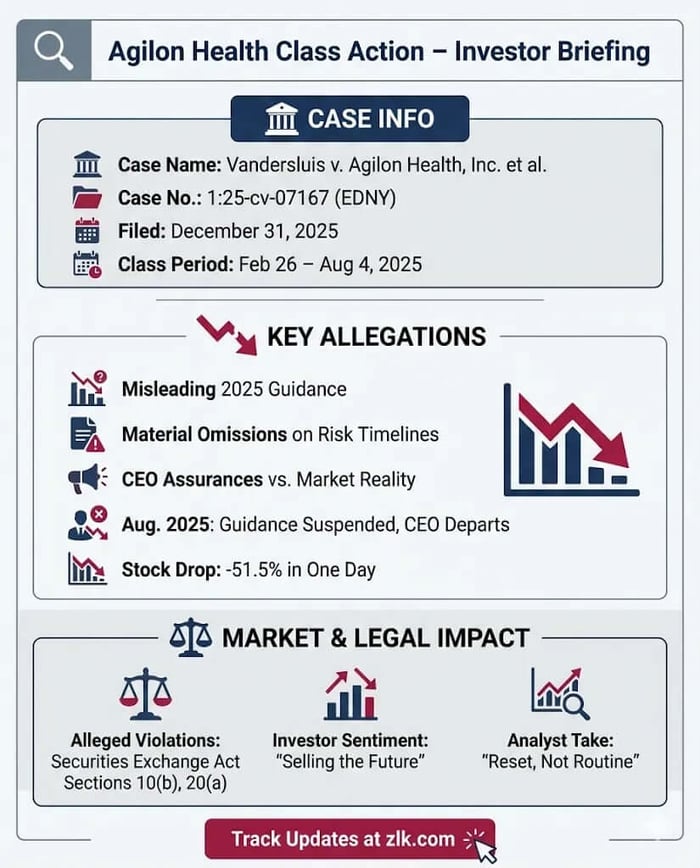
Case Name: Vandersluis v. Agilon Health, Inc. et al.
Case No.: 1:25-cv-07167
Jurisdiction: U.S. District Court, Eastern District of New York
Filed on: December 31, 2025
Class Period: February 26, 2025-August 4, 2025
Introduction
Agilon Health, Inc. told investors it had stabilized risk, tightened underwriting, and laid the groundwork for a stronger 2025. By August, that narrative had collapsed. A federal securities class action now accuses the company and two senior executives of issuing guidance they knew—or recklessly disregarded—could not be met, masking the depth of industry headwinds and the delayed impact of so-called “strategic actions.” When the company suspended its outlook and announced a sudden CEO departure, the stock lost more than half its value in a single session. Now, investors are fighting back.

Backdrop and Business Context
Agilon Health, Inc. is a value-based healthcare platform that partners with primary care physicians serving Medicare Advantage and ACO Model patients. The company describes itself as a “trusted partner empowering physicians to transform health care in our communities,” operating a platform designed to manage medical cost risk while scaling physician networks nationwide. Its common stock trades on the NYSE under the ticker AGL.
During the period leading into 2025, agilon faced what it later described as a “challenging Medicare Advantage environment.” The company nevertheless issued full-year guidance premised on assumptions that strategic actions taken in 2024 would meaningfully improve near-term performance. According to the complaint, those assumptions sat uneasily with the realities of agilon’s business cycle and known industry pressures.
Promises Made vs. Reality
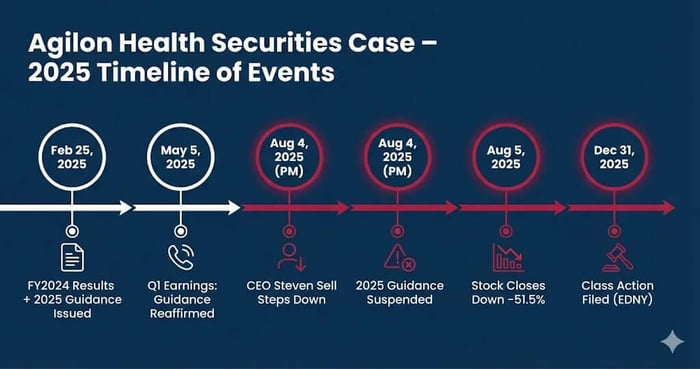
On February 25, 2025, agilon released fourth-quarter and full-year results, issuing detailed guidance for fiscal 2025. Management stated that full-year guidance “reflects the positive impact from strategic actions” and projected revenue between $5.825 billion and $6.025 billion, alongside a medical margin of $275 million to $325 million. CEO Steven Sell assured investors that despite a difficult environment, agilon had “established a stronger foundation for success.”
Three months later, on the May 5, 2025 first-quarter earnings call, Sell reiterated that the company remained “on track to deliver in line with our full year 2025 guidance.” The complaint alleges that these assurances were materially false when made, because executives knew that industry headwinds and the company’s own operating dynamics meant the benefits of prior cost and risk controls would not be realized until 2026.
That gap—between what was promised and when results could realistically materialize—sits at the heart of the case.
Timeline of Alleged Misconduct and Disclosures
The alleged misstatements began with the February 25, 2025 guidance release and continued through the May earnings call, according to the complaint. The reckoning arrived on August 4, 2025. That afternoon, agilon announced that CEO Steven Sell had stepped down as President, CEO, and director. A contemporaneous Form 8-K disclosed that his departure constituted a termination without “cause.”
The same day, agilon released second-quarter results revealing a sharp deterioration in performance and formally suspended its 2025 guidance. Management acknowledged that industry headwinds were “more acute than previously expected” and that risk adjustment for 2024 and 2025 was lower than anticipated. During the earnings call, Executive Chairman Ronald Williams conceded that actions taken in 2024 would not contribute meaningfully until 2026.
On this news, agilon’s stock fell approximately 51.5 percent, closing at $0.88 per share on August 5, 2025.
Investor Harm and Market Reaction
The complaint ties investor losses directly to the August 2025 disclosures. After months of reassurance that guidance remained intact, the company reversed course in a single day—suspending its outlook, acknowledging deeper-than-expected headwinds, and confirming a leadership shake-up. Media coverage characterized the results as an earnings miss coinciding with executive turnover.
Plaintiffs allege that throughout the class period, agilon’s stock traded at artificially inflated prices due to these misstatements and omissions. When corrective information reached the market, that inflation dissipated abruptly, leaving investors with significant losses.
Litigation and Procedural Posture
The action is pending in the U.S. District Court for the Eastern District of New York. The class period runs from February 26, 2025 through August 4, 2025.
Plaintiffs assert claims under Sections 10(b) and 20(a) of the Securities Exchange Act of 1934 and Rule 10b-5. Defendants include agilon Health, CEO Steven Sell, and CFO Jeffrey Schwaneke. The complaint alleges scienter based on defendants’ access to internal information, their control over public disclosures, and their awareness of industry headwinds and the delayed impact of cost controls. Control-person liability is asserted against the individual defendants.
Shareholder Sentiment
In the wake of the August 2025 collapse, when agilon health's stock plunged over 50% following the Q2 earnings report and CEO resignation, shareholder sentiment turned sharply negative. Retail investors and online commentators expressed frustration over the sudden suspension of full-year 2025 guidance after prior confident outlooks, viewing it as whiplash in management communication. Social media and financial discussions highlighted perceptions that leadership had overhyped future prospects while delaying acknowledgment of execution challenges and timing issues. The abrupt CEO exit further eroded trust, amplifying concerns about governance and internal stability, rapidly shifting sentiment from lingering hope to widespread distrust.
Analyst Commentary
Financial media and analyst coverage described agilon’s Q2 2025 results as an earnings miss, with revenue declining 6% year-over-year to $1.39 billion (below expectations), widening losses, and a sharply negative medical margin of -$53 million. Commentary emphasized the dual impact of the disappointing quarter and leadership transition, portraying the guidance withdrawal as a major strategic reset rather than a minor tweak. This narrative highlighted the stark gap between earlier projections and the revealed operational realities, contributing directly to the market's aggressive downward repricing of the shares.
SEC Filings & Risk Factors
Throughout the class period, agilon communicated with investors through press releases, earnings calls, and SEC filings. Plaintiffs allege that while the company acknowledged a challenging Medicare Advantage environment, it failed to disclose that its 2025 guidance lacked a reasonable basis given known headwinds and the timing of risk mitigation measures. The August 4, 2025 Form 8-K, filed alongside the leadership transition, marked the first explicit admission that near-term expectations were no longer reliable.
According to the complaint, this omission rendered earlier disclosures misleading by omission, violating defendants’ duty to provide a complete and accurate picture of operational risk.
Conclusion: Implications for Investors
The agilon case offers a familiar but instructive lesson. Guidance is not merely aspirational—it carries an implied claim about visibility, timing, and internal confidence. When management represents that strategic actions will drive near-term results, investors are entitled to assume those benefits are plausible within the stated timeframe. Here, plaintiffs allege that the benefits were always a year away. For investors in value-based care and other risk-bearing healthcare models, the case underscores the importance of scrutinizing not just what management promises, but when those promises can realistically be kept.
Disclaimer: This shareholder alert is for informational purposes only and does not constitute legal advice. Consult a qualified attorney for personalized guidance. No specific outcomes are guaranteed.
![Klarna Group Plc (KLAR) Securities Class Action Lawsuit Update [January 1, 2026]](https://dropinblog.net/cdn-cgi/image/fit=scale-down,format=auto,width=700/34260815/files/featured/klar-alert-plus-banner.webp)
![LifeMD, Inc. (LFMD) Securities Class Action Lawsuit Update [December 3, 2025]](https://dropinblog.net/cdn-cgi/image/fit=scale-down,format=auto,width=700/34260815/files/featured/lfmd-alert-plus-banner.webp)
![Fermi Inc. (FRMI) Securities Class Action Lawsuit Update [January 8, 2026]](https://dropinblog.net/cdn-cgi/image/fit=scale-down,format=auto,width=700/34260815/files/featured/frmi-alert-plus-banner.webp)