
Defining Stock Price Manipulation
What Constitutes Stock Price Manipulation?
Section 10(b) and Rule 10b-5 of the Securities Exchange Act of 1934 define stock price manipulation as any act designed to deceive or defraud investors by artificially inflating or deflating the price of a security.
The intent is to create a false impression of market activity or value, allowing the perpetrator to profit at the expense of others.
Manipulation distorts the actual supply and demand dynamics of the market, undermining its integrity and eroding investor confidence.
Regulatory Insights and Legal Framework
The U.S. Securities and Exchange Commission (SEC) is the primary regulator responsible for enforcing laws against stock price manipulation.
Key statutes include the Securities Act of 1933 and the Securities Exchange Act of 1934, which prohibit manipulative and deceptive practices.
The SEC’s enforcement actions target a range of activities, from spreading false information to executing complex trading schemes that create artificial price movements.
The SEC’s Market Abuse Unit utilizes advanced data analytics to identify suspicious patterns and take prompt action.
Common Techniques of Stock Price Manipulation
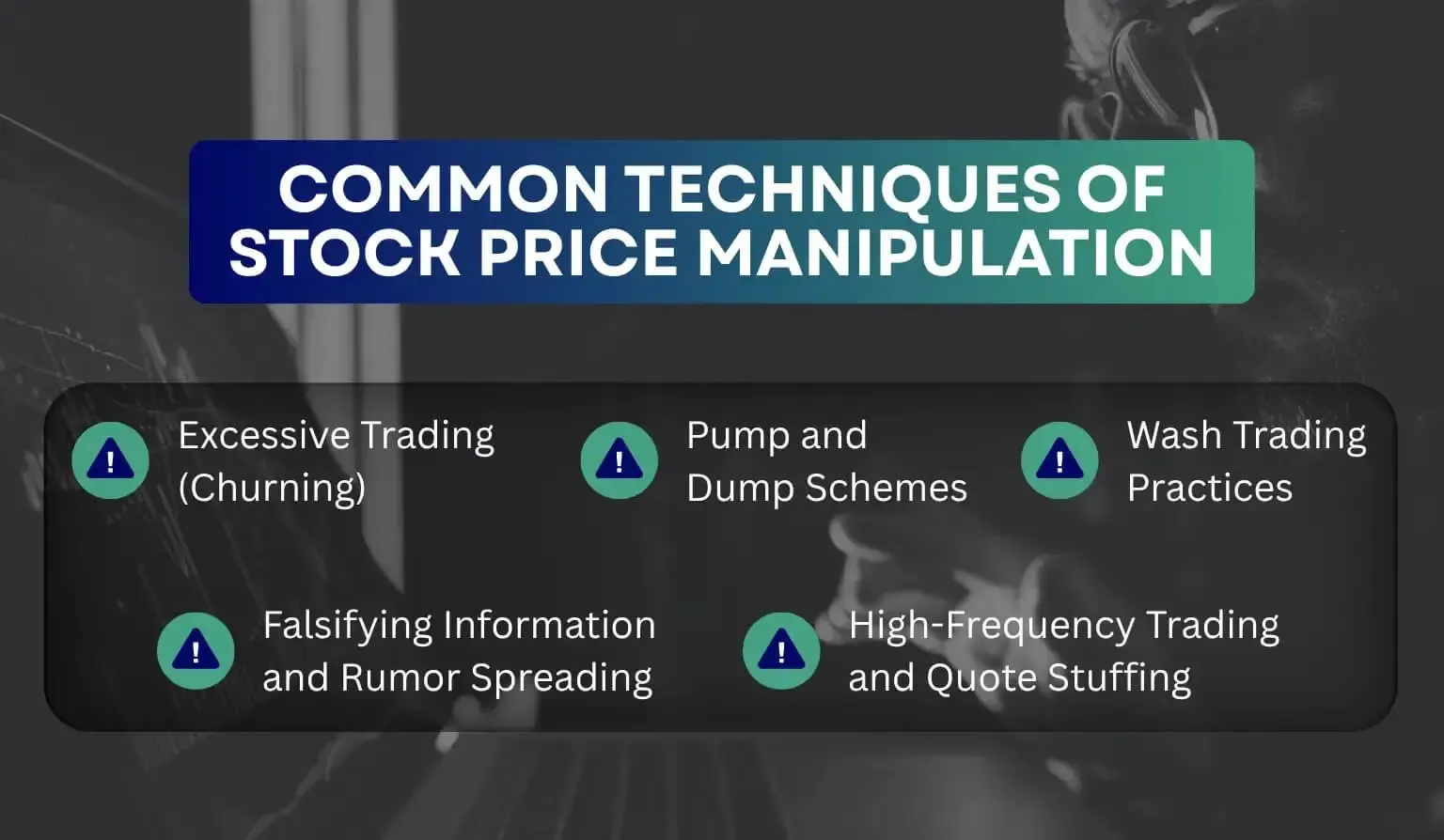
Excessive Trading (Churning) : Churning occurs when a broker excessively buys and sells securities for a client’s account to generate commissions, regardless of the client’s best interests. This can artificially inflate trading volume, misleading others about the stock’s popularity.
Pump and Dump Schemes : In these schemes, fraudsters buy shares of a stock, aggressively promote it (often with false or misleading information), and then sell their holdings at the inflated price.
For example, the SEC recently charged eight social media influencers in a $100 million scheme where they promoted stocks to their large followings on Twitter and Discord, then sold their shares when prices rose, without disclosing their intent to dump the securities.
Wash Trading Practices : Wash trading involves buying and selling the same security multiple times to create the illusion of active trading activity.
For example, Montgomery Street Research was accused by the SEC of conducting approximately 100 wash trades, where buy and sell orders were placed within 90 seconds of each other, at nearly identical prices and quantities, to make a rarely traded stock appear active and attractive to investors.
Falsifying Information and Rumor Spreading : Spreading false or misleading information about a company’s prospects is a classic manipulation tactic.
Activist short sellers, such as Andrew Left and his firm Citron Capital, have been charged by the DOJ and SEC for spreading sensationalized and false information to drive down stock prices, profiting from the resulting volatility.
High-Frequency Trading and Quote Stuffing : Although high-frequency trading (HFT) is legal, specific practices, such as quote stuffing—flooding the market with orders to create confusion or volatility—can be considered manipulative.
The SEC has increased scrutiny of these practices, especially in thinly traded or microcap stocks.
Case Studies of Stock Price Manipulation
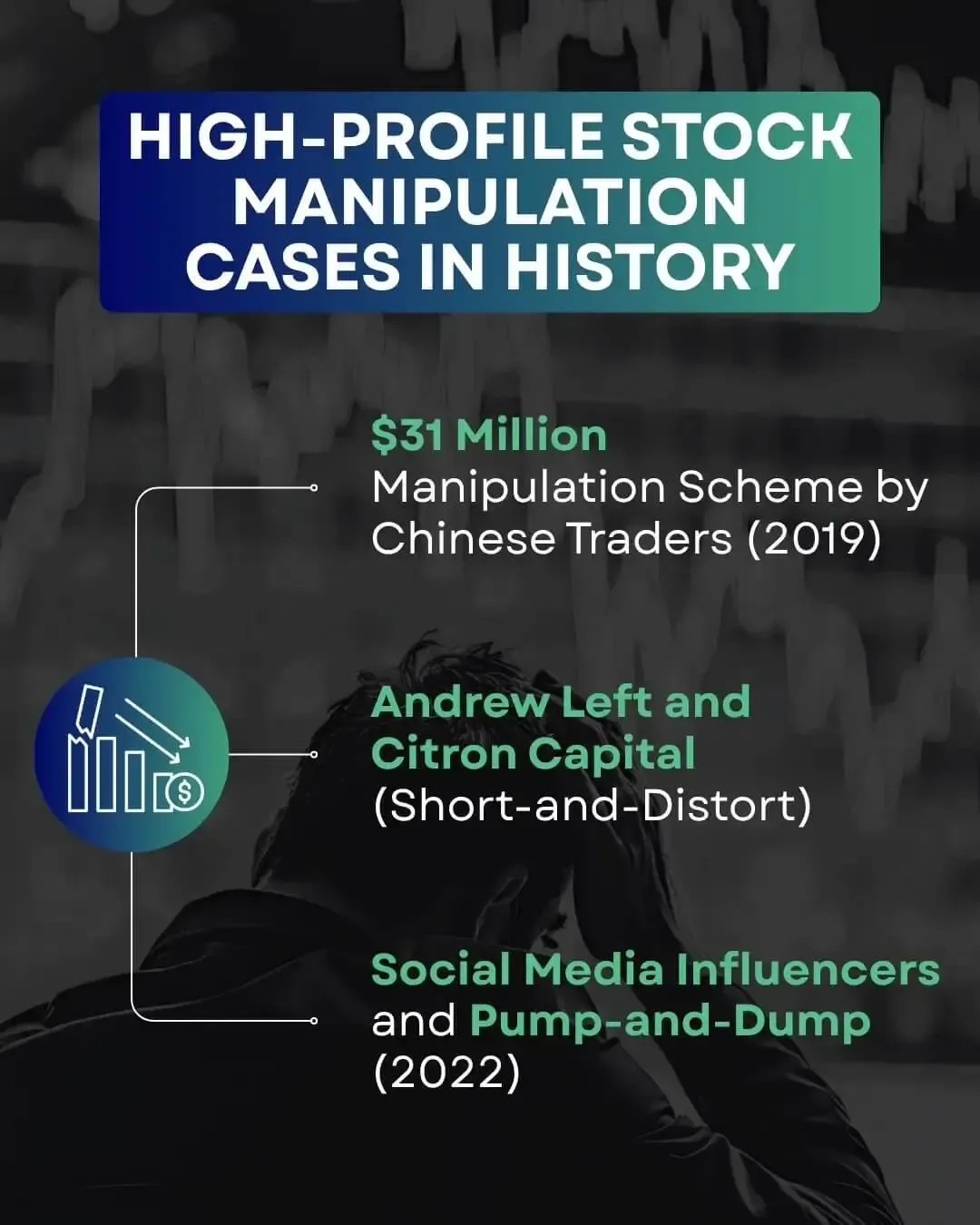
High-profile Manipulation Cases in History [2]
- $31 Million Manipulation Scheme by Chinese Traders (2019): The SEC charged 18 traders, primarily based in China, with manipulating over 3,000 U.S.-listed securities for more than $31 million in illicit profits.
The traders used multiple accounts to place small sell orders to drive down prices, buy at artificially low prices, then put small buy orders to push prices up before selling at inflated prices.
This sophisticated operation created a false appearance of trading interest and activity, misleading other market participants and enabling the traders to profit at their expense. - Andrew Left and Citron Capital (Short-and-Distort): Andrew Left, and his firm, Citron Capital, have faced regulatory scrutiny and lawsuits alleging they spread misleading information as part of short-selling campaigns.
The complaint alleged that Left and his firm, Citron Capital, spread sensationalized and false information about targeted companies, causing significant volatility in their stock prices.
The SEC brought parallel civil charges, accusing Citron of orchestrating a $20 million market manipulation scheme.
The case highlights the risks posed by “short-and-distort” campaigns, where short sellers profit by spreading misinformation to drive down stock prices. - Social Media Influencers and Pump-and-Dump (2022): The SEC charged eight individuals in a $100 million securities fraud scheme.
Seven of the defendants promoted themselves as successful traders on Twitter and Discord, encouraged their followers to buy specific stocks, and then sold their shares when prices rose, without disclosing their intention to sell the securities.
This modern twist on the classic pump-and-dump scheme leveraged social media to manipulate thousands of investors.
Analyzing the Impact on Market Stability
Market manipulation erodes trust in financial markets. It can lead to abrupt price swings, increased volatility, and misallocation of capital.
For example, the manipulation of thinly traded stocks by Chinese traders not only harmed individual investors but also disrupted the broader market, making it harder for legitimate companies to raise capital and for investors to make informed decisions.
Consequences for Companies and Investors
Companies targeted by manipulative schemes often suffer reputational damage, loss of investor confidence, and regulatory scrutiny.
Investors who buy into manipulated stocks risk significant financial losses, especially if they are unaware of the artificial price movements.
Enforcement actions against manipulators, such as those taken by the SEC and DOJ, aim to recover illicit profits and deter future misconduct.
Preventing Stock Price Manipulation
Regulatory Measures by Financial Institutions
The SEC and FINRA use advanced surveillance tools and data analytics to detect suspicious trading patterns.
The SEC’s Market Abuse Unit, for example, investigates false or misleading statements on securities prices, insider trading, manipulative trading schemes, and other abusive practices.
The agency also coordinates with other law enforcement bodies, such as the DOJ and FBI, to pursue criminal charges when appropriate.
Best Practices for Investors and Traders
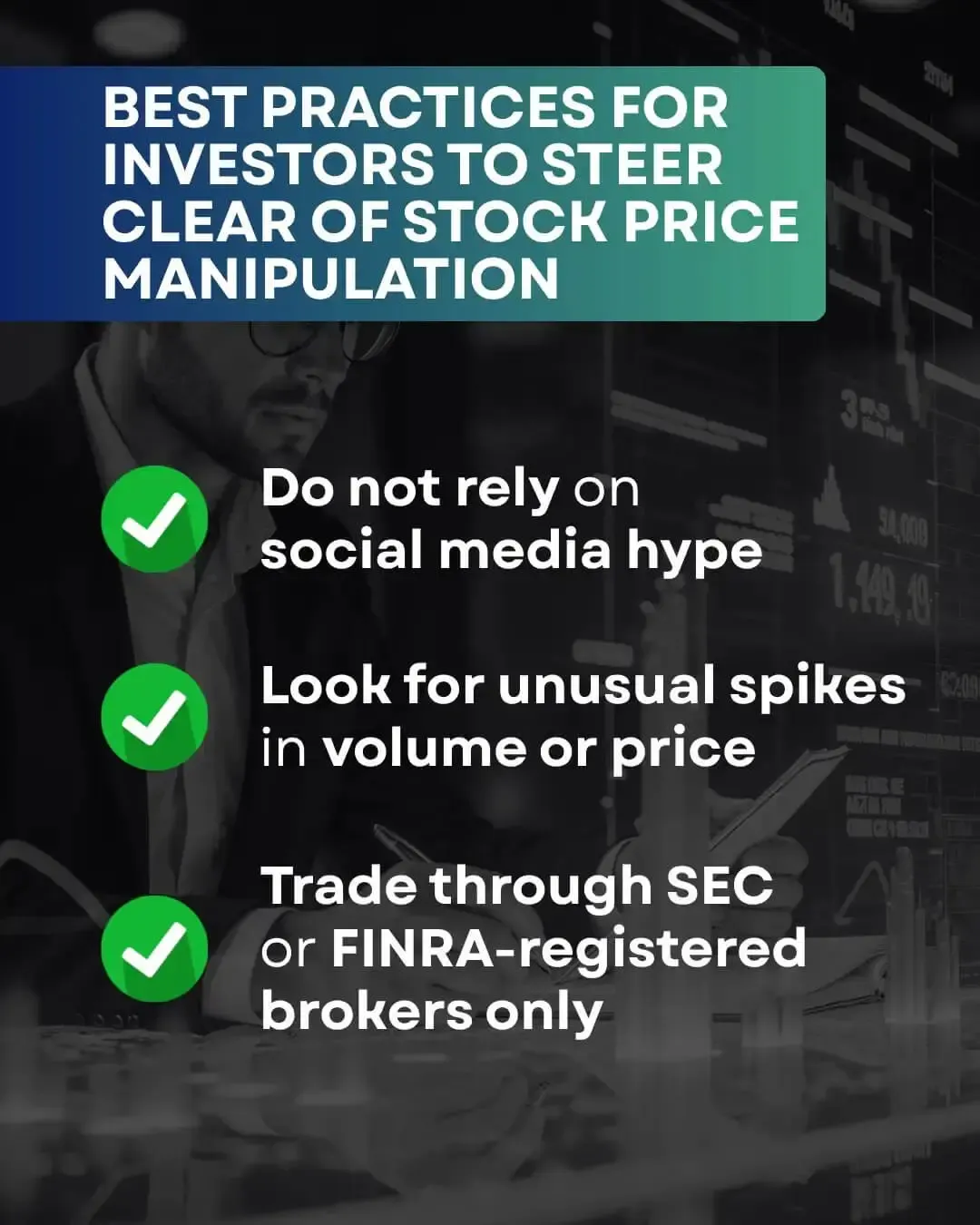
Investors should:
- Conduct thorough research: Avoid relying on unsourced information or social media hype.
- Monitor trading patterns: Look for unusual spikes in volume or price without corresponding news.
- Use reputable brokers: Ensure brokers are registered with the SEC or FINRA.
The Importance of Transparency and Disclosure
Transparency is essential for market integrity. Companies must disclose material information promptly and accurately, and regulators must enforce disclosure requirements to prevent manipulation.
Impact on Investor Confidence and Market Health
How Manipulation Affects Individual Investors
Individual investors are often the most vulnerable to manipulation. They may lack the resources or expertise to detect fraudulent schemes, making them susceptible to pump-and-dump or churning schemes.
The social media influencer case is a prime example of how modern manipulators exploit the trust and naivety of retail investors.
The Broader Economic Implications
Market manipulation undermines the efficient functioning of markets, resulting in the mispricing of assets and an inefficient allocation of resources.
Over time, this can lead to reduced overall market participation and slower economic growth.
Taking Action Against Stock Price Manipulation
Whistleblower Protections and Reporting Mechanisms
The SEC’s whistleblower program incentivizes individuals to report securities violations by offering monetary rewards and protections against retaliation.
This has led to the detection of numerous cases of stock market manipulation.
Future of Market Regulation and Investor Protection
Advances in technology, such as machine learning and artificial intelligence, are enhancing regulators’ ability to detect manipulation in real time.
The SEC and other agencies are investing in sophisticated surveillance systems to identify suspicious trading patterns and respond more swiftly to threats.
Stock price manipulation is a serious threat to market integrity and investor confidence.
Regulatory bodies, such as the SEC and DOJ, play a critical role in detecting and prosecuting manipulative practices, while technological advances are enhancing their ability to identify and respond to these threats.
Investors must remain vigilant and informed to protect themselves from manipulation.
By fostering transparency, enforcing robust regulations, and leveraging cutting-edge technology, the financial industry can safeguard the interests of all market participants.
Disclaimer: The information provided in this blog is for general informational purposes only and does not constitute legal advice. Readers should not act or refrain from acting based on the information contained in this blog without consulting a qualified legal professional. Levi & Korsinsky LLP is not responsible for any actions taken or not taken based on the information provided in this blog.