![PubMatic, Inc. (PUBM) Securities Class Action Lawsuit Update [November 27, 2025]](https://dropinblog.net/cdn-cgi/image/fit=scale-down,format=auto,width=700/34260815/files/featured/pubm-alert-plus-banner.webp)

The Ad-Tech Headwind Investors Never Saw Coming
Caption: Hsu v. PubMatic, Inc., et al.
Case No.: 3:25-cv-07067
Jurisdiction: U.S. District Court, Northern District of California
Filed on: August 20, 2025
Class Period: February 27, 2025–August 11, 2025
Introduction
The digital advertising ecosystem, often promised as a machine of endless, automated growth, revealed its fragility in the securities class action lawsuit filed against PubMatic, Inc. (PUBM). This litigation, led by plaintiff Sidney Hsu in the United States District Court for the Northern District of California (Case No. 3:25-cv-07067), centers on a single, critical allegation: that the supply-side platform (SSP) concealed a material erosion of its business with a top partner during the Class Period of February 27, 2025, through August 11, 2025.
PubMatic’s positive public statements concerning its business operations and guidance allegedly masked the fact that a key Demand Side Platform (DSP) buyer was shifting a significant number of clients to a competing platform that evaluated inventory differently. The truth arrived after the market close on August 11, 2025, when the Company disclosed the unexpected headwind and issued drastically reduced guidance. Investors reacted with sudden, punitive force; the stock plummeted 21.1% the following day, wiping out substantial value. This case is a cautionary narrative about the inherent risk of concentration and the high stakes of transparency in the fluid, complex world of programmatic ad technology.

Backdrop and Business Context
PubMatic operates at a crucial nexus of the digital economy, providing an independent technology platform that enables real-time programmatic advertising transactions. In essence, it serves the sell-side of the industry, helping publishers monetize their digital inventory—whether video, mobile, or connected TV (CTV)—by connecting them to advertisers and their DSPs. This function positions PubMatic as a key player in the Supply Path Optimization (SPO) trend, where buyers seek the most direct and efficient route to quality inventory.
The Company frequently highlighted its success in high-growth areas, particularly CTV and its platform capabilities, suggesting a technological moat that would allow it to capture market share. CEO Rajeev Goel and CFO Steven Pantelick consistently framed the Company’s performance as exceeding expectations, assuring the market of "strong momentum" and "accelerated growth" expected for 2025. The narrative was one of robust resilience driven by secular tailwinds, a classic story for a tech growth stock on the NASDAQ.
Promises Made vs. Reality
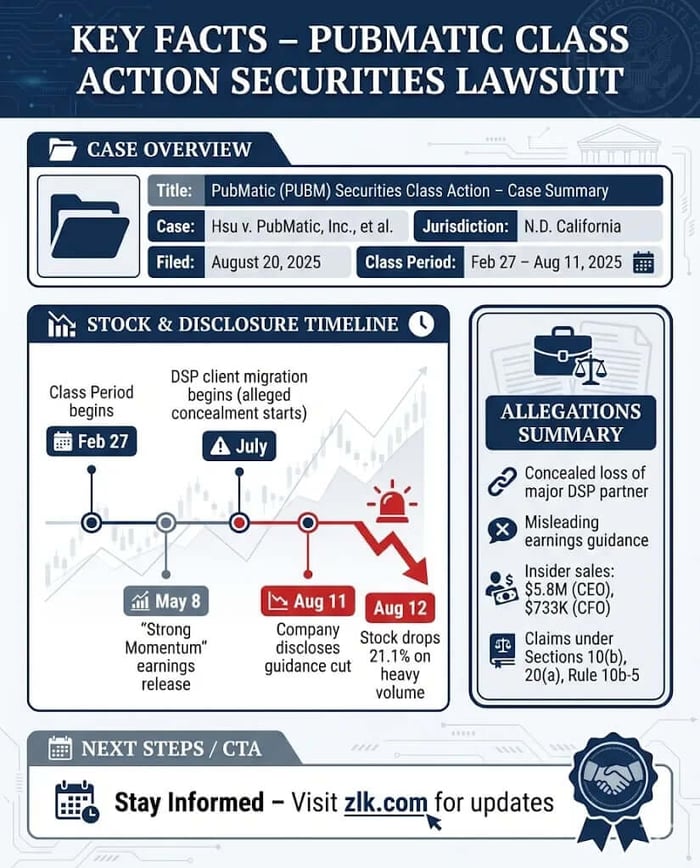
The chasm between management’s public pronouncements and the alleged internal reality forms the core of the complaint.
In their Q1 2025 earnings release on May 8, 2025, management touted performance "exceeding guidance," driven by "secular growth." Later, Rajeev Goel stated: “We delivered a strong second quarter, with revenue and adjusted EBITDA exceeding expectations. We added new publishers, streamers and ad buyers to the platform, continued to scale Activate and commerce media, and saw significant growth in sell side targeting.” CFO Pantelick reinforced this optimism, stating that based on the "strong momentum we are seeing," underlying revenues were expected to continue growing 15%+ in the second half of the year.
The reality, as belatedly disclosed on August 11, 2025, was one of material decay. The Company revealed that "a headwind emerge[d] from a top DSP buyer, which recently shifted a significant number of clients to a new platform that evaluates inventory differently." This was not a general macroeconomic tremor; it was a specific, named (though the partner remains anonymous in the complaint) operational hit that began in July 2025. The allegation is simple: by July, the core promise of sustained momentum was already broken by a known operational failure, a fracture the market was not allowed to see until the full quarter closed.
Timeline of Alleged Misconduct and Disclosures
The events unfolded quickly, tracing a classic sequence of optimistic statements followed by a devastating correction.
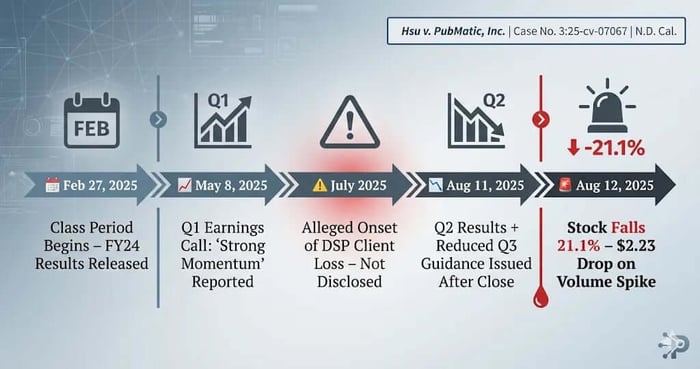
February 27, 2025: The Class Period begins. PubMatic provides FY 2024 results, reinforcing confidence in the business trajectory and internal controls.
May 8, 2025: Q1 2025 results are released, with management emphasizing "strong momentum" and high expectations for 15%+ growth in the second half of the year.
July 2025: Allegedly, the headwind from the top DSP buyer begins, as the partner shifts clients to a new, competing platform that evaluates inventory differently. This material adverse fact is, the suit contends, known internally but concealed from investors.
August 11, 2025: After market close, PubMatic reports Q2 results and, critically, issues Q3 guidance projecting revenue of only $61–66 million, an 8–15% year-over-year decline. Management explains the poor outlook by citing the abrupt shift by a "top DSP buyer."
August 12, 2025: The stock price falls $2.23, or 21.1%, on heavy volume, as investors quantify the damage from the lost partnership and the surprising reversal of growth expectations.

Investor Harm and Market Reaction
The lawsuit alleges that PubMatic’s failure to timely disclose the material operational headwind directly resulted in investor losses. The single-day market rout of August 12, 2025, was the definitive moment of loss causation, where the stock closed at $8.34 per share after a $2.23 drop.
The disclosure triggered an immediate repricing of PubMatic’s future. Prior to the news, analyst expectations were significantly higher; in the preceding months, price targets ranged up to $19.00. The day after the disclosure, the professional consensus dissolved. Scotiabank set a grim new target of $10.00, and B. Riley Securities dropped its target to $9.00. While some firms, like RBC Capital and JMP Securities, maintained "Outperform" ratings, they lowered their price targets to $11.00 and $12.00, respectively, demonstrating a tempered view of the Company's future trajectory. This was not simply a misfire on guidance; it was a crisis of confidence in management’s grasp of the business, or, more darkly, its willingness to share adverse facts.
Litigation and Procedural Posture
The class action complaint asserts claims under Sections 10(b) and 20(a) of the Securities Exchange Act of 1934 and Rule 10b-5 promulgated thereunder. These claims allege that the defendants—PubMatic, CEO Rajeev K. Goel, and CFO Steven Pantelick—made false and misleading statements and omissions concerning the Company’s operations and financial prospects.
A core element of any securities fraud claim is scienter, or the required state of mind, typically involving intent to deceive or severe recklessness. The complaint supports this by pointing to the timing of the adverse events (the DSP partner's shift in July 2025) and the delay in disclosure, arguing that the Individual Defendants, due to their executive positions, had access to highly material non-public information and knew, or were reckless in not knowing, that their prior positive statements were false and misleading. The scienter narrative is often bolstered by evidence of insider selling, and in this case, CEO Goel sold 575,382 shares for an estimated $5.8 million, and CFO Pantelick sold 69,929 shares for approximately $733,235 in the preceding six months. These sales, alleged to have occurred while the material truth was concealed, become a critical point of focus for plaintiffs’ counsel.
Shareholder Sentiment
Shareholder sentiment in the wake of the August 11 disclosure reflected a deep sense of betrayal mixed with analytical second-guessing.
Before the fall, the retail sentiment, particularly on platforms like X/Twitter, was generally optimistic, captivated by the Company’s focus on high-growth areas like CTV and AI-driven products. The stock was often discussed as an undervalued “pure-play” in ad-tech.
The post-disclosure reaction was immediate and visceral: the stock "took a swan dive." The subsequent conversations on investor forums were less about the Q2 beat and entirely focused on the "muted third-quarter outlook" and the “significant amount of business” lost to the unnamed client. A curious strain of debate emerged—the suggestion that management was “sandbagging its guidance again.” This reflection, however, offered little comfort to those who endured the 21.1% loss, with some investors concluding the stock had become a “falling knife” despite the long-term case. The volatility was a clear manifestation of investor confidence being abruptly exchanged for fundamental uncertainty.
Analyst Commentary
The professional analyst community swiftly recalibrated its view of PubMatic following the August 11, 2025, warning. The shift was less a downgrade of the technology and more a downgrade of management's near-term visibility and credibility.
Before the disclosure, the consensus was firmly entrenched in the growth narrative. Analysts from Lake Street and RBC Capital held price targets in the mid-to-high teens. The Company was consistently lauded for its focus on SPO and CTV expansion.
Immediately following the guidance miss, the reaction was brutal, albeit measured. While some firms maintained positive ratings (like RBC’s "Outperform"), nearly every major bank slashed its price target. The new targets fell into a narrow, low range of $9.00 to $12.00. The narrative shifted from "growth story" to "value play with near-term headwinds." The most direct judgment came in mid-August, when one analyst explicitly advised investors to "Avoid This Stock, As Cheap Alone Won't Cut It," signaling a loss of faith in the underlying growth thesis despite the stock’s now-lower valuation. The sudden, collective lowering of expectations underscores the material nature of the concealed operational problem.
SEC Filings & Risk Factors
SEC filings, particularly the Form 10-K, offer a roadmap of generic risks, which often become material facts in class action litigation. The lawsuit against PubMatic forces a review of whether its boilerplate risk factors adequately prepared investors for the specific, realized loss.
PubMatic’s 10-K acknowledged, as all ad-tech companies must, the volatile nature of the ecosystem. It cited risks related to platform functionality, algorithmic changes, and the ability to maintain relationships with key partners. Crucially, the issue at the heart of the lawsuit—a major DSP partner changing its inventory evaluation approach and shifting clients—is the literal crystallization of the general risk that the Company’s partners could alter their technology or relationships in a way detrimental to revenue.
The core legal argument is not that the risk wasn't mentioned, but that once the risk materialized—allegedly by July 2025, when the revenue reduction began—the Company ceased to be covered by the safe harbor protection. Management’s continued positive guidance in the face of this known, materialized headwind transforms a generic risk into a material, actionable omission in its public filings and earnings statements.
Conclusion: Implications for Investors
The PubMatic securities class action provides a stark, crucial lesson for investors in the dynamic, often opaque programmatic advertising sector. The core takeaway centers on the risk of concentration of demand and the difficulty of gauging the true operational health of SSPs.
Investors should learn to focus less on broad, high-level metrics and more on the qualitative disclosures regarding partner relationships. A company’s reliance on a "top DSP buyer" is an immense source of non-diversified risk. When platform-specific issues arise—such as a partner changing its evaluation algorithm—the company’s platform integrity, which management consistently touts as a competitive advantage, is immediately compromised.
The ultimate implication here is that in the programmatic landscape, the technology and the business relationships are inseparable. When management, like that of PubMatic (namely Rajeev K. Goel and Steven Pantelick), is alleged to have masked a material relationship breakdown while continuing to sell shares and tout growth, the market’s trust dissolves. This case serves as a loud warning: in ad-tech, a single, unmitigated platform shift can unravel an entire growth narrative, and when that unraveling is alleged to have been concealed, the resulting litigation is not just a legal matter; it is a reckoning.
Disclaimer: This shareholder alert is for informational purposes only and does not constitute legal advice. Consult a qualified attorney for personalized guidance. No specific outcomes are guaranteed.
![Alexandria Real Estate Equities, Inc. (ARE) Securities Class Action Lawsuit Update [December 19, 2025]](https://dropinblog.net/cdn-cgi/image/fit=scale-down,format=auto,width=700/34260815/files/featured/are-alert-plus-banner.webp)
![F5, Inc. (FFIV) Securities Class Action Lawsuit Update [December 22, 2025]](https://dropinblog.net/cdn-cgi/image/fit=scale-down,format=auto,width=700/34260815/files/featured/ffiv-alert-plus-banner.webp)
![Sprouts Farmers Market, Inc. (SFM) Securities Class Action Lawsuit Update [December 19, 2025]](https://dropinblog.net/cdn-cgi/image/fit=scale-down,format=auto,width=700/34260815/files/featured/sfm-alert-plus-banner.webp)