
Securities fraud is an example of an illegal corporate action and is a pervasive threat that undermines the stability of financial markets and the confidence of investors worldwide.
By manipulating information, concealing crucial facts, or engaging in deceptive practices, individuals and organizations can inflict significant financial harm, not only on direct victims but also on the broader economy.
High-profile scandals, such as those involving Enron, WorldCom, and Adelphia Communications, have revealed the far-reaching consequences of securities fraud.
Understanding the nature, risks, and impact of these fraudulent schemes is crucial for investors, regulators, and all parties involved in the financial system.
What is Securities Fraud?
Securities fraud encompasses a wide range of deceptive practices that undermine the integrity of the financial markets and erode investor trust.
At its core, securities fraud involves the use of false or misleading information, or the concealment of material facts, to influence investment decisions for unlawful personal gain.
This type of fraud can be perpetrated by individuals, companies, or financial professionals, and it can take many forms, ranging from insider trading to market manipulation and false financial reporting.
Importantly, securities fraud can be addressed through both criminal and civil legal actions, each with distinct processes and consequences.
Securities Fraud as a Crime
Prosecuted by government authorities, such as the Department of Justice (DOJ) or state attorneys general, this requires proof beyond a reasonable doubt.
Convictions can lead to imprisonment, substantial fines, and court-ordered restitution to victims. Examples include large-scale Ponzi schemes, insider trading, and deliberate falsification of financial statements.
Securities Fraud as a Civil Action
Regulatory agencies, such as the Securities and Exchange Commission (SEC), and private parties like investors can bring forth actions seeking compensation. In these cases, the standard of proof is lower, requiring only a preponderance of the evidence.
Penalties for violations typically include monetary damages, disgorgement of ill-gotten gains, and injunctions aimed at preventing future violations. The SEC frequently initiates civil enforcement actions to protect investors and ensure the integrity of our fair markets.
Elements of Securities Fraud
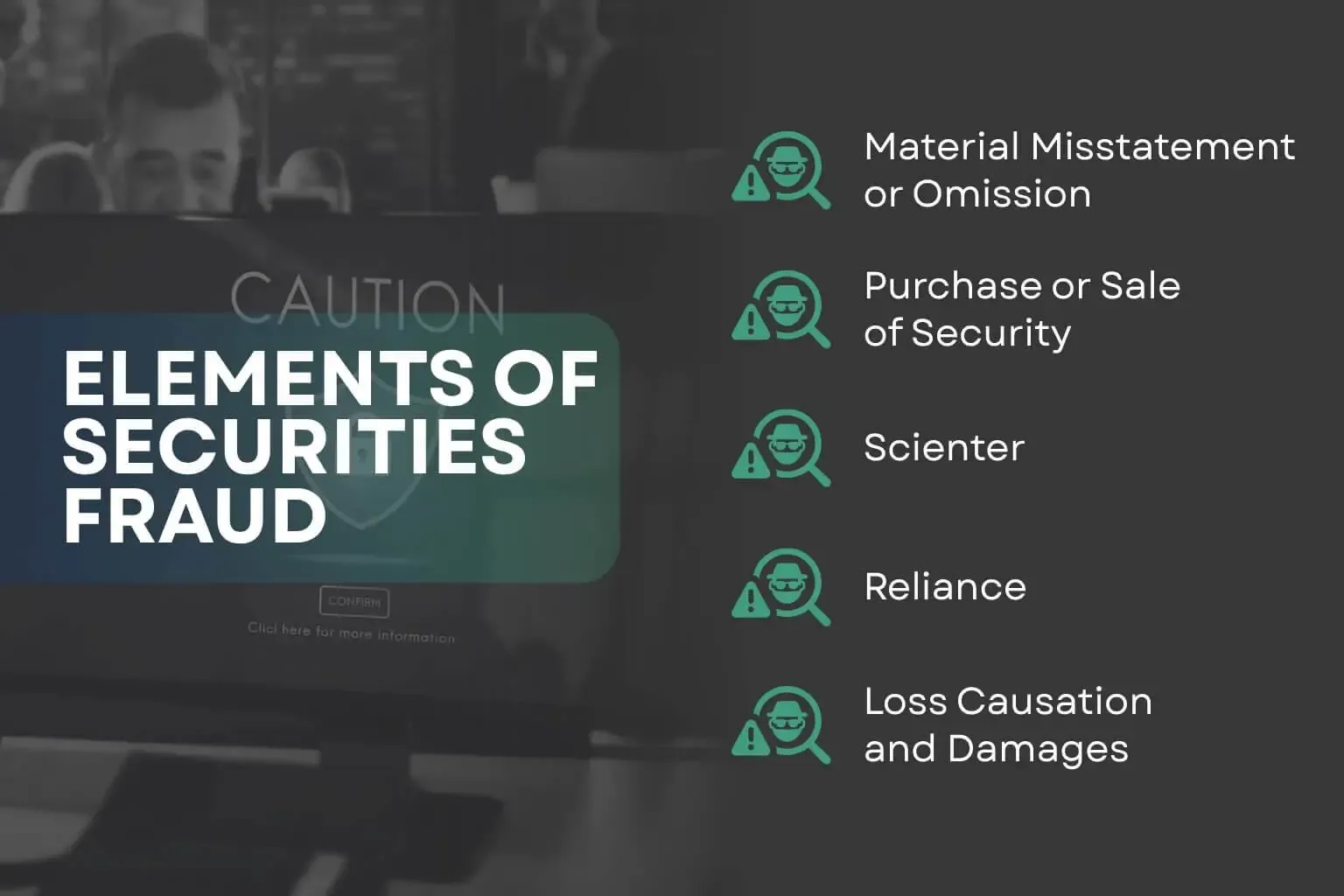
Purchase or Sale of Security: A connection between the misrepresentation or omission and the plaintiff’s purchase or sale of a security.
Material Misstatement or Omission: The defendant provided material untrue statements, data, or made omissions leading to misstatements.
Materiality: The misrepresentation and/or omission must be material, or in other words, that a reasonable buyer or seller of the security would consider that information important.
Intention: An intent to deceive, manipulate, or defraud (that is, with scienter).
Reliance: The plaintiff relied on the misstatement, false information or omission in connection with their decisions to buy or sell the security.
Causality and Actual Damage: There is a causal connection between the material misrepresentation or omission and the plaintiff’s economic loss.
Legal Framework
The Securities Act of 1933 and the Securities Exchange Act of 1934 established the legal foundation for regulating securities fraud in the United States.
Specifically, SEC Rule 10b-5 makes it unlawful to defraud, make untrue statements of material fact, or omit material facts in connection with the purchase or sale of any security.
As the primary federal agency, the SEC is responsible for enforcing securities laws and protecting investors from fraudulent activities.
Famous Examples of Securities Fraud
History is replete with examples of various types of securities fraud. Securities fraud has taken many forms over the past decade, with several high-profile cases leaving a lasting mark on financial regulation and investor confidence. The following cases stand out for their scale, complexity, and the lessons they offer:
1. Enron Scandal (2001)
The Enron scandal stands as one of the most notorious examples of corporate fraud in American history.
Enron, once a highly regarded energy company, engaged in a complex scheme to hide billions of dollars in debt and artificially inflate its stock price. Executives used off-the-books partnerships, known as special purpose entities (SPEs), and accounting loopholes to obscure the company’s true financial condition from investors and regulators.
As details of the fraud emerged in late 2001, Enron’s stock price plummeted from over $90 to less than $1, erasing billions in shareholder value and employee pensions.
The scandal led to criminal convictions for top executives, the dissolution of Arthur Andersen, its accounting firm, and the enactment of the Sarbanes-Oxley Act to strengthen corporate oversight and financial reporting standards.
2. Tyco International
Tyco International unravelled under the weight of a massive corporate theft orchestrated by its CEO, Dennis Kozlowski, and CFO, Mark Swartz.
The executives looted the company of hundreds of millions of dollars through unauthorized bonuses, art purchases, and lavish personal expenses, all of which were concealed from shareholders and the board.
Their fraudulent activities eventually came to light, resulting in criminal convictions and substantial financial penalties.
3. Adelphia Communications
Adelphia Communications crumbled due to a family affair gone wrong, with the Rigas family embezzling over $2.3 billion from the company.
The Rigases hid company debts by co-mingling personal and corporate finances and used company funds to pay for luxury homes, a golf course, and other personal expenses.
The fraud led to the company’s bankruptcy and criminal convictions for several family members.
4. WorldCom
WorldCom orchestrated massive accounting fraud by misclassifying $3.8 billion in operating expenses as capital expenditures.
This manipulation made the company’s financial statements appear far healthier than they were, misleading investors and analysts.
The fraud, uncovered in 2002, led to what was then the largest bankruptcy in U.S. history, resulted in criminal convictions for top executives, and prompted significant reforms in corporate governance and financial reporting.
These cases not only resulted in devastating financial losses for investors and employees but also prompted significant regulatory reforms and stricter enforcement to help prevent similar frauds in the future.
Reporting Securities Fraud
Securities fraud undermines investor confidence and market integrity, making effective reporting mechanisms essential for enforcement and prevention.
The U.S. Securities and Exchange Commission (SEC) plays a central role in receiving, investigating, and acting on reports of securities fraud, often in coordination with other regulatory and law enforcement agencies. The SEC investigates violations like false disclosures ( Securities Act of 1933) and market manipulation (Rule 10b-5). Whistleblowers can report anonymously.
How to Report Securities Fraud
Contacting the SEC: Investors and members of the public who suspect securities fraud, such as insider trading, Ponzi schemes, market manipulation, or false financial disclosures, can report their concerns directly to the SEC.
Suspected securities fraud can be submitted online through the SEC’s Tips, Complaints, and Referrals (TCR) system, by mail, fax, or phone. The SEC’s Office of Investor Education and Advocacy also provides resources and guidance for victims of securities law violations.
Other Reporting Channels:
In addition to the SEC, individuals can report suspected fraud to:
Financial Industry Regulatory Authority (FINRA), particularly in cases involving misconduct by brokers or brokerage firms.
State securities regulators, who may have jurisdiction over certain investment products or local matters.
Law enforcement agencies, such as the FBI or the Department of Justice, are mainly involved if the fraud involves criminal conduct. The FBI works with the SEC on cases involving bank fraud, embezzlement, and insider trading. In Adelphia’s case, the DOJ prosecuted the Rigas family for securities and bank fraud, highlighting the importance of interagency cooperation.
SEC Whistleblower Program
Incentives and Protections: The SEC Whistleblower Program, established under the Dodd-Frank Act, encourages individuals to report potential securities law violations by offering monetary awards and strong protections against retaliation. Whistleblowers who provide original, timely, and credible information that leads to successful enforcement actions may be eligible to receive awards.
Confidentiality: The SEC is committed to maintaining the confidentiality of whistleblowers. Reports can be made anonymously if submitted through an attorney, and the SEC strictly prohibits retaliation against individuals who report violations.
Scope of Violations: The SEC investigates a wide array of misconduct, including but not limited to Ponzi schemes, insider trading, accounting fraud, market manipulation, and false or misleading statements in SEC filings.
Legal Assistance in Securities Fraud
Victims of securities fraud often face complex legal and financial challenges. Accessing the right resources and professional guidance is essential for recovering losses and holding wrongdoers accountable. Multiple avenues exist for legal assistance, and regulatory agencies provide crucial support throughout the process.
Legal Assistance Options for Victims
Regulatory Agency Support: The Securities and Exchange Commission (SEC) offers resources to help victims understand their rights and available remedies.
The SEC may recover funds from fraudsters through enforcement actions and distribute them to harmed investors via Fair Funds or disgorgement plans. Information about these distributions is available through the SEC’s Office of Distributions.
Class Actions and Private Lawsuits: In addition to SEC actions, victims may participate in private class action lawsuits brought on behalf of all harmed investors. These civil suits are separate from regulatory enforcement and may provide another path for compensation.
Brokerage Account Protection: Investors may have protections through the Securities Investor Protection Corporation ( SIPC) if their brokerage firm fails financially. The Customer Protection Rule also helps safeguard customer assets held by broker-dealers.
Corporate Bankruptcy Proceedings: If a public company files for bankruptcy due to fraud, investors may have claims through the bankruptcy process. The SEC and bankruptcy courts provide guidance on how to file claims and what to expect in such proceedings.
Role of Legal Professionals
Accountability for Brokers and Advisors: Licensed attorneys and regulated professionals play a crucial role in holding brokers, investment advisors, and firms accountable for misconduct.
Legal professionals can help victims navigate arbitration or mediation (such as through FINRA), file lawsuits, or negotiate settlements to recover losses.
Guidance Through Complex Proceedings: Securities fraud cases often involve complicated financial transactions and legal standards.
Attorneys experienced in securities law can advise victims on the best course of action, represent them in regulatory or civil proceedings, and help ensure compliance with deadlines and procedural requirements.
At Levi & Korsinsky, LLP, we specialize in legal counsel for investor class action lawsuits, representing shareholders who have suffered financial losses due to securities fraud, corporate misconduct, and deceptive investment practices.
With over 80 collective years of experience, our experienced attorneys are on hand to provide you with the support and legal expertise you need to maximize your recovery.
Importance of Consulting Licensed and Regulated Professionals
Avoiding Further Victimization: The SEC and the Federal Trade Commission warn that fraud victims can be targeted again by asset recovery scams or unlicensed individuals promising to recover lost funds for a fee.
It is crucial to collaborate only with attorneys and professionals who are appropriately licensed and regulated by their respective state bars or recognized regulatory bodies.
Accessing Trusted Resources: The SEC, FINRA, and FBI offer resources and referrals for victims seeking legal and emotional support.
The FINRA Investor Education Foundation provides guides and checklists to help victims protect themselves and pursue recovery.
Prevention and Detection
Recognizing the warning signs of securities fraud is critical for protecting your investments. Fraudsters often use sophisticated tactics to lure investors, but certain red flags consistently appear across fraudulent schemes.
Regulatory agencies such as the SEC, FINRA, and state securities regulators emphasize vigilance and scrutiny before committing to any investment.
Common Red Flags of Securities Fraud ![]()
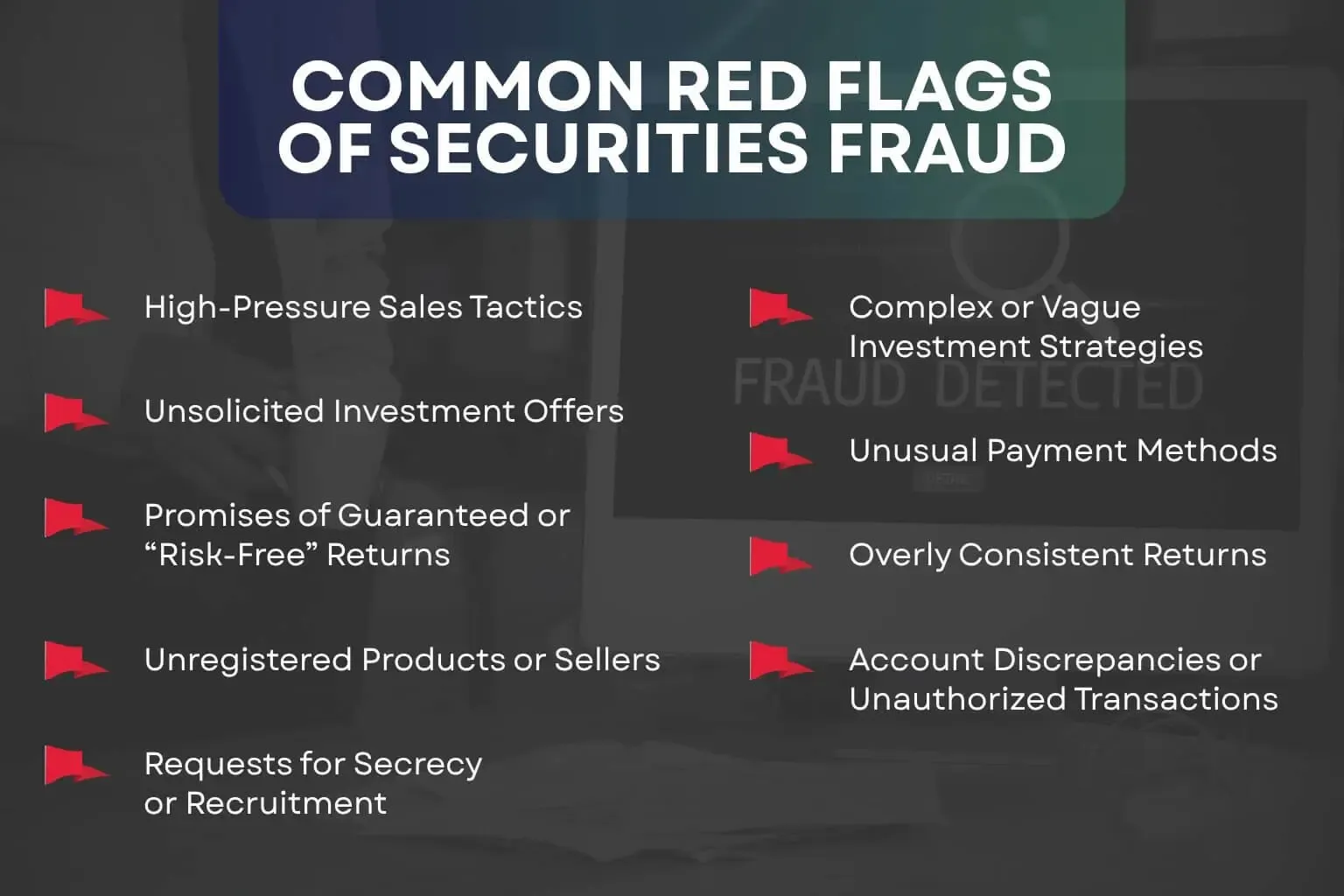
- High-Pressure Sales Tactics: Be wary of anyone urging you to invest immediately or discouraging you from seeking advice. Pressure to make quick decisions is a hallmark of many scams.
- Unsolicited Investment Offers: Unsolicited calls, emails, or messages, especially those promising exclusive or time-sensitive opportunities, should be treated with skepticism. Scammers often use cold contacts to target potential victims.
- Promises of Guaranteed or “Risk-Free” Returns: Any claim of high, consistent, or “guaranteed” returns with little or no risk is a major red flag. All investments carry some level of risk, and legitimate professionals will not promise otherwise.
- Unregistered Products or Sellers: Fraudulent investments often involve products or sellers not registered with the SEC or other regulatory bodies. Always verify the registration of both the investment and the person offering it using official resources, such as Investor.gov.
- Requests for Secrecy or Recruitment: If you are asked to keep the investment confidential or to recruit friends and family, exercise extreme caution. Legitimate investments do not require secrecy or personal recruitment.
- Complex or Vague Investment Strategies: Be cautious of investments that are difficult to understand or are explained using overly complex jargon. If the professional cannot clearly explain how the investment works, it may be a scam.
- Unusual Payment Methods: Requests to pay for investments via credit card, gift card, wire transfer, or to a personal account are strong indicators of potential fraud.
- Overly Consistent Returns: Investments that claim to deliver steady, positive returns regardless of market conditions should be viewed with suspicion. Even the most stable investments experience some volatility.
- Account Discrepancies or Unauthorized Transactions: Regularly review your account statements for unauthorized trades, missing funds, or other discrepancies. These may be signs of churning or outright fraud.
How to Protect Yourself
- Ask Questions and Do Your Research: Thoroughly investigate any investment opportunity. Use official resources such as Investor.gov to check the registration and disciplinary history of investment professionals.
- Report Suspicious Activity: If you suspect fraud, contact the SEC, FINRA, or your state securities regulator immediately.
- Trust Your Instincts: If an investment sounds too good to be true, it probably is. Take your time, seek independent advice, and never let anyone rush your decision.
Financial Fraud and Its Impact
Securities fraud has consequences that extend well beyond individual investors. Major scandals, such as Adelphia’s collapse and WorldCom’s bankruptcy, have demonstrated how such fraud can erode confidence in entire markets and impact the broader economy.
Key impacts include:
- Direct investor losses: Victims can lose significant sums, sometimes their entire investments, when fraudulent schemes collapse.
- Erosion of market trust: High-profile frauds undermine public confidence, making investors hesitant to participate in the markets.
- Regulatory response: Widespread fraud leads to increased scrutiny and stricter regulations, resulting in higher compliance costs for businesses.
- Broader economic harm: Fraud can distort market prices and reduce the flow of capital, ultimately slowing economic growth.
Disclaimer: The information provided in this blog is for general informational purposes only and does not constitute legal advice. Readers should not act or refrain from acting on any of the information contained in this blog without consulting a qualified legal professional. Levi & Korsinsky LLP is not responsible for any actions taken or not taken based on the information provided in this blog.