
Securities litigation is a critical area of legal practice that addresses disputes arising from violating of securities laws, corporate misconduct, and investor protections.
This guide examines key aspects of securities litigation, including common case types, regulatory frameworks, risk mitigation strategies, and recent trends.
Overview of Securities Litigation
Securities litigation is a specialized domain of law that addresses disputes arising from issuing, purchasing, and selling securities such as stocks and bonds.
These cases often involve significant financial stakes and can have far-reaching implications for corporations, investors, and markets.
Securities litigation frequently centers on securities fraud allegations, fiduciary duty breaches, and corporate misconduct.
Trigger events include public offerings, mergers and acquisitions, and disputes over financial reporting.
The regulatory framework for these cases is primarily shaped by the Securities Act of 1933 and the Securities Exchange Act of 1934, both of which are enforced by the U.S. Securities and Exchange Commission (SEC).
Types of Securities Litigation
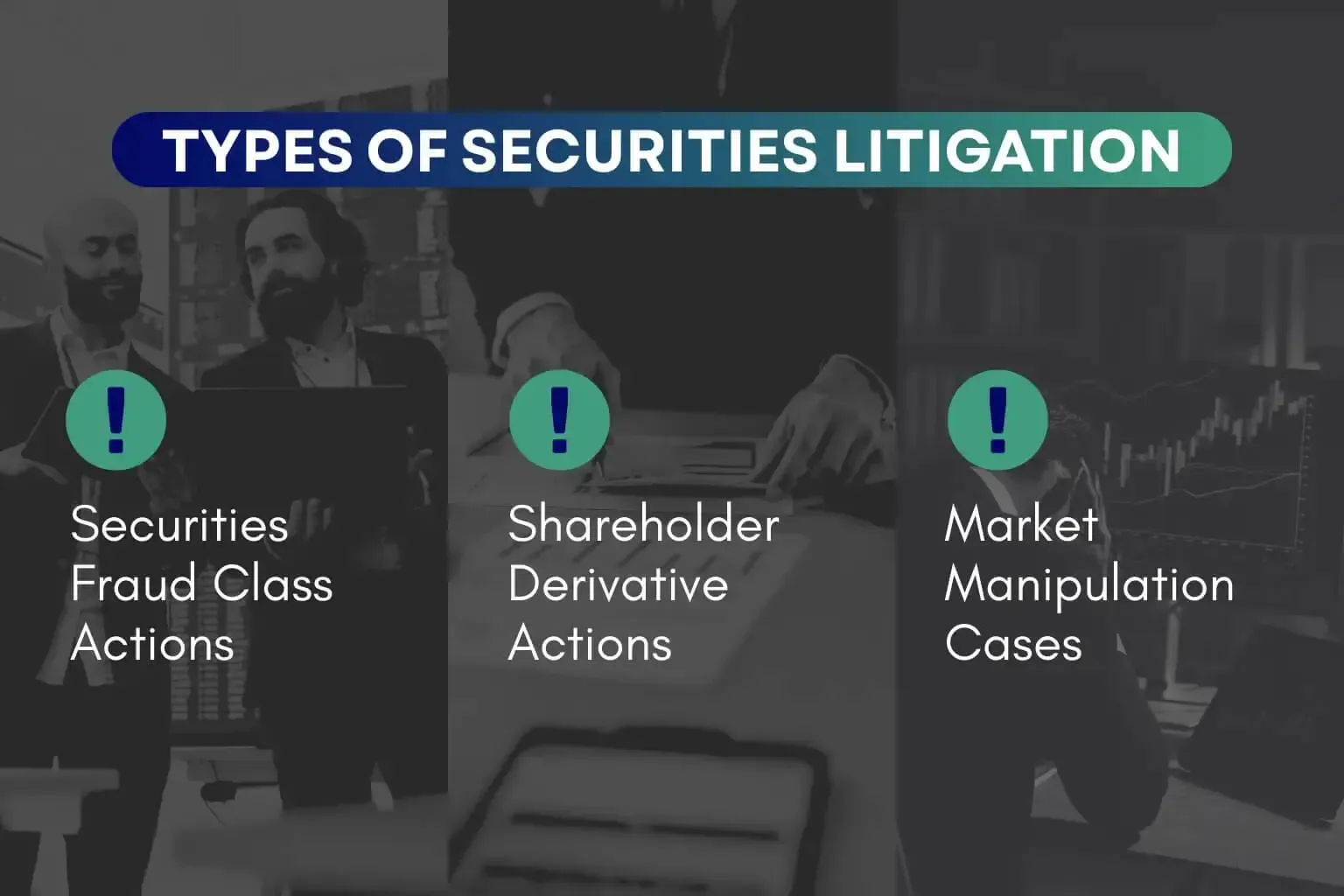
1. Securities Fraud Class Actions
Securities fraud class actions are among the most common and high-profile forms of securities litigation.
Groups of investors file these lawsuits, claiming that a firm or its officials made false or misleading claims about the company's financial situation or prospects, which led to losses for the investors when the reality came to light.
For instance, the 2001 Enron scandal led to one of the most significant securities class actions in U.S. history, resulting in billions of dollars in settlements for defrauded shareholders. Such cases often follow SEC investigations, whistleblower reports, or the restatement of financial results.
2. Shareholder Derivative Actions
Shareholder derivative actions are lawsuits filed by shareholders on behalf of the company itself, typically against corporate executives or board members accused of misconduct that harms the company’s value.
These cases seek to hold insiders accountable for breaches of fiduciary duty, self-dealing, or failure to oversee compliance.
For example, in 2020, Boeing faced a derivative lawsuit alleging that its board failed to properly oversee the development of the 737 MAX, resulting in catastrophic losses for the company and its investors.
3. Market Manipulation Cases
Market manipulation cases involve illegal trading practices such as insider trading, wash sales, or artificially inflating stock prices.
One notable example is the prosecution of Raj Rajaratnam, the founder of Galleon Group, who was convicted of insider trading in 2011 after a high-profile investigation by the SEC and the Department of Justice. Such cases can result in severe financial penalties and regulatory sanctions.
4. Corporate Governance and Securities Litigation
Strong corporate governance is a critical defense against securities litigation. Companies implementing robust disclosure controls, transparent financial reporting, and effective compliance programs are less likely to face lawsuits or regulatory action.
Board members and executives have a fiduciary duty to act in the best interests of shareholders, and failure to do so can expose them to personal liability. The SEC has emphasized the importance of governance in preventing fraud and ensuring market integrity.
5. Market Manipulation and Securities Litigation
Market manipulation undermines investor confidence and market efficiency. Common schemes include insider trading (trading based on non-public, material information), pump-and-dump schemes (artificially inflating stock prices before selling), and spoofing (placing deceptive orders to create false demand).
The Securities Exchange Act of 1934 prohibits such conduct, and violations can lead to federal prosecution and civil lawsuits.
The SEC’s case against Michael Coscia, who was convicted of spoofing commodities markets, illustrates the legal risks of market manipulation.
6. Delaware Courts and Securities Litigation
Delaware is the legal home to many U.S. corporations, making its courts central to securities litigation. The Delaware Court of Chancery is renowned for its expertise in handling shareholder derivative actions and governance disputes.
Its judges are recognized for their business acumen and efficient case management, making Delaware a preferred venue for resolving complex securities cases.
For example, the court’s decision in In re Walt Disney Co. Derivative Litigation set important precedents on director fiduciary duties.
7. District Courts and Securities Litigation
Federal district courts oversee most securities class actions and shareholder derivative lawsuits. They have the authority to grant summary judgments, resolving cases without a full trial when no disputed facts exist.
Judges can also impose sanctions for frivolous or abusive litigation, helping maintain the legal process's integrity.
The 2014 Supreme Court decision in Halliburton Co. v. Erica P. John Fund, Inc. clarified the standards for class certification in securities fraud cases, reinforcing the role of federal courts in shaping securities law.
Best Law Firms for Securities Litigation
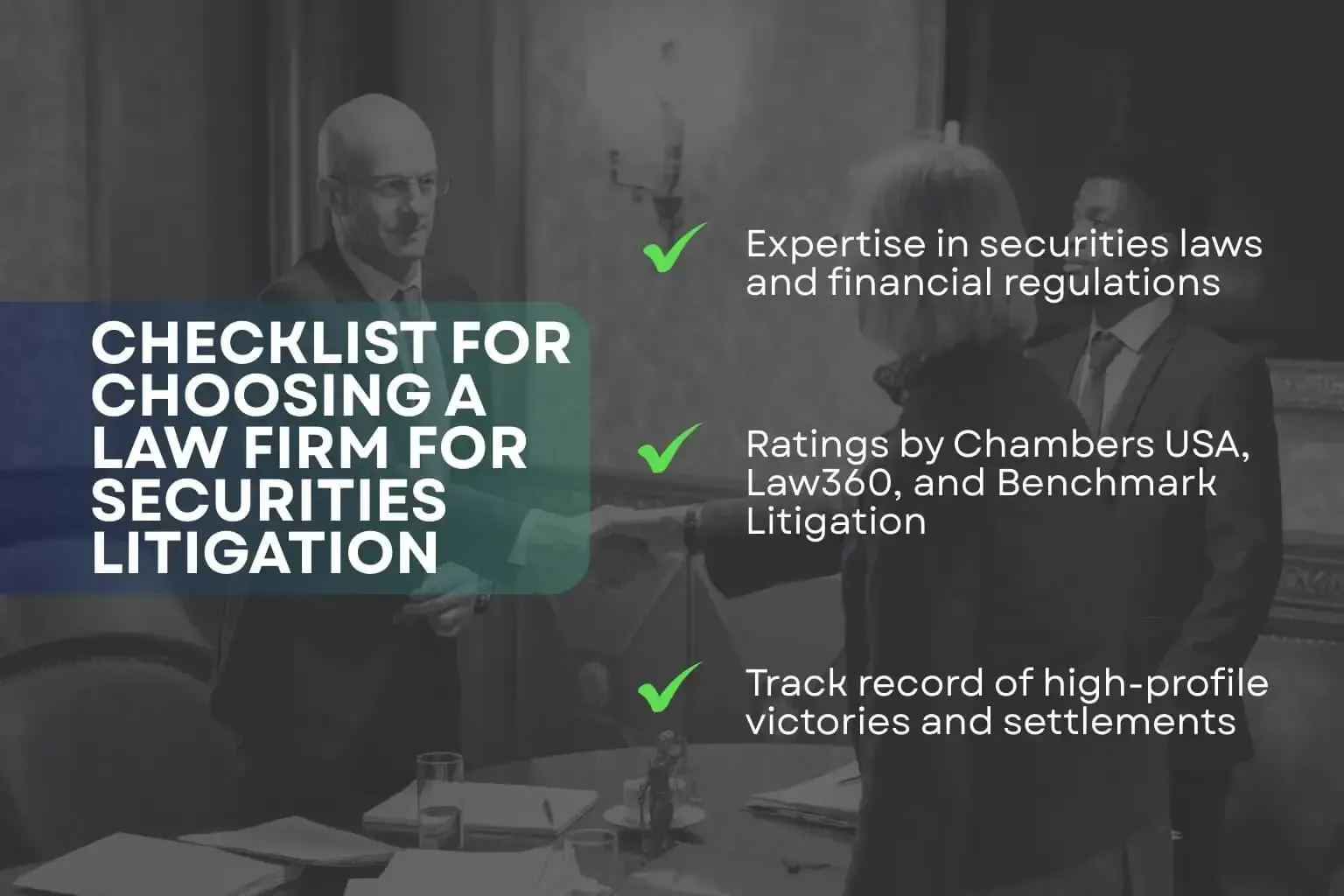
The most effective law firms in securities litigation are those with deep expertise in securities laws, a strong reputation among clients and peers, and a proven track record of high-profile victories and settlements.
What sets the best securities litigation firms apart are several key factors:
- Expertise in securities laws and financial regulations: Top firms have teams with deep knowledge of the evolving legal and regulatory landscape.
- Reputation and peer recognition: These firms are consistently ranked by Chambers USA, Law360, Benchmark Litigation and others, reflecting their stature among clients and the legal community.
- Track record of high-profile victories and settlements: Leading firms secure significant recoveries for investors and successfully defend clients in precedent-setting shareholder derivative litigation cases, often shaping the direction of securities law.
At Levi & Korsinsky, LLP , we specialize in investor class action lawsuits, representing shareholders who have suffered financial losses due to securities fraud, corporate misconduct, and deceptive investment practices.
With over 80 collective years of experience, our experienced attorneys are on hand to provide you with the support and legal expertise you need to maximize your recovery.
Private Companies and Securities Litigation
While much of securities litigation focuses on public companies, private companies are not immune. If a private firm offers stock or other securities to investors, it must still comply with anti-fraud provisions and disclosure requirements.
Failure to do so can result in lawsuits and regulatory action. For example, the SEC’s 2018 action against the private company Theranos and its founder, Elizabeth Holmes, for misleading investors underscores the importance of transparency and governance, even for non-public entities.
Regulatory Investigations and Enforcement
Government agencies such as the SEC and the Department of Justice are central in investigating and enforcing securities laws. Common triggers for regulatory investigations include accounting fraud, illegal insider trading, and failure to disclose material risks.
Companies that maintain strong compliance programs and cooperate with regulators are often better positioned to avoid or mitigate enforcement actions.
The SEC’s whistleblower program, which rewards individuals who report securities violations, has led to numerous high-profile enforcement actions and substantial recoveries for harmed investors.
Recent Developments and Trends in Securities Litigation
Securities litigation has evolved in response to changing market dynamics and regulatory priorities. In recent years, there has been an increase in class actions, driven partly by heightened SEC enforcement and the growing influence of third-party litigation funding.
Environmental, Social, and Governance (ESG) litigation has become more prominent, with companies facing lawsuits over allegedly misleading sustainability claims.
For example, investors have sued Volkswagen, alleging that the company misrepresented carbon emissions risks to its business.
Whistleblower-driven cases and event-driven litigation—such as lawsuits following major cyberattacks or product failures—are also rising.
How to Stay Informed and Minimize Securities Litigation Risks
Staying abreast of legal and regulatory developments is essential for minimizing securities litigation risks. Companies should regularly monitor SEC rulings, enforcement actions, and emerging trends in corporate fraud.
Implementing compliance best practices—such as transparent financial disclosures, robust internal controls, and ongoing training for executives and staff—can significantly reduce exposure.
Consulting with experienced securities litigation counsel is crucial for proactively addressing potential risks and responding effectively to legal challenges.
Best Practices and Insights on Securities Litigation for Investors and Companies
Securities litigation is a complex and dynamic field that demands expert legal representation and proactive risk management.
Enhancing corporate governance, maintaining transparent disclosures, and fostering a compliance culture can help companies reduce their litigation exposure.
Law firms specializing in securities litigation play a vital role in protecting investor rights and upholding market integrity.
Staying informed and adopting best practices are the keys for businesses and investors to navigate the evolving landscape of securities litigation confidently.
Disclaimer: The information provided in this blog is for general informational purposes only and does not constitute legal advice. Readers should not act or refrain from acting on any of the information contained in this blog without consulting a qualified legal professional. Levi & Korsinsky LLP is not responsible for any actions taken or not taken based on the information provided in this blog.