
A securities class action (or securities fraud class action) is a lawsuit filed by investors. Those investors allege they suffered economic injury from selling or purchasing a company's securities within a specific time frame. Specifically, the investors allege the economic injury they suffered is due to a company's violation of federal securities laws.
Notable for their complexity and scale, these lawsuits often involve large groups of shareholders seeking compensation for their financial losses resulting from violations of the Securities Exchange Act of 1934 (“the Exchange Act”). The class action mechanism provides a means for individual investors, who might otherwise lack the resources to pursue claims individually, to challenge corporate malfeasance and seek justice collectively.
Rule 23 of the Federal Rules of Civil Procedure governs federal class actions in the United States. This rule permits one party or a group of parties (the lead plaintiff, approved by the court) to file a class action complaint on behalf of a "class" of similarly situated persons and entities meeting specific requirements under Rule 23.
The lead plaintiff is responsible for prosecuting claims on behalf of the class and has the power to settle and release claims of all class members in consultation with class members. When a lead plaintiff files a lawsuit as a representative of a class of similarly situated victims, a federal court judge must swiftly determine whether to certify the action as a class action. This procedure is commonly known as class certification.
The Importance of the Class Period
The Class Period is crucial to understanding a securities class action. It is the specific timeframe during which the plaintiffs allege the defendant's alleged misconduct inflated the security's price. The class period determines who is and is not a plaintiff. Only individuals who bought or sold the security during the class period are eligible plaintiffs for the class action.
Consequently, when an investor seeks to become the lead plaintiff, attorneys will first request the client's transactions in the security during, before, and after the Class Period. Using this data, the attorney will calculate the client's largest financial interest in the securities class action litigation.
Implications of the Class Period
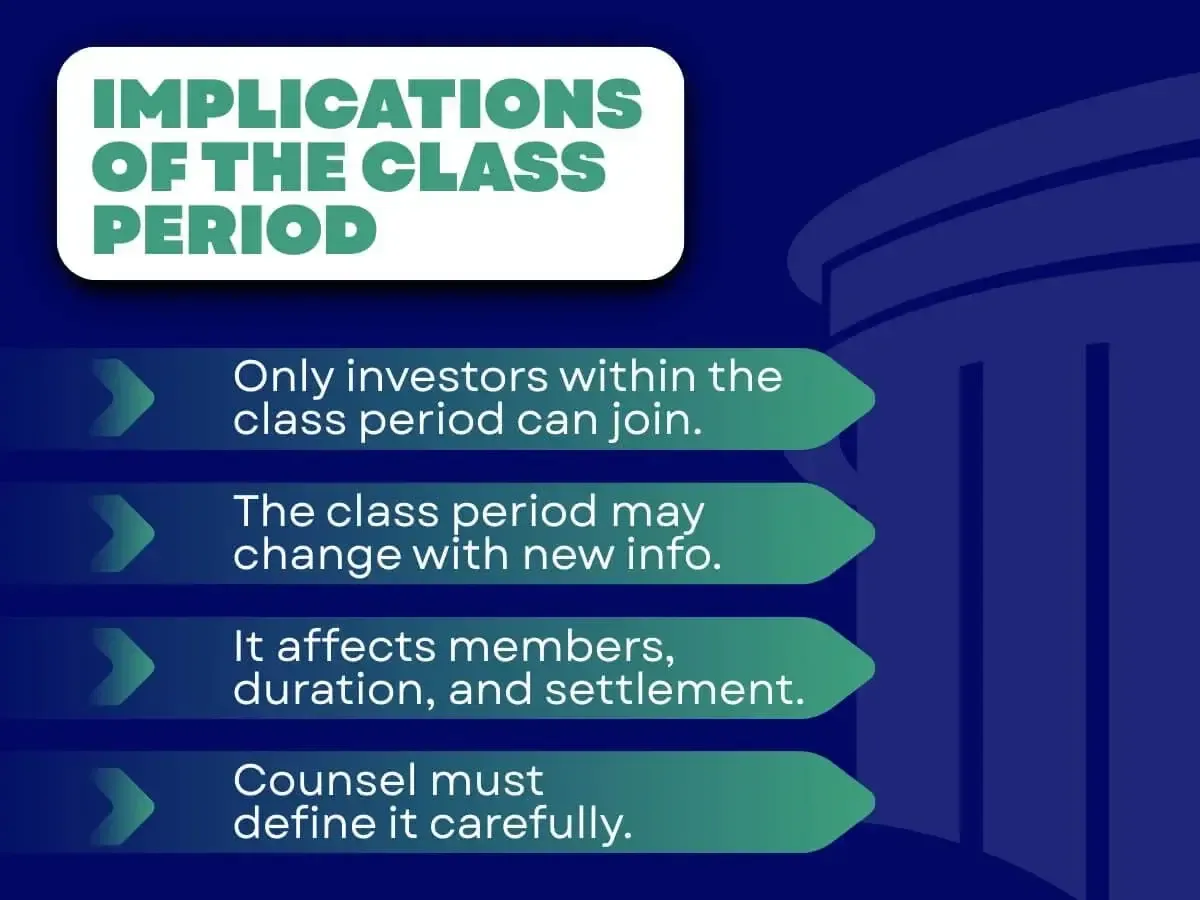
- Only investors who purchased stock during the class period are allowed to join the class action.
- The class period is subject to change during the litigation process (if new information comes to light).
- The selection of the class period can change the class members, litigation time, and settlement amount.
- Counsel has a critical responsibility to help plaintiffs carefully define this period.
Lead Plaintiff and Class Representation
The lead plaintiff initiates the lawsuit, acting as the face and named plaintiff of the class action. The lead plaintiff represents the entire class and actively works with the lawyers throughout the case. Individual members can opt out and pursue their respective individual claims if they feel it is a better option.
Plaintiffs' lawyers drive the litigation process, often working on a contingency fee basis, and must ensure they adequately represent the interests of all class members.
Understanding Class Representation
The lead plaintiff is a representative individual or entity that has suffered the most significant financial loss in a given class action and is approved by the court. This role involves prosecuting claims on behalf of all class members and has the authority to settle the case and release claims for all involved. Key roles and responsibilities include:
- Overseeing the litigation process ensures that plaintiff attorneys work in the class members' best interests.
- Zero Cost or Expenses - No fees or financial exchanges are required. Most law firms work on a contingency model (they get paid only if the class members get paid)
- Settlement Discussions—Lead plaintiffs must approve settlements before they are presented to a court, since they are fiduciaries to the class.
- Attorney fees—Lead plaintiffs influence attorney fees before the court approves them. Fairness in expense claims ensures better outcomes for investors.
Participating in a Securities Class Action Lawsuit
The pre-litigation phase, the first step in a securities fraud class action, lays the groundwork for subsequent legal proceedings. It is characterized by the following steps, which can proceed concurrently.
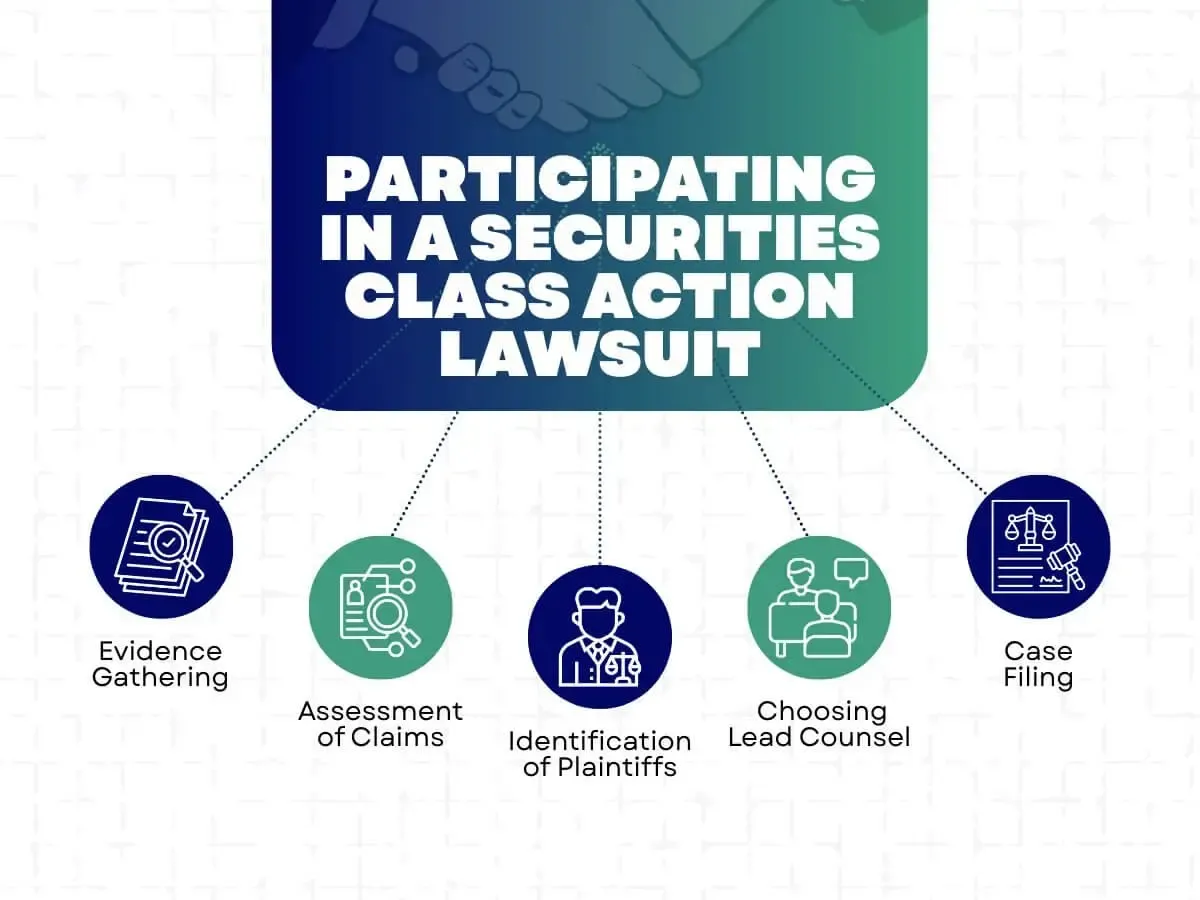
1. Evidence Gathering
Before filing a lawsuit, potential plaintiffs typically conduct thorough investigations to collect relevant evidence supporting their claims, including but not limited to financial reports, press releases, and communications from the publicly traded company involved.
Investors must establish that they suffered economic injuries due to alleged violations of federal securities laws. This necessitates clearly understanding the specific misrepresentations, omissions, or misleading information within a designated class period.
2. Assessment of Claims
Plaintiffs must then evaluate the strength of their claims. This assessment involves determining whether the information allegedly misrepresented was indeed reflected in the market price of the company's securities, as plaintiffs can often rely on a presumption of market efficiency to establish class-wide reliance on these misrepresentations.
3. Identification of Plaintiffs
In the pre-litigation stage, investors must also identify and coordinate with other affected parties who may have similar claims. If multiple investors express interest in pursuing a class action, they may need to work together to select a lead plaintiff and lead counsel.
The lead plaintiff is typically the individual or entity that has suffered the most significant financial loss and is responsible for representing the interests of the class in any future legal action.
4. Choosing Lead Counsel
The lead counsel is responsible for fairly and adequately representing the interests of the class and navigating potential conflicts of interest that may arise among class members and defendants.
The lead plaintiff typically selects class counsel, negotiates attorney fees, and oversees litigation alongside the lead counsel.
5. Case Filing
As plaintiffs prepare to file a lawsuit, they must also be aware of the legal standards and implications of filing under the Private Securities Litigation Reform Act (PSLRA), which was established to prevent the frivolous interpretation of the Exchange Act.
Ultimately, this phase culminates in the formal filing of the lawsuit in either federal or state court, after which the court will certify the case as a class action based on the evidence and approve a class period.
Securities Class Action Litigation Process
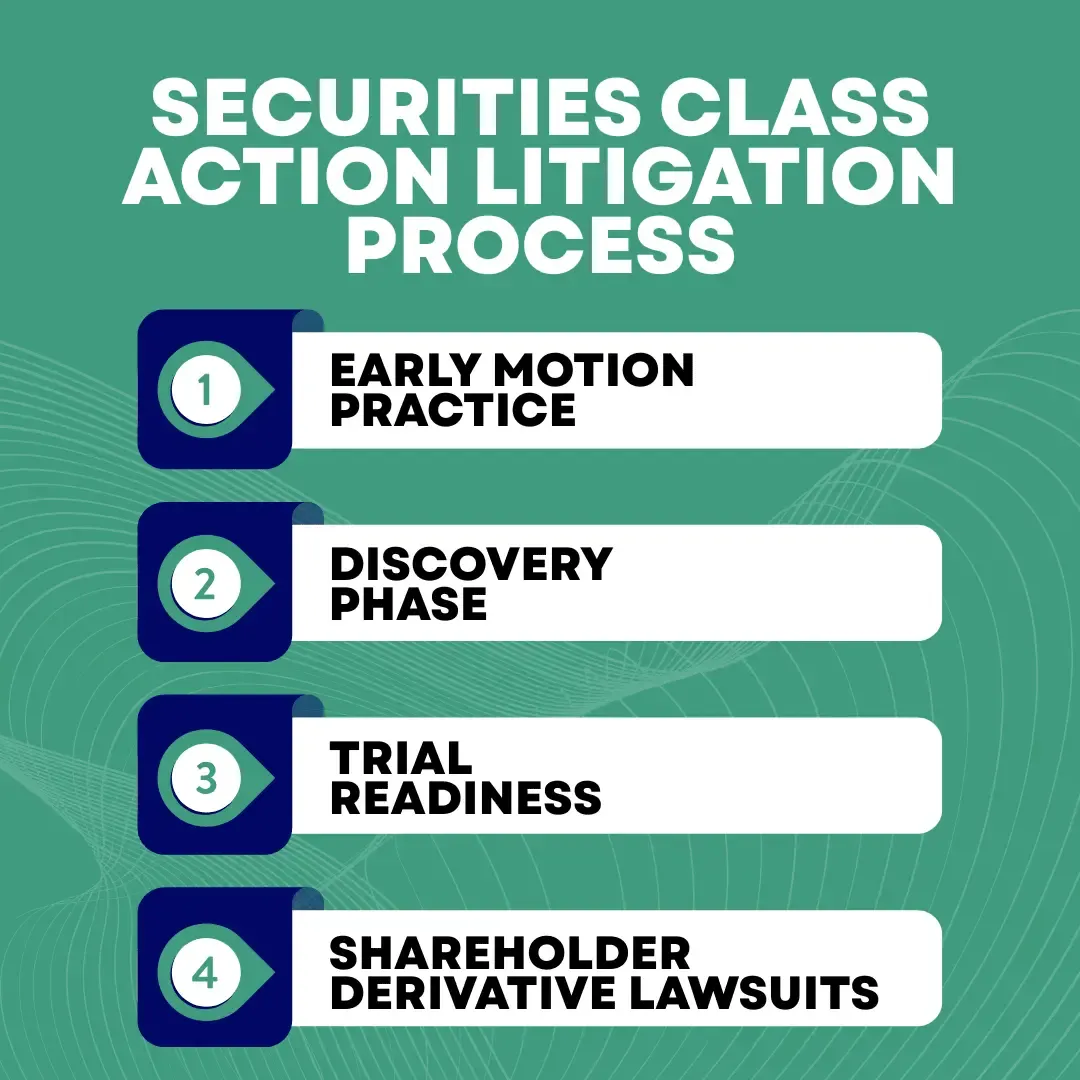
1. Early Motion Practice
A fundamental approach in the litigation phase is early motion practice, where defendants often succeed in disposing of claims before proceeding to discovery. This strategy is crucial in minimizing business disruptions and managing clients' costs effectively.
By leveraging seasoned legal teams/law firms, defendants can swiftly identify key pieces of evidence, which helps them craft a compelling narrative that may lead to an early resolution of the case.
2. Discovery Phase
For cases that advance to the discovery phase, gathering and analyzing evidence that supports the claims or defenses becomes essential. The discovery process can be complex, involving collecting and submitting documents, and exchanging interrogatories.
During this phase, defendants must be vigilant about potential conflicts, especially if individual defendants have differing interests, for example, former company officers implicated in the alleged fraud.
3. Trial Readiness
Maintaining a trial-ready posture is crucial in situations where a trial is unavoidable. Experienced legal teams possess a formidable reputation, providing clients with distinct advantages in the courtroom.
This readiness encompasses aggressive and creative pre-trial litigation strategies designed to resolve most matters before trial. The ability to present a strong case during the trial or at the settlement negotiation stage can significantly impact the outcome for all parties involved.
4. Shareholder Derivative Lawsuits
The litigation phase may involve shareholder derivative lawsuits, in which shareholders sue on behalf of the corporation against its officers, directors, or other parties for damages allegedly inflicted upon the company.
These cases require a nuanced understanding of shareholder rights and the duties of corporate officers, adding another layer of complexity to the litigation phase.
Securities class actions are long-drawn battles that can last many years, and settlements can take a few more years to reach class members. It is common for an institutional investor (like a public pension fund ) to step in as a lead plaintiff.
Opting Out of a Securities Fraud Class Action Suit
Some investors choose to opt out of a class action lawsuit. They must submit a form stating that they agree to opt out of the class and waive any compensation that might be awarded in the event of a settlement. Investors may choose an individual action over a class action lawsuit if they believe they will fare better or have a specific set of circumstances that sets them apart from the rest of the class.
Securities Class Action: Benefits and Recovery
Settlement often serves as the final stage in the legal process. Almost all securities fraud class action lawsuits culminate in a settlement rather than proceeding to trial, which involves a structured process that helps facilitate resolution between the parties involved.
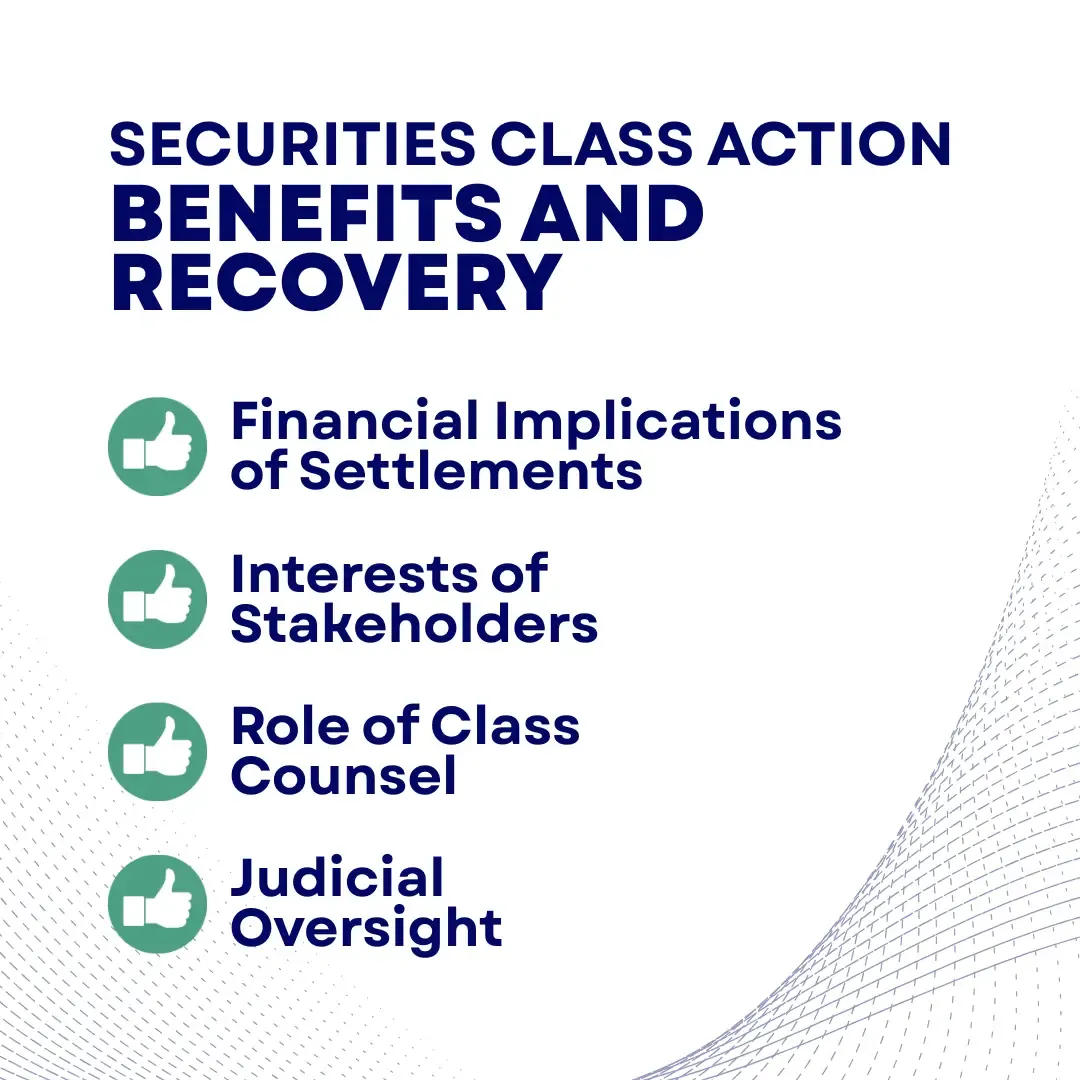
1. Financial Implications of Settlements
Settlements from securities class actions have amounted to substantial sums in 2024, primarily against mid- to large-cap companies. These financial outcomes highlight the significant stakes in these lawsuits, not only for the plaintiffs but also for the defendants and their legal representatives.
2. Interests of Stakeholders
Once a settlement is agreed upon and approved, various stakeholders—including plaintiffs' counsel, defendants, and the court—have vested interests in maintaining its integrity. This collective interest aims to prevent disputes from undermining the agreed terms and the compensation structure designed to benefit the class members.
3. Role of Class Counsel
The role of class counsel is vital in the settlement process. They are responsible for fairly and adequately representing the interests of the class and navigating potential conflicts of interest that may arise among class members and defendants.
4. Judicial Oversight
Class action settlements require judicial approval to prevent collusion and protect the rights of absent class members. The judicial system ensures that the settlement terms are fair and just for all parties involved. Class action judgments carry a res judicata effect, which can significantly impact parties that may not wish to release their claims as part of the settlement.
Concluding Notes on Navigating Security Class Action Suits
Securities class action lawsuits exemplify the critical intersection of corporate governance , investor rights, and legal accountability, highlighting the complexities inherent in protecting stakeholders' interests in the wake of alleged corporate misconduct.
The role of legal counsel spans from the first step to the lawful culmination of the trial and settlement process. Following the COVID-19 pandemic, the focus of securities class actions is gradually shifting toward technology companies, with “AI washing” emerging as the latest focus area in class action litigation. Experienced counsel is the prime catalyst for favorable outcomes for investors.
Why Choose L&K as your Securities Fraud Class Action Counsel?
Over the past 20 years, the team at Levi & Korsinsky has secured hundreds of millions of dollars for aggrieved shareholders and built a track record of winning high-stakes cases. Our firm has extensive expertise representing investors in complex securities litigation, with over 70 employees dedicated to serving our clients. For seven years in a row, Levi & Korsinsky has ranked in ISS Securities Class Action Services' Top 50 Report as one of the top securities litigation firms in the United States.
If you suspect securities fraud has affected your financial investments, you may qualify for a class action lawsuit. Check your eligibility at L&K's Current Securities Class Action Lawsuits Page . Act now—deadlines apply for filing securities fraud claims!
Disclaimer: The information provided in this blog is for general informational purposes only and does not constitute legal advice. Readers should not act or refrain from acting on any of the information contained in this blog without consulting a qualified legal professional. Levi & Korsinsky LLP is not responsible for any actions taken or not taken based on the information provided in this blog. |