
Shareholder class action lawsuits are legal actions brought by groups of investors who have suffered financial losses due to corporate misconduct, such as securities fraud or misleading statements.
By joining together in a single class action suit, investors can collectively seek compensation for their losses, making it more feasible and efficient than pursuing individual claims.
Recovering these financial losses provides a measure of justice to investors when companies fail to uphold their legal and ethical obligations.
This guide outlines the process of participating in such lawsuits, from eligibility to payout, supported by real-world examples and legal precedents.
Who Can Qualify for a Shareholder Class Action?
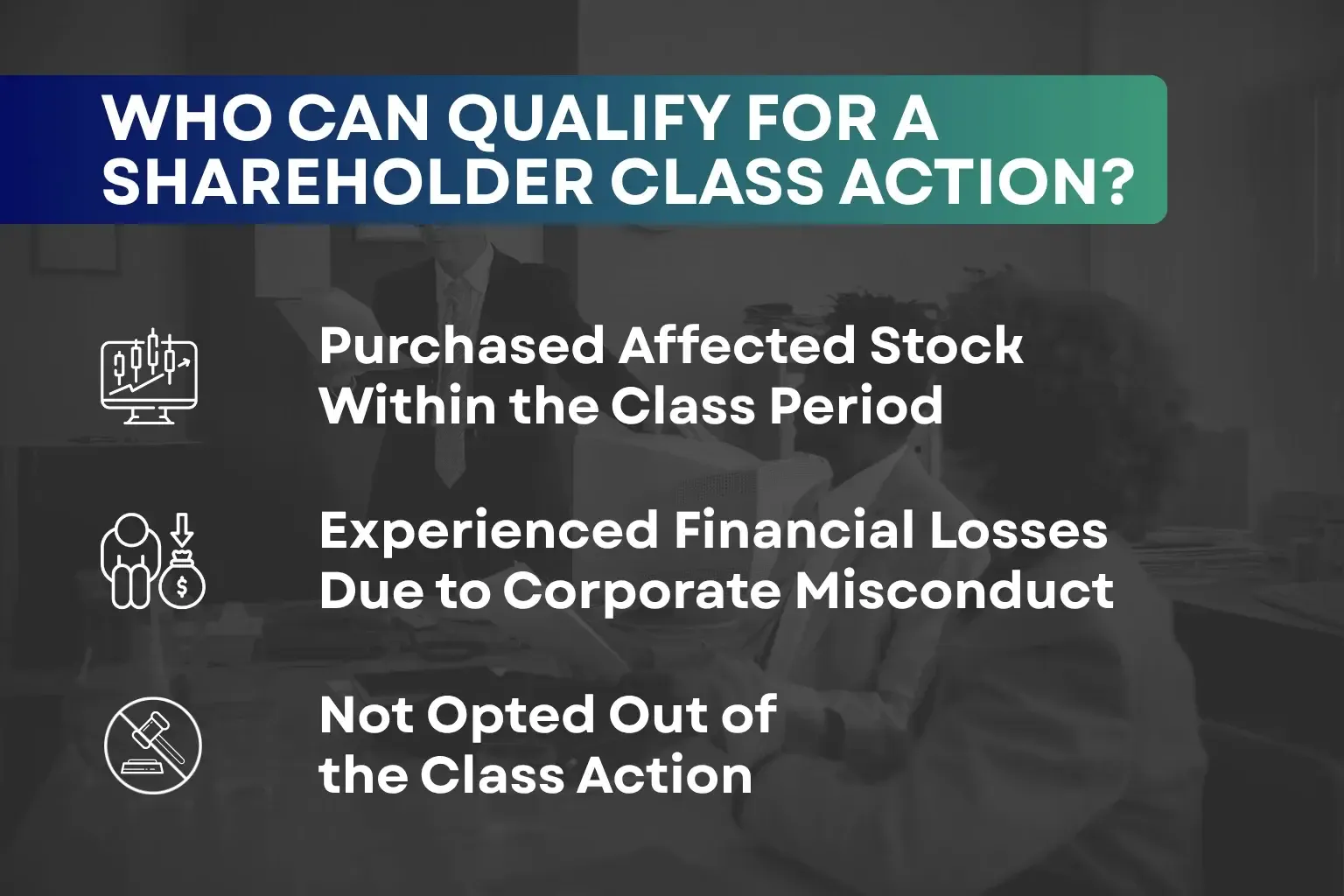
Investors meeting the basic eligibility criteria qualify to participate in a shareholder class action lawsuit. Understanding these criteria and how to verify eligibility is essential for any investor seeking compensation through a class action.
a) Basic Eligibility Requirements
Purchased Affected Stock Within the Class Period: Investors must have bought shares of the company during the class period, which is the time of the alleged misconduct.
The court determines the class period and outlines it in the official class action notice.
Experienced Financial Losses Due to Corporate Misconduct: Investors who have suffered financial losses due to a company’s actions qualify to participate in class action lawsuits. The decline in stock value must be linked to the alleged fraud or misrepresentation.
Courts have emphasized that only those whose rights as shareholders are affected by the misconduct have standing to participate in the class action.
Not Opted Out of the Class Action: Once a class is certified, investors who qualify for a class action lawsuit typically receive mail from the court. Investors can choose to remain part of the class or opt out if they prefer to pursue their legal action or have no interest in participating.
Those who do not opt out remain eligible for any settlement or judgment awarded to the class.
b) How to Check If You Are Eligible
- Notification Process: Once a lawsuit is certified as a class action, the court-appointed law firm usually sends notices to all potential class members at their registered addresses. This notice details the class period, the nature of the claims, and instructions for participating or opting out.
- Review Official Notices and Litigation Websites: If you believe you qualify but have not received a notice, you can check eligibility by reviewing information on official litigation websites or contacting the law firm managing the case.
- Confirm Ownership and Losses: To participate, investors may need to provide documentation such as brokerage statements or trade confirmations showing stock purchases during the class period and evidence of losses.
Benefits of Joining a Shareholder Class Action Lawsuit
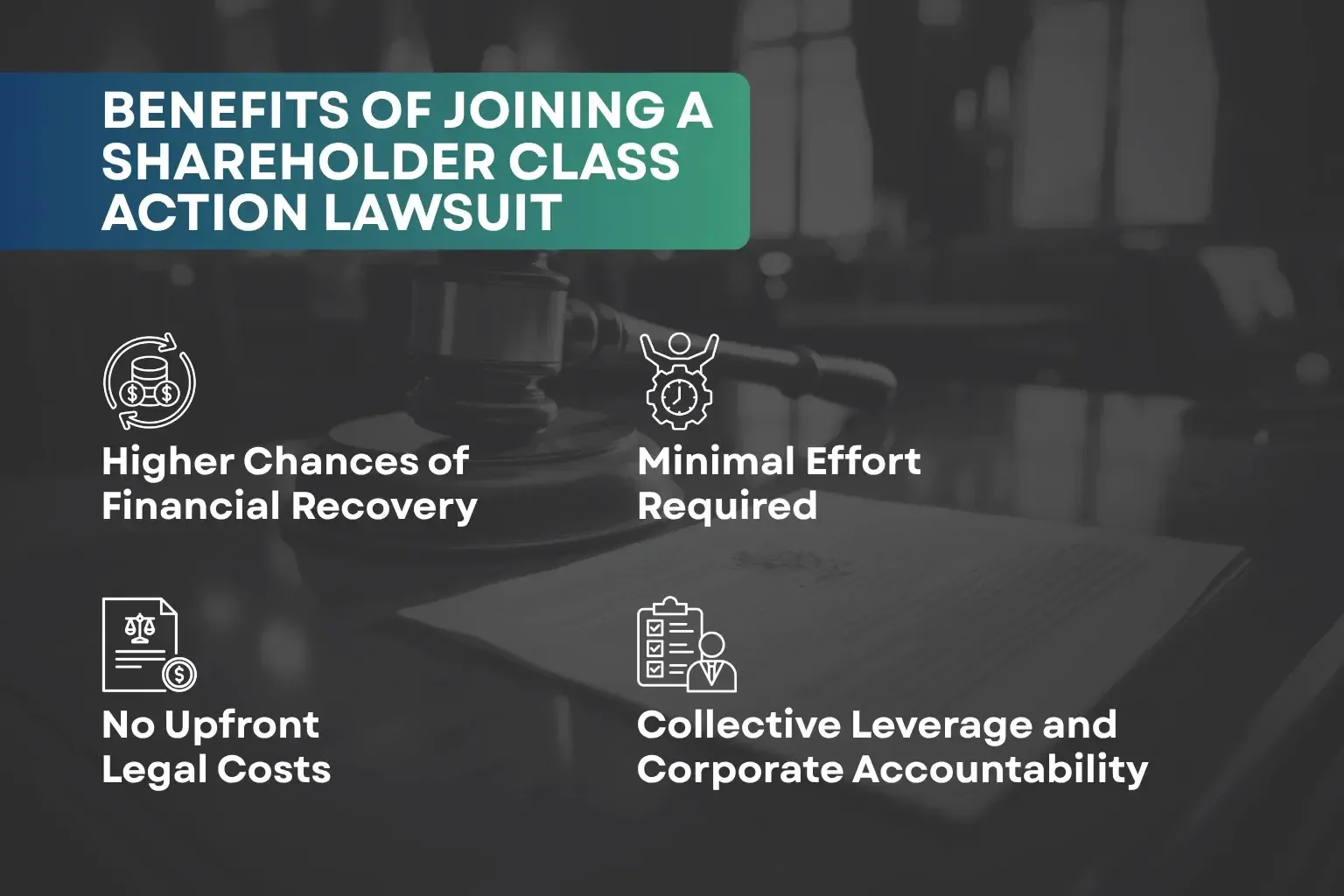
Participating in a shareholder class action lawsuit offers several advantages for investors who have suffered losses due to corporate misconduct.
Higher Chances of Financial Recovery
Class actions allow investors to pool their claims, increasing the likelihood of a successful outcome. Aggregating cases through class action lawsuits allows courts to address widespread harm more efficiently and consistently.
No Upfront Legal Costs
One of the most significant advantages of class actions is the absence of upfront legal fees for participants. Attorneys in these cases typically work on a contingency basis, meaning they only receive payment if the case is successful and funds are recovered for the class.
This arrangement removes financial barriers for investors, as legal fees and court costs are shared among all class members and deducted from any settlement or award.
Minimal Effort Required
Most investors require very little involvement in class action. On behalf of the entire class, the lead plaintiff and legal team manage the litigation, negotiate settlements, and handle court proceedings.
Individual investors generally need only to submit a claim form once the case is resolved to receive their share of any settlement.
Collective Leverage and Corporate Accountability
Class actions amplify investors' collective power, making it more difficult for corporations to ignore or minimize claims of wrongdoing.
Large claimant pools can pressure defendants into reaching equitable settlements, as seen in high-profile cases like Wells Fargo’s $1 billion agreement.
How to Join a Shareholder Class Action Lawsuit
Investors who believe they have been harmed by corporate misconduct can participate in shareholder class action lawsuits by following a straightforward process. This ensures their eligibility for any compensation from a settlement or court judgment. Here’s how to get involved:
Step 1: Find Active Lawsuits
Begin by identifying ongoing class action lawsuits that may affect your investments.
Reputable platforms such as Levi & Korsinsky regularly list current securities class actions, including details about the class period and alleged misconduct.
Official court notices and dockets also provide information about active cases and essential deadlines.
Step 2: Submit a Claim with Proof of Stock Ownership and Losses
You must submit a claim to participate once you have identified a relevant lawsuit.
This typically involves providing documentation, such as brokerage statements or trade confirmations, showing that you purchased the affected stock during the class period and experienced financial losses.
The settlement notice sent to shareholders, also available on the claims administrator’s website, includes the claim form and instructions.
Ensure all information is complete and submitted by the stated deadline to avoid missing out on potential compensation.
Step 3: Monitor Case Updates and Await Resolution
After submitting your claim, monitor the progress of the lawsuit.
Settlement approval and distribution of funds can take several years, as securities class actions often involve complex litigation and large numbers of claimants.
To stay informed, check updates from the claims administrator or the law firm handling the case, and keep records of your claim submission for reference.
What Happens When a Securities Class Action Lawsuit Settles?
When a securities class action lawsuit settles, a structured process ensures that the outcome is fair, transparent, and compliant with legal standards.
Understanding how settlements are reached, how funds are distributed, and the tax implications for recipients is crucial for investors anticipating compensation.
How Settlements Are Reached
Settlements in securities class actions typically occur after extensive negotiations between the parties, often with the assistance of a mediator.
The process involves several key steps:
1. Negotiation: Plaintiffs’ and defendants’ attorneys negotiate the settlement terms, sometimes over several months. Once an agreement is reached, a Memorandum of Understanding (MOU) is drafted.
2. Preliminary Court Approval: The court reviews the fairness of settlement terms and supporting documents through a preliminary approval hearing. The judge usually issues an order preliminarily approving the settlement.
3. Final Court Approval: During a final approval hearing, the court reviews any objections and ensures all notice requirements have been met. Once satisfied, the judge grants final approval, allowing the settlement to proceed.
4. Claims Administration: A court-appointed claims administrator takes over, sending notices to eligible class members, processing claims, and preparing for the distribution of funds.
This process can take several years from the initial filing to final distribution, especially in significant cases with thousands of claimants.
How Settlement Funds Are Distributed
Once the settlement is approved, the distribution of funds follows a court-approved plan:
Pro-Rata Basis: Courts typically distribute settlement funds on a pro-rata basis. It implies that each eligible claimant receives compensation proportional to their recognized losses.
The claims administrator calculates these amounts based on documentation provided by investors, such as proof of stock purchases and losses during the class period.
Notice and Claims Process: Class members receive a notice outlining the settlement, eligibility requirements, and instructions for submitting a claim. The administrator processes these claims and determines each claimant’s share.
Multiple Rounds of Distribution: If funds remain after the initial payouts, there may be secondary or tertiary distributions.
Tax Implications: Is Settlement Money Taxable?
The tax treatment of settlement funds depends on the nature of the compensation:
General Rule: Most settlement payments from securities class actions are taxable income under Internal Revenue Code (IRC) Section 61, unless a specific exemption applies.
Adjustment to Basis or Capital Gain: If the settlement is a refund of your original purchase price (for example, due to accounting fraud that inflated the stock price), it may be treated as an adjustment to your stock’s basis if you still own the shares.
The payment is generally reported as a capital gain for investors who have sold the stock before the settlement.
Interest and Punitive Damages: Any portion of the settlement attributed to lost interest or punitive damages is typically taxable as ordinary income.
Personal Injury Exception: Only settlements for personal physical injury or sickness are excluded from taxable income under IRC Section 104, which rarely applies to securities class actions.
How Much Money Can You Expect?
Understanding potential compensation from a shareholder class action lawsuit involves looking at industry-wide data, factors influencing individual payouts, and typical timelines for receiving funds.
While past settlements provide some context, averages and medians from credible research help set realistic expectations without promising specific results.
Average Settlement Payouts
According to Cornerstone Research, the average settlement amount for U.S. securities class action lawsuits in 2024 was $42.4 million. The median settlement was $14 million, reflecting a 10% decline from the previous year but still above the decade-long median.
Notably, settlements can range from a few million dollars to over $100 million in so-called "mega settlements," but most cases resolve for amounts near the median or average.
Factors That Determine Individual Payouts
Several key factors influence how much an individual investor might receive from a class action settlement:
1. Size of Recognized Loss: Payouts are typically based on the claimant’s financial losses during the class period. The larger your recognized loss, the greater your share of the settlement fund.
2. Number of Claimants: The total number of eligible claimants can dilute individual payouts, especially in cases involving large classes.
3. Legal Fees and Expenses: Attorneys’ fees and administrative costs are deducted from the settlement fund before distribution. The court usually decides on the attorney’s fee, which can range from 20% to 30% of the total settlement.
4. Plan of Allocation: Each settlement includes a court-approved plan that outlines how funds are distributed, often using a pro-rata formula based on losses.
5. Company’s Financial Condition: Cases involving companies that have declared bankruptcy or been delisted often result in lower settlements.
Typical Timelines: How Long Does It Take to Receive Compensation?
The process from filing a class action to receiving compensation is lengthy.
According to Broadridge’s 2025 Global Class Action Annual Report, the average timeline for securities class action settlements in the U.S. was about 45.4 months (nearly four years) in 2024.
Larger and more complex cases with settlements of over $100 million can take even longer, averaging around six years from filing to payout. After a settlement is reached, the claims administrator reviews and processes claims.
This can add several months to the process, particularly in cases with thousands of claimants.
Risks and Considerations Before Joining a Lawsuit
Investors should be aware of several important risks and practical considerations before participating in a shareholder class action lawsuit.
While these lawsuits can provide a pathway to financial recovery, they also involve timing, compensation, and control trade-offs.
1. Lengthy Resolution Timelines
Securities class action lawsuits typically take several years to resolve. The average time from filing to settlement in 2024 was approximately 3.7 years, with the median time to settlement at 3.1 years, according to ISS Securities Class Action Services and Broadridge’s 2025 Global Class Action Annual Report.
Some cases, particularly those involving larger settlements or more complex issues, can take longer to resolve. On average, class action lawsuits with settlements of over $100 million take six years to resolve.
2. Potentially Lower Payouts Than Expected
While class actions offer the benefit of collective action, individual payouts may be lower than some investors anticipate.
Several factors contribute to this:
Legal Fees and Expenses: Plaintiffs’ attorneys’ fees and administrative costs are deducted from the total settlement fund before any distributions are made. In 2024, these fees and expenses accounted for 20-45% of the aggregate settlement amount.
Large Claimant Pools: The higher the number of investors participating in a settlement, the smaller each payout will be, as the available funds are divided pro rata among all eligible claimants.
Dismissal Rates: Not all cases result in settlements; a significant proportion are dismissed before resolving, meaning some investors may receive no compensation.
Limited Investor Control: Once you join a shareholder class action, control over the litigation largely rests with the lead plaintiffs and the appointed legal team.
Individual class members typically have little direct influence over the process or the terms of any eventual class action lawsuit settlement. This structure is designed to streamline proceedings but may not suit investors who prefer a more active role in legal matters.
How to Stay Updated on Shareholder Class Action Lawsuits
Staying informed about shareholder class action lawsuits is essential for maximizing your chances of recovering losses and ensuring you don’t miss critical deadlines.
Where to Track Active Lawsuits and Settlements
Specialized Platforms and Law Firm Notices: Investors can monitor active and pending class actions through dedicated online platforms, such as the Securities Class Action Clearinghouse at Stanford Law School, which maintains a comprehensive filings database.
Law firms handling securities class actions, like Levi & Korsinsky, also publish regular notices about new lawsuits and settlement opportunities, including deadlines and eligibility details.
Court Dockets and Official Notices: Federal court dockets and official court-approved notices provide authoritative information on case status, settlement terms, and important dates.
Investors should review these notices carefully to understand their rights and next steps.
Importance of Meeting Claim Deadlines
Strict Filing Deadlines: Each class action lawsuit has specific deadlines for registering as a class member, submitting claims, or seeking appointment as lead plaintiff.
Missing these deadlines can result in forfeiture of your right to compensation, regardless of eligibility.
Notification and Reminders: Many law firms and claims administrators offer portfolio monitoring services that provide ongoing status updates and reminders about upcoming deadlines once you register as a shareholder.
Always keep your contact information updated to ensure you receive these important notifications.
Tips for Maximizing Potential Compensation
1. Maintain Accurate Records: Keep all relevant documentation, such as brokerage statements and trade confirmations, showing your stock purchases and sales during the class period. These records are essential for proving eligibility and calculating your recognized losses.
2. Respond Promptly to Notices: As soon as possible after receiving the settlement notice, submit your claim forms and supporting documents. Early submission can help avoid delays or issues with claim processing.
3. Monitor Case Updates: Stay engaged with the case by checking updates from law firms, claims administrators, and official court sources. This will help you respond quickly if additional information or documentation is requested.
4. Consult Professional Resources: If unsure about any part of the process, consider consulting with a financial advisor or legal professional familiar with securities class actions.
Where to Find Legal Counsel to Initiate a Class Action Lawsuit?
At Levi & Korsinsky, LLP, we specialize in legal counsel for investor class action lawsuits, representing shareholders who have suffered financial losses due to securities fraud, corporate misconduct, and deceptive investment practices.
With over 80 collective years of experience, our experienced attorneys are on hand to provide you with the support and legal expertise you need to maximize your recovery.
Understanding the legal terminology and how class actions function is essential for any investor considering initiating a class action lawsuit.
Key Legal Terms Investors Should Know Before Initiating a Class Action Lawsuit
Class Period: This is when the alleged misconduct occurred. The class period typically starts with the first misleading statement or omission and ends when the truth is fully disclosed to the market.
Lead Plaintiff: The lead plaintiff appointed by the court is usually the party with the most considerable financial loss, overseeing the legal process and making key litigation decisions.
Pro-Rata Distribution: Each investor’s payout is proportional to their recognized loss, ensuring that those who suffered the most significant harm receive the largest share of the settlement.
Corrective Disclosure: The event or statement that reveals the truth about the alleged misconduct, typically marking the end of the class period. This disclosure often triggers a sharp decline in the company’s stock price, crystallizing investor losses.
How Do Class Action Lawsuits Work?
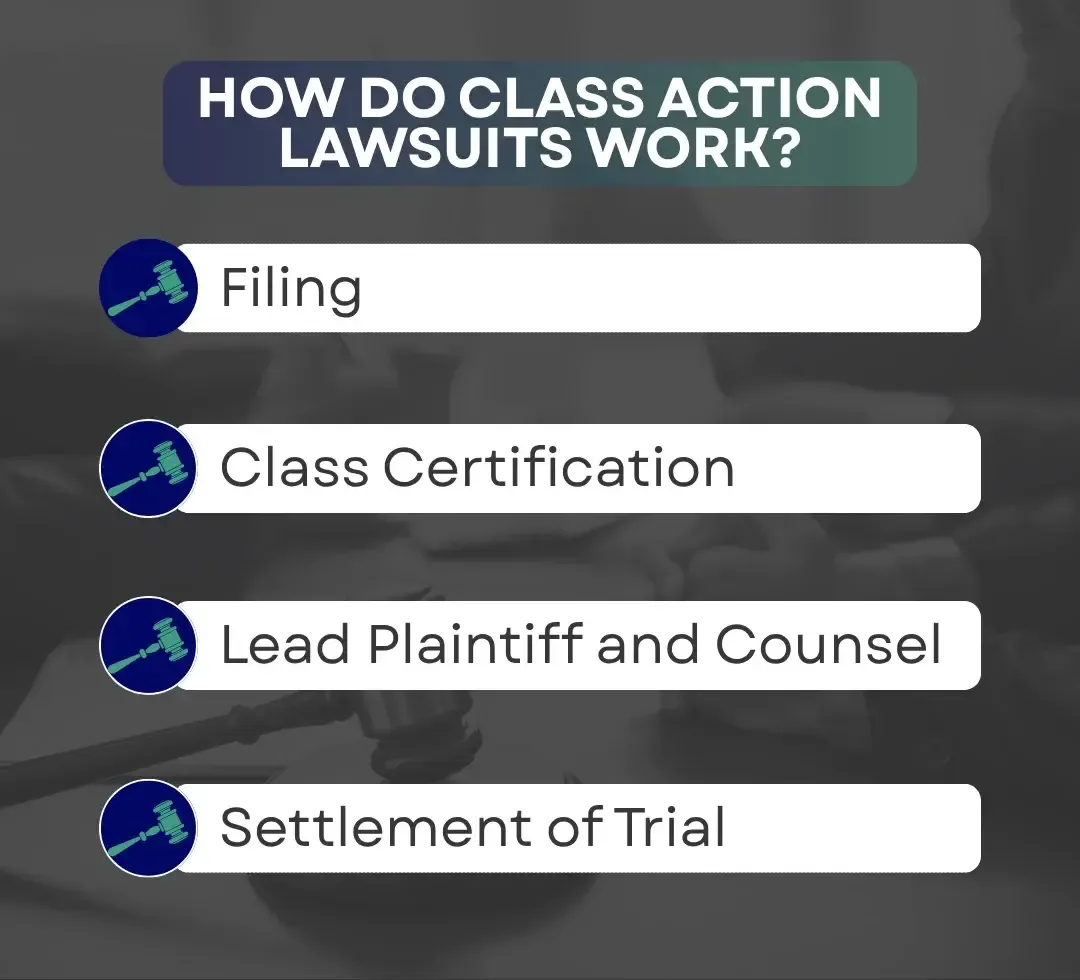
Shareholder class actions consolidate the claims of all affected investors into a single lawsuit, making it more efficient to address widespread harm.
The process generally follows these steps:
Filing: The lead plaintiff files the lawsuit on behalf of all similarly affected shareholders.
Class Certification: The court must certify the lawsuit as a class action. This is a critical procedural step, as it determines whether the case can proceed on behalf of all affected investors.
Appointment of Lead Plaintiff and Counsel: The court appoints a lead plaintiff; generally, the investor with the most significant financial interest gets to represent the class.
Settlement or Trial: Most securities class actions are resolved through settlements rather than trials. Settlements are negotiated between the parties and must be approved by the court to ensure fairness.
For example, in early 2025, General Electric agreed to a $362.5 million settlement to resolve a securities class action.
Disclaimer: The information provided in this blog is for general informational purposes only and does not constitute legal advice. Readers should not act or refrain from acting on any of the information contained in this blog without consulting a qualified legal professional. Levi & Korsinsky LLP is not responsible for any actions taken or not taken based on the information provided in this blog.